How Gen AI Is Transforming Capital Market Software in 2026

Rhutu Talati
Artificial Intelligence
Published : Dec 8, 2025

What GenAI Means for the US Capital Market in 2026
AI in capital markets has changed everything. It is no longer just a fun chat tool. It is now the brain behind big trades. In 2026, systems do not just talk; they act. The focus has moved from simple text to smart action.
How GenAI Evolved From a Chat Interface to a Core System Layer
We moved past simple chatbots this year. Core GenAI + Finance is now part of the engine. It connects directly to trading desks. It does not just summarize news; it helps run the actual system.
Why GenAI Is Treated as an “Enabler” Instead of a Trader
Trust is the main reason for this limit. Agentic AI acts as a competent helper, not a boss. It prepares all the data and options. But a human must always click the final button.
The New Standard: Intelligence Without Autonomy
Systems are intelligent but not free. Strict financial regulation keeps them in check. The AI does the heavy lifting and math. The human keeps control. This balance keeps the market safe and efficient.
Why 2026 Is a Turning Point
AI in capital markets has grown up. The testing phase is over. Now, real money is involved.
- Projects moved from labs to desks.
- Budgets focus on reliable daily use.
- Speed and uptime matter most now.
- Safety is the new top priority.
From Hype to “Hard Hat” Reality: AI Becomes Infrastructure
The excitement has turned into real work. Generative AI industry trends show a shift to building strong foundations. We are not playing with toys anymore. We are pouring concrete for the future of finance systems.
The AI Infrastructure Boom and the 2026 Wealth Effect
Banks are spending big on new tech. Legacy System Modernization is the primary driver of this spending. Firms that update their legacy mainframes now will save significant money in the coming years.
Industrial-Grade Reliability: When Probabilistic Models Must Hit 99.9% Uptime
Traders cannot afford a system crash. Generative AI for finance must work every single time. New systems catch errors before they happen. This ensures the tech is as reliable as the power grid.
Adoption Trends and Benchmarks (2024–26)
Adoption is moving very fast now. Generative AI in capital markets is standard for top players. Most firms have moved past the fear. They are now racing to integrate these tools into every single workflow.
Enterprise Adoption Benchmarks: Banks vs. Brokers vs. Buy-Side
Different players use tech in different ways. AI in investment banking focuses on secure, private clouds. Hedge funds want speed and unique data signals. Brokers are building tools to connect everyone else efficiently.
| Market Player | Primary 2026 Strategy | Maturity Level | Key AI Use Case |
|---|---|---|---|
| Tier-1 Banks | Infrastructure Builders | High (Sovereign AI Clouds) | Creation of air-gapped LLMs on which to rewrite old COBOL cores and perform IPO due diligence automatically. |
| Buy-Side (Hedge Funds) | Alpha Consumers | Medium-High (Agentic Adoption) | Deploying “Research Agents” to synthesize unstructured data (earnings calls, news) into trade signals. |
| Brokers & FinTechs | The Middleware Layer | High (Embedded AI) | Providing the “pipes” (APIs) and Generative UI dashboards that allow clients to query data via chat. |
Integration Maturity Curve: Copilots → Semi-Agents → Controlled Agents
Firms grow through three clear stages. Agentic workflows in finance reveal how much trust you place in the machine.
Level 1: The Copilot (Human Initiates, AI Assists)
You ask, and the bot answers. AI-driven automation in capital markets starts here. It is like a smart search bar.
Level 2: The Semi-Agent (Human Sets Goal, AI Executes Steps)
You set a goal, and it works. This delivers massive productivity gains (quantified) by doing multi-step tasks for you.
Level 3: Controlled Agents (AI Monitors & Suggests, Human Approves)
It watches the market for you. Autonomous trading agents spot the trade and suggest it. You just approve.
The Shift Toward AI-Augmented Workflows
Standalone tools are fading away fast. Workforce impact metrics prove that integrated tools work best. Users want AI inside their Excel sheets. They no longer want to log in to a separate website.
How GenAI Is Transforming the US Capital Market (Use Cases)
You might think AI is just for chats. But AI in capital markets is now doing real work. It handles complex tasks across your trading desk. This moves your firm from testing ideas to making money.
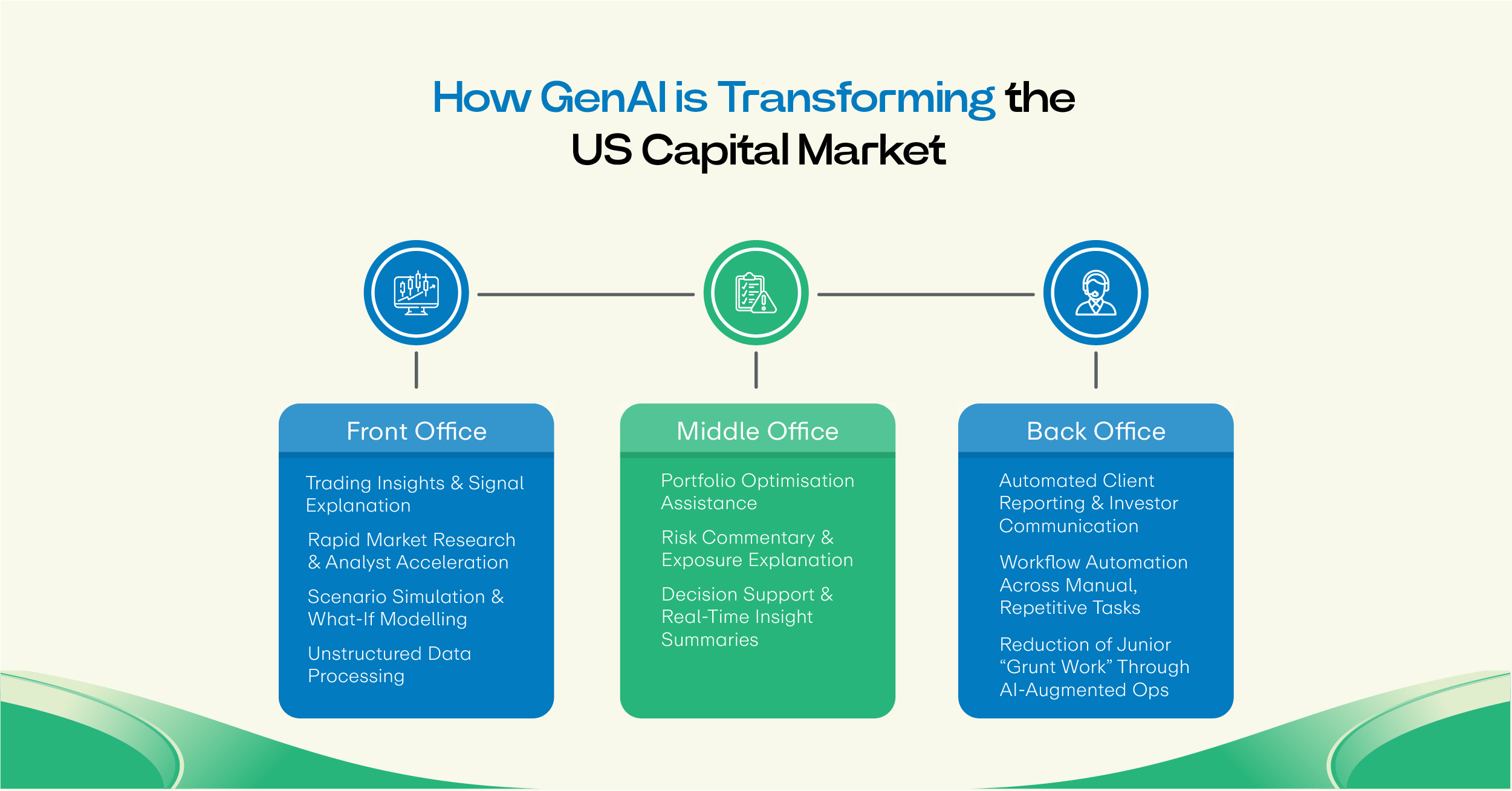
Category A: Front Office (Trading & Research)
Speed matters most here. The best AI use cases in capital markets help traders react faster than their competitors can.
Trading Insights and Signal Explanation
Traders need to know why a price moved. New tools explain these moves clearly. This helps you adjust your trading strategies instantly. You get an apparent reason for each alert, not just a raw number.
Rapid Market Research and Analyst Acceleration
Analysts used to read reports all day. Now they use agents to scan thousands of files. This solves the Predictive Analytics vs Generative AI debate. One predicts the price, and the other explains the story.
Scenario Simulation and What-If Modelling
You cannot predict what happens during a crash. You need to test it. Advanced scenario simulation lets you run complex tests using plain English. This shows exactly how your portfolio reacts to sudden market shocks.
Unstructured Data Processing (News, Filings, Earnings Calls)
Essential data is often hidden in news or audio. We use unstructured data processing in finance to unlock this. It finds clues in PDF files and earnings calls that regular spreadsheets will always miss.
Category B: Middle Office (Risk & Portfolio)
This office focuses on safety and balance. Innovative tools improve portfolio management by enabling simultaneous monitoring of thousands of positions.
Portfolio Optimisation Assistance
Building a balanced fund is hard work. Generative AI in capital markets acts like a coding partner for managers. You describe your goals in simple words, and the system adjusts the math to fit your needs.
Risk Commentary and Exposure Explanation
Risk reports are often hard to read. Modern risk management tools in algorithmic trading platforms change this. They write clear summaries that explain precisely why the risk level increased. This helps you act fast.
Decision Support and Real-Time Insight Summaries
Too many alerts can confuse your team. Intelligent systems use anomaly detection in trading to filter the noise. They only show you the weird patterns that matter. This keeps your team focused on real problems.
Category C: Back Office (Ops & Client Servicing)
Efficiency is the main goal here. We automate post-trade operations to cut costs and reduce simple human errors.
Automated Client Reporting and Investor Communication
Clients want updates that feel personal. Automated client reporting builds these reports in seconds. It pulls data for each investor and writes a custom note for each. This turns a long monthly task into a quick review.
Workflow Automation Across Manual, Repetitive Tasks
Manual tasks slow down your business. Agents can read emails and fix trade errors alone. This boosts operational productivity by a huge margin. Your team stops fixing data and starts adding real value to the firm.
Reduction of Junior “Grunt Work” Through AI-Augmented Ops
Junior staff should not just copy data. Capital markets software Development now focuses on removing boring tasks. This lets your young talent handle exceptions without having to type numbers. It makes their work much more meaningful.
Cost and ROI of Integrating GenAI in Trading Software
Adding AI is not always cheap. You must look beyond the sticker price. The real integration cost comes from connecting new brains to old systems. You need a smart plan to keep your budget safe.
The Integration Tax: Why the Model Is Cheap but Adoption Isn’t
Models are cheap, but making them work is not. This hidden fee is the Integration Tax. It includes all the work needed to connect data.
- Cleaning dirty data takes time.
- Connecting old apps costs money.
- Testing ensures the system is safe.
The 2026 Decision Matrix: Assemble vs. Build vs. Buy
Choosing the right path is hard. Smart Capital markets software Development starts with this simple choice.
| Strategy | Est. Cost Profile (2026) | Time-to-Alpha | Best For… |
|---|---|---|---|
| Buy (SaaS) | Low Upfront ($20k–$50k implementation + Monthly Fees) | Immediate (Weeks) | Commodity workflows: CRM summaries, Client Reporting, Basic Sentiment Analysis. |
| Assemble (API-First) | Medium ($80k–$200k + Usage Fees) | Fast (3–5 Months) | Middle-Office tasks: Building a custom Risk Copilot using OpenAI/Anthropic APIs on internal data. |
| Build (Proprietary) | High ($500k–$1M+ CAPEX) | Slow (9–18 Months) | The “Crown Jewels”: Proprietary trading signals, High-Frequency Trading (HFT) logic, and Sovereign Models. |
The “Buy” Strategy: SaaS & Embedded AI
Buying is best for standard tasks. It is fast and easy to start. However, custom financial software solutions are better if you need a special edge. Buying works well for generic jobs like email summaries.
The “Assemble” Strategy: Private LLMs via API
This is the middle ground. You use AI assembly to connect powerful models to your own private data. It is cheaper than building from scratch. This works great for internal risk tools and research helpers.
The “Build” Strategy: Fine-Tuned Proprietary Models
This is for your secret weapons. You build this only for your unique trading ideas. You will need to hire FinTech developers who know how to train models. This path takes time but gives ownership.
Hidden Cost Drivers: Vector DBs, Data Pipelines, and Security Layers
Hardware bills can grow very fast. You must plan for GPU cost optimization for trading early on. If you ignore this, your fees will skyrocket.
- Storing vector data adds up.
- Cloud fees grow with usage.
- Security tools add extra costs.
ROI Stack: Research Efficiency, Time-to-Insight, and Speed-to-Alpha
Value comes from speed and better choices. Following the proper steps to develop trading software unlocks this value. You will see gains in three areas.
- Research happens much faster now.
- Trade insights arrive instantly.
- Staff do less manual work.

Payback Windows: What Firms
Actually See (12–18 Months)
Profits usually appear after a year. Building AI-native trading teams is a long game. Most firms see the authentic return on investment in about 18 months.
- First-year costs are high.
- Efficiency gains start in year two.
- Scale brings the biggest savings.
Tech Stack for Next-Gen AI-Enabled Trading Platforms
As global financial needs are evolving, institutions need a major tech stack upgrade. Old systems cannot handle the new AI in capital markets. You need modern tools to run these heavy models. This new foundation keeps your firm fast and reliable.

RAG-Centric Architecture as the 2026 Accuracy Standard
Accuracy is the most important thing. Retrieval augmented generation (RAG) prevents the AI from guessing. It forces the system to look at real facts first.
- Finds the correct data first.
- Sends facts to the model.
- Checks the answer for truth.
Generative UI: The Rise of Liquid, Query-Driven Dashboards
Static dashboards are going away. The best tech stack for low-latency trading platforms now uses chat. You ask questions, and the screen displays the answers.
- Users type plain English queries.
- Charts appear instantly on screen.
- Layouts change based on context.
Data Engineering + Vector Stores: The New “Mainframe” for AI
Your data needs a new home. You need specific databases to handle RAG for market data. This acts like a giant memory bank for AI.
- Stores data as math vectors.
- Finds similar patterns very fast.
- Connects news to price action.
Model Hosting: On-Prem, VPC, or Private LLMs?
Where you put the brain matters; private LLMs keep your secrets safe. You must choose between cloud ease and total security for your On-Prem, VPC, or Private LLMs models.
- Cloud is easy but shared.
- Private clouds offer better safety.
- On-premises is the most secure.
| Hosting Model | Data Privacy Score | Latency Profile | 2026 Cost Verdict |
|---|---|---|---|
| Public Cloud (Shared) | ⭐⭐(Low – Shared GPUs) | 🔴 High (Internet variance) | Cheapest: Good for non-sensitive research or marketing content. |
| Virtual Private Cloud (VPC) | ⭐⭐⭐⭐(High – Logical Isolation) | 🟡 Medium (Dedicated throughput) | The Standard: The “Goldilocks” zone for 80% of enterprise apps. |
| On-Premise (Air-Gapped) | ⭐⭐⭐⭐⭐ (Max – No Internet) | 🟢 Ultra-Low (Local inference) | Most Expensive: Reserved for HFT algos and highly sensitive IP protection. |
Agentic Orchestration: When Systems Need to Talk to Systems
Systems must talk to each other. Multi-agent orchestration lets different bots work as a team. One bot plans while another bot executes the trade.
- Agents share a common goal.
- Tasks pass between agents smoothly.
- Humans approve the final step.
Risks, Limitations, and Security Concerns
Moving fast brings new dangers. Risk management and compliance in capital markets is now your most critical team. You must stop models from lying or leaking private data before deployment.
Hallucination and Accuracy Failure in High-Stakes Decisions
Models can lie confidently. AI hallucination control in trading is vital to stop fake trades. You need strict rules to catch these errors early.
- Checks facts against real data.
- Flags weird numbers instantly.
- Stops trades that look wrong.
Synthetic Data: Value, Risks, and the Loop Contamination Problem
We use Synthetic data for stress-testing to simulate market crashes. But if models learn from their own fake data, they get dumber over time.
- Simulates rare market crashes.
- Protects real client privacy.
- Avoids model collapse loops.
Vendor Lock-In and Model Drift Across GPT, Claude, Llama
Relying on one vendor is risky. Large Language Models in finance change often. If a model updates and changes its logic, your trading strategy might break.
- Models change without warning.
- Costs can rise suddenly.
- Logic drifts over time.
Security Threats: Prompt Injection and Non-Deterministic Vulnerabilities
Hackers target AI inputs now. Data security teams must block “prompt injection” attacks. These attacks trick the AI into ignoring safety rules and revealing secrets.
- Blocks malicious text inputs.
- Stops unauthorized data access.
- Filters out bad commands.
Why Compliance, Reporting, and Audit Dominate Integration
Regulators are watching closely. AI in capital markets cannot remain a black box. You must prove exactly how every decision was made to satisfy strict new government rules.
SEC/FINRA’s Line: “Decision Support” vs. “Black Box Trading”
The rules are clear. Generative AI for regulatory compliance means the machine suggests, but humans decide. You cannot blame the bot for a bad trade.
- Humans must sign off.
- No fully autonomous trading.
- Clear lines of blame.
Disclosure and Explainability: Meeting the Right-to-Explain Standard
You must explain why. Explainable AI (XAI finance) translates complex math into plain English. This proves to regulators that your model is not biased or broken.
- Translates math to English.
- Shows decision logic clearly.
- Proves fairness to regulators.
Audit Trails and Watermarking Every AI-Generated Output
Every output needs a tag. An Audit trail for AI tracks every single token generated. You need to know precisely which model version wrote a report, which is where watermarking helps.
- Tags every generated word.
- Tracks model version history.
- Stores prompts for review.
Why GenAI Must Stay an Enabler and Not an Actor
Going by the regulations, the AI is merely an assistant. AI governance in finance ensures it does not act unilaterally. AI is a significant tool, but not a substitute for human opinion.
- AI drafts the work.
- Humans own the risk.
- Limits autonomous system actions.
Governance and Human Oversight in AI-Assisted Trading Systems
Trust requires control. Model Governance is the framework that keeps AI safe. It ensures that no single machine can crash your firm or break the law without oversight.
Human-in-the-Loop (HITL): The Modern “Four-Eyes” Principle
The Human-in-the-loop (HITL) trading system rule is simple. Two pairs of eyes are better than one. We use a framework to decide when humans step in.
| Oversight Phase | AI Role | Human Role | Kill Switch” Trigger |
|---|---|---|---|
| Pre-Trade | Signal generation, Scenario drafting. | Gatekeeper: Validates the thesis & checks logic. | Hallucination Score > 15% (e.g., AI cites non-existent data). |
| Execution | Order routing, Slicing, Venue selection. | Pilot: Monitors execution quality (slippage). | Liquidity Breach: If the spread widens beyond 5 bps, stop auto-trading. |
| Post-Trade | Reconciliation, Anomaly detection. | Auditor: Reviews “Why” the trade was made. | Unexplainable Output: If AI cannot generate a citation trail, flag for audit. |
Pre-Trade Oversight: The “Kill Switch” & Signal Verification
Before execution, the Trading API checks for errors. It acts as a strict gatekeeper to stop bad orders.
Post-Trade Oversight: Reconciliation & Explainability
Once the trade has been made, backtesting is used to verify the logic. We compare the AI’s output to historical data.
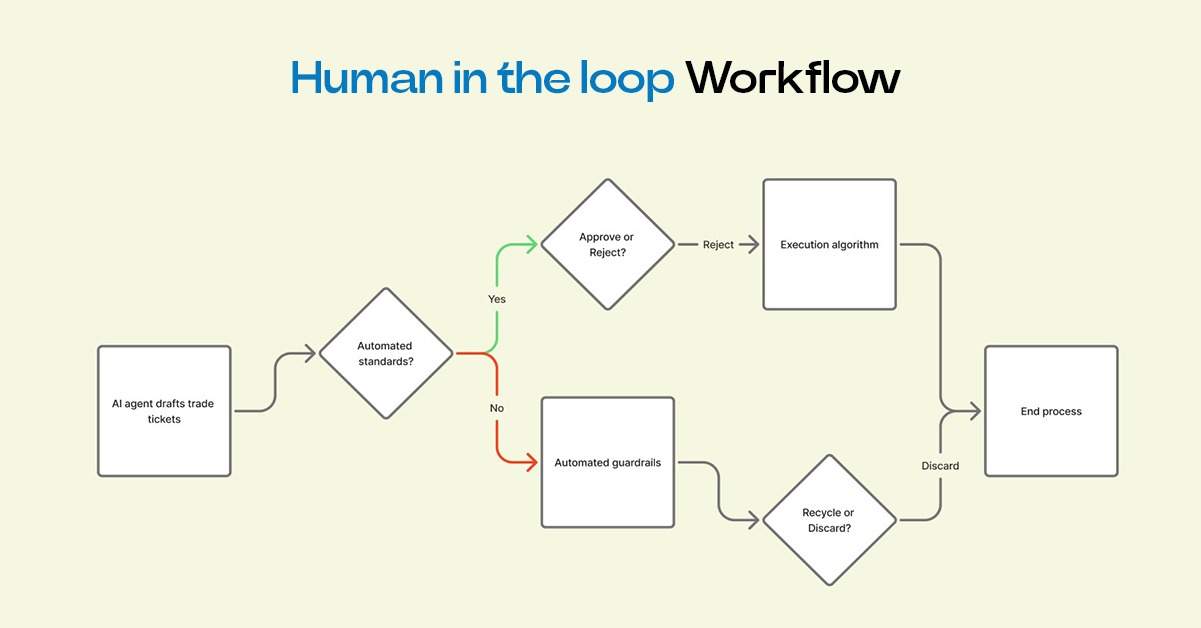
Segregation of Duties: AI Generates, Human Approves
We separate duties strictly. Human-in-the-loop (HITL) trading systems ensure that the bot that generates a trade is never the same entity that approves it for final execution.
- The bot proposes the trade.
- Humans approve the trade.
- Systems remain totally separate.
Operational Governance: Escalation Paths for Confident Hallucinations
Sometimes models are wrong but confident. Model risk management (MRM) for GenAI creates a path to escalate these issues to a human manager for a final check.
- Flags high-confidence errors.
- Alerts senior human managers.
- Stops bad automated decisions.
Red-Teaming and Adversarial Testing for Trading AI
We attack our own systems. Stress testing involves “Red Teams” trying to trick the AI. This finds weak spots before the real market finds them.
- Hackers test system safety.
- Finds hidden logic flaws.
- Simulates worst-case scenarios.
Impact of GenAI on Traders, Analysts, and Portfolio Managers
The job is changing fast. Coders are no longer the only ones for fintech software development. The only way forward is to learn to work with intelligent machines, which is why traders and analysts need to remain relevant in 2026.
Rise of the AI Generalist: Hybrid Between Analyst and Technologist
Analysts can no longer rely solely on Excel. Trading software development skills are blending with finance skills. You must understand code to control the models that run your data.
- Analysts learn basic Python code.
- Coders learn financial strategy rules.
- Teams merge into one unit.
Shift Toward High-Level Judgment Over Manual Data Work
Humans stop doing the boring work. Operational productivity rises because you focus on strategy, not data entry. The machine gathers the facts, and you decide the final move.
- AI gathers all raw data.
- Humans judge the final risk.
- Strategy becomes the primary focus.
New Roles: Model Risk Managers and AI Ethics Officers
New dangers create new job titles. Model Governance is now a full-time career. These officers ensure that the trading bots play by the rules and do not cheat.
- Officers check model ethics daily.
- Managers monitor AI risk limits.
- Teams audit algorithm decisions regularly.
Skill Shift: From Prompt Engineering to Context Engineering
Asking questions is not enough anymore. Context Engineering means feeding the AI the correct data to solve problems. You must teach the model the whole story to get answers.
- Feeds AI clean, rich data.
- Sets clear goals for tasks.
- Refines output for better results.
Market Trends: The Frontier Beyond 2026
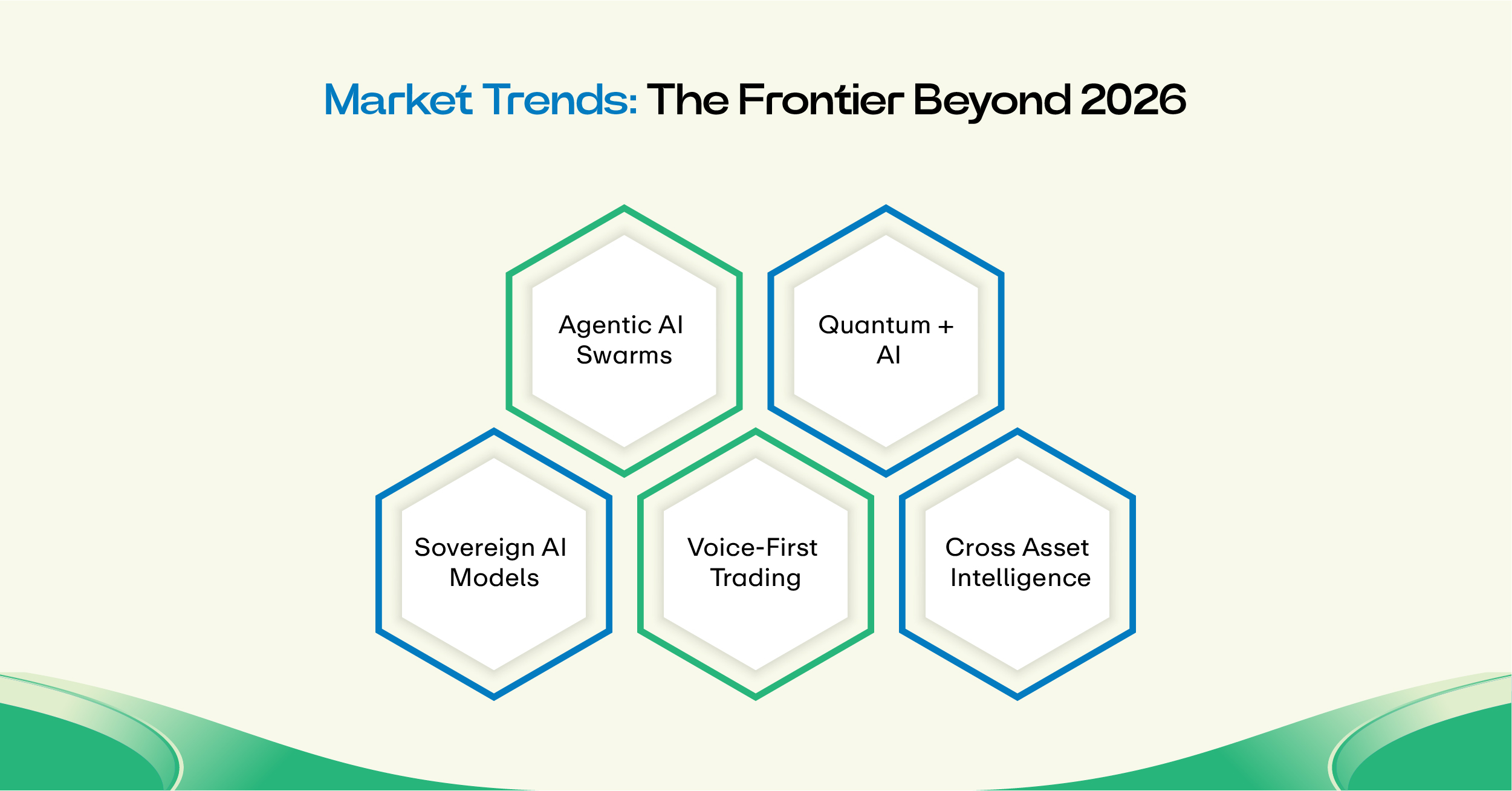
The future moves very fast. Agentic AI is taking us beyond simple chats. We are entering a world where machines talk to machines to solve complex money problems instantly.
Agentic AI Swarms: Coordinated Multi-Step Decision Systems
One bot is good, but many are better. Agentic AI swarms work together like a team. One finds data, one checks risk, and one executes the trade.
- Bots share a single goal.
- Tasks pass between bots smoothly.
- Complex problems get solved faster.
Quantum + AI: High-Speed Scenario Simulation Begins
Speed is about to get extreme. Low-latency architecture meets quantum computing. This allows us to test millions of market scenarios in under a second for optimal planning.
- Tests millions of scenarios instantly.
- Finds risks others miss completely.
- Optimizes portfolios in real time.
Sovereign AI Models for Regulatory Boundaries
Nations want their own data to be safe. Sovereign AI keeps models inside the country’s borders. This ensures that sensitive financial data never breaks local laws or leaves the secure region.
- Data stays in the country.
- Complies with local privacy laws.
- Prevents foreign data access leaks.
Voice-First Trading and the Return of “Voice” Channels
Talking is faster than typing. Natural Language Processing brings voice back to the trading desk. You speak a complex order, and the system executes it instantly without a keyboard.
- Traders speak orders out loud.
- The system understands slang and intent.
- Execution happens without typing keys.
Cross-Asset Intelligence: Connecting Crypto, Macro, and Equities
Markets are connected in new ways. Cross-Asset Intelligence sees patterns everywhere. It finds hidden links between Bitcoin prices, oil supplies, and stock trends that humans cannot see.
- Finds links between different assets.
- Predicts ripple effects across markets.
- Spot opportunities in hidden correlations.
Real-Life Examples (2026 Maturity)
Theory is good, but proof is better. Leading firms are showing us real AI use cases in capital markets. These examples prove that the technology is ready for big business today.
Morgan Stanley: Industrial-Scale AI Knowledge Assistant
They built a brain for their wealth team. It organizes thousands of research reports. Advisors get instant answers to client questions without having to search through endless piles of PDFs.
JPMorgan: LOXM + IndexGPT as Execution Intelligence
Their system executes trades with superhuman skill. It learned from billions of past trades. It knows precisely how to buy and sell without moving the market price against them.
BlackRock Aladdin: The GenAI Copilot for Risk
The world’s biggest risk platform got smarter. It acts as a copilot for risk managers. It scans portfolios and warns users about hidden dangers in plain English text.
BloombergGPT / Goldman Sachs: The Rise of Specialized Finance Models
They built models just for finance. These are not general chat tools. They understand complex math and financial terms perfectly because they were trained on real market data.
Conclusion
AI in capital markets has gone from a science experiment to a business requirement. The eventual winners in 2026 are the ones with the most advanced infrastructure, not the flashiest chatbots. And whether you are developing a web-based trading platform or modernizing a mainframe, it is all aimed at the same thing: operationalizing intelligence. We are no longer asking questions; we are delegating tasks. The new labor force is agentic AI that can achieve multifaceted goals under strict human control.
Nevertheless, buying a model is not a strategy. You have to establish the right base. It would imply determining the key features of a trading software MVP focused on safety and control and on implementing raw speed. Those that will succeed are the firms that view AI as a collaborator, not a magic wand. As a financial firm, you need the right team to put together a secure, compliant, and future-ready software solution. To ensure you stay ahead of the curve, hire fintech developers who know what it takes to build GenAI-enabled trading software of 2026.
Key Takeaways
- Agentic AI now does work; it does not just chat.
- Human oversight is required for all high-stakes trading decisions.
- Data privacy demands a private, secure, and sovereign model of hosting.
- Integration costs time and money, but adoption is mandatory.
FAQs
Building custom AI often starts at $200k or more. The primary expense shifts from paying human staff to paying for cloud computing power and data cleaning.
Public APIs are fast but risky for IP. Use private models to keep your trading strategies secret and comply with strict data laws.
Old databases cannot handle AI memory. You need vector stores to help the AI remember context and RAG systems to fetch accurate facts.
GenAI is too slow for millisecond trading. It analyzes data to set the strategy, but fast, hard-coded software executes the actual trade.
You do not need to rewrite everything manually. AI agents can read your old mainframe code and rewrite it into modern cloud languages automatically.

Rhutu Talati
Rhutu Talati is a seasoned AI & Python Developer with 8+ years of experience, currently leading the AI initiatives at Tuvoc Technologies. Her expertise in Python, AI/ML, and automation empowers the development of custom APIs and intelligent solutions for modern businesses.

Have an Idea? Let’s Shape It!
Kickstart your tech journey with a personalized development guide tailored to your goals.
Discover Your Tech Path →Share with your community!
Latest Articles

When to Choose a White Label Real Estate App Development Company and Why?
Most real estate businesses we talk to aren't short on leads or deals. Even your search for a white-label real…
Real-Time Payment Infrastructure Architecture: Why Money Can No Longer Move at Yesterday’s Speed
Blog Summary Money still moves through infrastructure built for another era Consumer expectations are reshaping payment system priorities Real-time payments…
Cost to Develop a Real Estate App Like Zillow or Trulia
This Blog Explains: Cost Breakdown: Understand what actually increases Zillow-like app development expenses Infrastructure Reality: Learn why MLS systems change…