Trading Platform Development | Cost vs. ROI in 2026

Bhavin Umaraniya
Finance
Published : Dec 16, 2025
Introduction – Cost to Build a Trading Platform in 2026
There is uneasiness among investors worldwide. The uncertainty surrounding Japan, China, and the US economy threatens the positive investment outlook for 2026. Therefore, the outcry to build a trading platform that is secure, resilient, and capable of offsetting financial losses is growing among financial businesses.
Nonetheless, the cost-to-ROI ratio of having an advanced, multi-asset trading platform often witnesses pushback. Moreover, the infrastructure requirements and regulations, such as DORA, escalate costs. Hence, financial institutions need to understand why the cost to build a trading platform is rising in 2026.
Why 2026 demands higher investment (AI Agents, DORA, PQC, HFT latency)
Rising standards and advancements in trading software are causing price inflation. Financial businesses are expecting AI-based, cloud-native, and compliance-ready trading platforms. Resultantly, the trading platform development cost pushes for greater investments from founders and fund management firms.
The Buy vs Build equation
As the cost to develop a fintech app goes northward, fintech businesses face a dilemma of whether to buy or build a trading platform. Building an in-house team of developers improves customization and provides better control, but the development costs rip the roof off.
Financial businesses can halve their costs by outsourcing the MVP, potentially reducing development time. Given the complexity, regulations, and security requirements, businesses are adopting a hybrid development model that controls costs while delivering rich features.
What determines cost (complexity, speed, jurisdiction)
Speed, features, and geography aren’t the only factors that determine the financial trading software development cost nowadays. Besides infrastructure and emerging technologies such as AI, quantum computing, and Blockchain, compliance automation also impacts overall costs.
Balancing Cost vs ROI
Despite the high cost of building trading platforms, Investors and CXOs are focusing on long-term ROI and wealth creation. They are partnering with a trading software development company that not only builds advanced features but also prioritizes acquisition and monetization, focusing on value creation instead of price tag.
Quick Estimates – Cost by Platform Type & Complexity
We know you want precise numbers right away. When you want to build a trading platform, prices vary depending on the features you choose. A simple app costs less, but a full exchange needs more money. Here are the estimated price ranges for different platform types.
| Platform Type | Estimated Cost Range | Best For |
|---|---|---|
| Stock Trading MVP | $45,000–$70,000 | Early-stage startups are testing the market. |
| Crypto Trading MVP | $45,000–$80,000 | Founders are launching a basic spot exchange. |
| Crypto Exchange (CEX) | $150,000–$400,000+ | Professional exchanges need deep liquidity. |
| Decentralized Exchange | $50,000–$120,000 | DeFi projects focusing on privacy & custody. |
| Multi-Asset Platform | $150,000–$300,000 | Brokers offering stocks, forex, and crypto. |
| AI Robo-Advisor | $80,000–$200,000 | Wealth tech firms are automating investment. |
| Institutional HFT | $400,000–$1M+ | Hedge funds demanding microsecond speed. |
Stock Trading MVP: $45K–$70K
Starting with stocks is a popular choice. The Simple trading app development cost usually sits between $45k and $70k. This price covers basic buying features and user accounts. It is the best starting point for founders who want to launch quickly.
Crypto Trading MVP (Spot): $45K–$80K
Crypto markets move fast and never sleep. Your crypto trading app development cost will range from $45k to $80k for a spot trading version. This budget ensures you have secure wallets and a fast matching engine to handle trades safely.
Crypto Exchange (CEX): $150K–$400K
Centralized exchanges require strong security and speed. The CEX development cost is higher, often hitting $150k to $400k. You need this budget for deep liquidity connections and advanced order types. This investment builds a robust foundation for high-volume trading businesses.
Decentralized Exchange (DEX): $50k–$120k
Decentralized apps offer users more privacy control. The typical DEX development cost ranges from $50k to $120k. This price depends heavily on the complexity of the smart contract. We help you build secure code that lets users trade directly from their own private wallets.
Multi-Asset Pro Platform (Stocks, Forex, Commodities): $150k–$300k
Professional traders want both stocks and crypto. The multi-asset trading platform development cost ranges from $150k to $300k. This complex system manages multiple asset classes in a single place. It requires a robust backend to manage various data feeds and rules smoothly.
AI-Powered Robo-Advisor: $80k–$200k
Automated advice attracts modern passive investors. The AI trading software cost for a robo-advisor ranges from $80k to $200k. This covers the intelligent algorithms that automatically manage portfolios. It is a smart way to offer wealth management without a large team of humans.
Specialized Trading Bots (Grid, Arbitrage, Signals): $20k–$50k
Traders love tools that automate their strategies. The algorithmic trading software cost for specialized bots ranges from $20k to $50k. This includes logic for grid or arbitrage trading. We build these focused tools to help your users execute trades with machine precision.
Institutional OMS/EMS (HFT-grade): $400k – $1M+
Institutional clients demand extreme speed and reliability. The cost to build a trading platform for this high level often exceeds $400k. This software handles massive orders in milliseconds. It is essential for serving hedge funds and professional trading desks effectively.
DeFi & RWA Platforms (Tokenization modules): $100k–$250k
Tokenization is the future of asset ownership. The trading software development cost for RWA platforms ranges from $100k to $250k. This involves complex blockchain integration for real assets. We ensure your platform complies with rules while offering new investment opportunities to users.
Gold Trading Platform App Development in the USA: Cost and Transaction Fee Considerations
Gold trading platform app development in the USA involves higher baseline costs due to regulatory compliance, data sourcing, and secure settlement requirements tied to precious metals markets.
Low transaction fees in gold trading platforms are influenced by execution architecture, liquidity sourcing, and clearing arrangements rather than front-end application features alone.
Balancing development cost with competitive transaction fees requires careful system design, efficient order routing, and infrastructure choices that minimize operational overhead at scale.
Feature-by-Feature Budget Breakdown (The Shopping List)
Understanding the price list helps you budget better. We break down the costs for every single feature you need. Our financial software development services ensure you pay only for what your business actually requires to function smoothly.
| Feature Module | Cost Estimate | Complexity |
|---|---|---|
| User Module (KYC/AML) | $5k–$12k | Low |
| Market Data & Charts | $10k–$25k | Medium |
| Order Management | $8k–$20k | Medium |
| Trading Engine | $40k–$100k+ | High |
| Wallet Management | $15k–$40k | High |
| Social Trading | $20k–$50k | Medium |
| Algorithmic Engine | $25k–$80k | High |
| Tokenization (RWA) | $20k–$70k | High |
Core Essentials
User Module (Biometrics + KYC/AML): $5k–$12k
Secure onboarding is mandatory for every user today. The KYC/AML compliance cost covers identity checks and biometric scans to keep your platform compliant.
- Includes ID verification and liveness checks.
- Integrates SumSub, Onfido, or custom code.
Market Data & Charting (Trading View, real-time): $10k–$25k
Traders need live price updates to make decisions. Investing in a real-time data feed/market feed ensures your charts always show accurate numbers in real time.
- Connects directly to global stock exchanges.
- Supports Trading View and custom chart libraries.
Order Management Logic (Market, Limit, SL/TP): $8k–$20k
Your system must handle many requests at once. We build logic for High-throughput order execution so users can place market or limit orders fast.
- Support market, limit, and stop orders.
- Validates user balance before every trade.
Trading Engine: $40k–$100k+ (matching engine + routing)
The trading engine is the heart of your exchange. The order-matching engine cost reflects the complex code required to pair buyers and sellers instantly.
- Matches buy and sell orders instantly.
- Handles thousands of transactions per second.
Portfolio, P&L, analytics: $6k–$15k
Users want to clearly track their profits. We include AI-driven trading analytics to show performance history and help them understand their investing patterns.
- Displays daily and total profit loss.
- Visualizes asset allocation with clear charts.
Wallet Management (Hot/Cold): $15k–$40k
Asset safety is the top priority here. The hot/cold wallet development cost ensures you have secure storage for both active trading and long-term holding.
- Secures funds with multi-signature technology.
- Separates active funds from cold storage.
Analytics Dashboards (candles, indicators): $10k–$25k
A clean look keeps traders engaged longer. An excellent user interface for trading apps displays candles and indicators clearly, so data is easy to read.
- Shows real-time price candles and volume.
- Customizable layout for professional trader needs.
Notifications & Alerts: $3k–$8k
Alerts bring users back to the app. Adding push notifications affects the mobile trading app cost but keeps traders updated on significant price moves.
- Sends alerts for price level hits.
- Notifies users about successful trade execution.
Advanced Modules
Social Trading Module (copy trading, leaderboards): $20k–$50k
Community features help beginners learn faster. We can add copy trading or leaderboards to your platform. This type of custom trading software development encourages users to stay active by following top-performing traders on your site.
- Let’s users copy expert trading moves.
- Displays leaderboards to rank top traders.
Options Chain + Greeks: $15k–$40k
Advanced traders demand complex instruments, such as options. Adding these risk management tools increases the build a trading platform cost due to the math involved.
- Calculates Delta, Gamma, Theta, and Vega.
- Displays complex option chains in real time.
Liquidity Aggregation + Smart Routing: $20k–$60k
An empty order book scares away users. You must connect with a reliable liquidity provider to ensure there are always buyers and sellers available.
- Aggregates prices from multiple global exchanges.
- Routes orders to the best price.
Algorithmic Trading Engine: $25k–$80k
Speed matters for automated strategies. We build engines that support algorithmic trading, allowing users to run scripts that execute trades faster than a human hand can.
- Executes high-speed strategies automatically 24/7.
- Supports custom Python or C++ scripts.
Multi-exchange integration (CEX + DEX): $15k–$50k
Connecting different markets creates better prices. A multi-asset trading system links CEX and DEX liquidity, so your users get the best possible rates globally.
- Connects centralized and decentralized exchange data.
- Offers unified trading across multiple platforms.
Tokenization & RWA modules: $20k–$70k
Real-world assets are moving to the blockchain. Adding tokenization modules increases the cost to build a trading platform but opens new revenue streams for you.
- Convert tangible assets into digital tokens.
- Manages fractional ownership and dividend payments.
Sentiment Feed Integration: $5k–$15k
News analysis helps predict market trends. The AI trading platform development cost includes integrating sentiment feeds that tell users how the market is feeling.
- Analyzes news headlines for market mood.
- Displays sentiment scores on trading charts.
The AI Surcharge – Cost of Intelligence in 2026
Generative AI – Autonomous agents – Predictive analytics – Private LLMs – compliance Automation – Sentiment AI
In the financial world, AI is no longer an option but a fundamental foundation for any software or mobile app. When you approach a tech partner to build a trading platform in 2026, you must factor in the cost for innovative features. Users expect their apps to think, predict, and execute trades for them automatically.
Generative AI vs Agentic AI (advisor vs executor)
Generative AI acts like a smart coach, offering advice. Agentic AI is different because it takes action. It powers trading bot automation, letting you execute strategies without having to watch.
- GenAI explains complex market charts.
- Agentic AI executes trades autonomously.
Cost of Agentic AI (Autonomous trading agents)
Building agents require complex logic and safety rails. This advanced tech significantly raises the trading software development cost. You need rigorous testing to ensure the bot never loses money.
- Requires sandboxed testing environments.
- Needs continuous human-in-the-loop monitoring.
Basic chatbot/advisor: $15k–$30k
A simple chatbot answers user support questions instantly. Adding this specific tool to your trading app development cost breakdown reduces the need for human support staff.
- Answers FAQs about account status.
- Uses OpenAI API or Claude.
Advanced agentic AI (signal + execution): $100k–$300k
These agents analyze live data and trade instantly. The estimated cost to develop a high-frequency trading platform jumps here because speed and accuracy are non-negotiable.
- Executes trades based on signals.
- Reacts to news in milliseconds.
Multi-agent orchestration cost
Multiple AI agents must talk to each other to work well. This complexity increases the cost to build a trading app like Robinhood for modern users.
- The manager agent controls risk limits.
- Execution agent places the orders.
GPU inference OpEx (the “Token Burn”)
AI needs computing power to think. This running cost is added to the crypto trading platform development cost each month. You pay for every question asked.
- Costs rise with user activity.
- Requires NVIDIA GPUs or APIs.
Predictive analytics & sentiment AI
Traders want to know where the price is going next. When calculating the trading app development cost by features, include predictive models. They forecast trends based on history.
- Forecasts price based on history.
- Scans social media for sentiment.
Hosting private LLMs (Llama 3, DeepSeek, finetuned quant models)
Privacy is key for financial data. You might host models locally. This demands a robust backend architecture for trading software to run heavy AI models on your own servers.
- Keeps user data strictly private.
- Runs Llama 3 on-premise.
AI-driven compliance (transaction monitoring, anomaly detection)
AI watches for bad actors around the clock. Compliance automation spots strange patterns that humans miss. It alerts your team before a small issue becomes a fine.
- Flags wash trading patterns instantly.
- Monitors user transactions for risk.
Technology Stack & Architecture Impact on Budget
If architecture is the foundation for building incontrovertible fintech software, the technology stack serves as the building blocks. Consequently, the tech stack determines scalability, security, speed, stability, and most importantly, cost. One wrong pick and you are off the track forever.
Native vs. Cross-Platform (Cost, speed, performance)
Choosing between native and cross-platform solutions can significantly affect your budget. Understanding the cost differences between web and mobile trading apps helps you launch faster without depleting your initial funding.
- Native offers superior speed and control.
- Cross-platform saves money on development time.
Native (Swift/Kotlin): Higher cost, best performance
Native fintech apps are platform-specific, either for Android or iOS. Financial institutions prefer native fintech app development for having fluent navigation and the smoothest UI/UX design for a trading app without latency.
- Best for high-performance mobile trading.
- Uses Swift for iOS and Kotlin for Android.
Flutter/React Native: Cheaper, faster to market
These frameworks let one team write code for both phones. It significantly reduces the cost of building a trading app for iOS and Android.
- Best for startups with tight budgets.
- Uses the Dart language or JavaScript code.
Serverless vs Containerized Architecture
Your server setup determines if your app crashes during busy times. A scalable microservices-based trading backend handles traffic spikes by breaking the system into smaller components.
- Serverless scales automatically with traffic.
- Containers give complete control over infrastructure.
Serverless is cheaper for MVPs
Serverless means you only pay when code runs. It is perfect for keeping the basic trading app cost low while you are just testing the market.
- Ideal for unpredictable user traffic.
- Tools include AWS Lambda and Google Functions.
Containerized essential for HFT, FX, and multi-asset workloads
Heavy workloads need constant power. Containers provide the stable high-frequency trading infrastructure required for professional forex and multi-asset platforms that run twenty-four hours a day.
- Best for consistent high-load performance.
- Uses Docker and Kubernetes for management.
Backend Language Choices
The language limits how fast your data moves. Your backend architecture for trading platform relies on this choice to process orders without making users wait.
- Python is great for AI logic.
- C++ offers the fastest execution speed.
Python (cheap, slower)
Python is popular because it has many ready-made libraries. It lowers the initial build a trading platform cost but might be too slow for high-speed trading.
- Best for rapid MVP development.
- Great for data science and AI.
Golang (premium, fast)
Go is built by Google for speed and concurrency. It is the modern standard for low-latency systems that need to handle thousands of users simultaneously.
- Handles many connections at once.
- Faster than Python, simpler than C++.
Rust/C++ (HFT-grade, high cost)
When every microsecond counts, you need these languages. Using them increases the high-frequency trading platform development cost because finding expert developers is very hard and expensive.
- Essential for high-frequency trading engines.
- Provides direct control over hardware.
Cloud vs Colocation (AWS vs low-latency racks)
Where you put your servers’ matters. Colocation means putting servers right next to the exchange, raising the low-latency trading infrastructure cost but maximizing your execution speed.
- Cloud offers flexibility and scalability.
- Colocation minimizes network travel time.
Databases: SQL vs Time-Series (KDB+/TimescaleDB cost impact)
Trading creates massive amounts of price history data. To process a real-time market feed, you need special databases that can write millions of rows fast.
- SQL handles user data reliably.
- KDB+ stores market data efficiently.
Real-time streaming infrastructure (Kafka, WebSockets)
Old web requests are too slow for trading. You need streaming tech. This infrastructure investment is separate from the real-time data feed license cost you pay.
- WebSockets allow two-way communication.
- Kafka handles massive data pipelines.
Microservices vs Monolith cost implications
Monoliths are a single, large block of code. Microservices are small pieces. Switching to microservices changes the feature-wise cost breakdown trading app by adding complexity overhead.
- Monolith is cheaper to start.
- Microservices scale better for growth.
Blockchain stack (EVM, Solana, custom L2 cost implications)
Web3 adds a new layer of tech. Integrating EVM or Solana nodes increases the crypto trading platform development cost due to storage and security needs.
- Node providers connect to the blockchain.
- Smart contracts automate asset movement.
Regional Cost Comparison & Team Composition
Where your team lives change everything. When you decide to build a trading platform, labor costs are your biggest variable. Choosing the right region helps you effectively balance quality with your available budget.
| Region | Hourly Rate (Avg.) | Total Project Cost (Est. 2500 Hrs) | Pros & Cons |
|---|---|---|---|
| USA / North America | $150+/hr | $375,000+ | Pros: Best time zone, legal ease. Cons: The highest cost globally. |
| Western Europe | $100/hr | $250,000 | Pros: High quality, GDPR focused. Cons: Expensive taxes/labor. |
| Eastern Europe | $60/hr | $150,000 | Pros: Strong math/HFT skills, value. Cons: Time zone gaps. |
| India/Asia | $35/hr | $87,500 | Pros: Lowest cost, large talent pool. Cons: Quality varies, comms gap. |
| Latin America | $50 / hr | $125,000 | Pros: US time zone alignment. Cons: Smaller fintech talent pool. |
Hourly Rate Map (US, Eastern Europe, India, LatAm, China/SEA)
Rates vary wildly across the globe. To know exactly How much does it costs to develop a trading platform, look at the map. US fintech developers charge the most, while India offers value.
- US rates exceed $150 per hour.
- Eastern Europe averages $60 per hour.
Ideal Team Structure (PM, UI/UX, Backend, Frontend, QA, DevOps)
You cannot build this alone. To succeed, you must hire fintech developers who know finance laws. A complete team covers design, coding, testing, and project management to ensure smooth delivery.
- The Project Manager leads the agile sprint.
- A QA Engineer tests for critical bugs.
Hybrid Model (US architecture + offshore execution)
Smart founders mix their teams up. For custom trading software development, keep the architect in the US and the coders offshore. This strategy saves money while maintaining high quality.
- The architect designs the core system locally.
- The offshore team builds the feature code.
Regional Strengths (HFT in Europe, Web3 in Asia)
Every region has a special skill. Understanding this helps lower the cost to build a trading platform. Europe is famous for banking tech, while Asia dominates the crypto and blockchain development space.
- Eastern Europe excels in math skills.
- Asia leads in crypto innovation speed.
Development Cost by Hours & Role (Hourly Rate Analysis)
Time is money in software building. Here is a detailed cost breakdown to build a trading platform in the US, based on hours. Complex features take longer, directly increasing the final invoice amount.
- Total hours range from 2000 plus.
- Senior devs work faster than juniors.
Backend developers (Node/Rust): 800–1,200 hours
These coders build the engine. Their hourly rate drives up the forex trading platform development cost because they handle the math and logic.
- Writes the order matching engine logic.
- Uses Node.js, Python, or Rust code.
Frontend developers (React/Flutter): 600–900 hours
They build what users see. This part of the stock trading app development cost ensures that charts load quickly and buttons work flawlessly.
- Builds responsive charts and trade buttons.
- Uses the React.js or Flutter framework.
UI/UX designers: 150–300 hours
Design builds trust with users. Investing here adds to the trading platform development costs but ensures traders are not confused by complex screens.
- Creates wireframes and user journey flows.
- Uses Figma for high-fidelity designs.
DevOps/QA: 200–400 hours
They keep the server running. Their work prevents bugs and lowers the long-term trading app maintenance costs by catching errors before launch.
- Automates server deployment and security checks.
- Uses Docker and Jenkins pipelines.
Development Timeline – How Long Does It Take?
Time is a critical factor for your launch. Building software is not instant. A simple app takes months, while a big platform takes over a year. We help you plan realistic schedules so you do not miss your market opportunity.
MVP timeline (3–5 months)
Launching fast lets you test early. If you cannot wait, comparing the white-label trading platform cost with custom development helps determine the speed.
- Weeks 1-4: Design and prototyping.
- Weeks 12-16: Final bug testing.
Mid-tier to enterprise (6–18 months)
Big platforms need more time for connections. The timeline expands because the API integration cost involves testing complex data links with many third-party banks.
- Months 4-8: Core backend coding.
- Months 12-15: Security stress tests.
Compliance-driven timeline extensions (SEC/FINRA/DORA)
Rules significantly slow down the coding process. You must budget extra time for approvals, which often adds to the cost of third-party API integration for market data.
- 3 to 6 months for licenses.
- Weekly legal review and audits.
Time penalties for AI, HFT, multi-asset complexity
Advanced tech needs careful calibration. Tuning the matching engine increases the total trading engine cost because developers spend weeks fine-tuning speed and accuracy.
- AI model training: 4 weeks.
- Latency optimization: 3-5 weeks.
Sequential vs parallel development cost impact
Working on everything at once is faster. However, rushing risks stability. We prioritize operational resilience by testing critical features one by one to ensure safety.
- Parallel work needs larger teams.
- Sequential work reduces bug risks.
Hidden & Recurring Costs (OpEx)
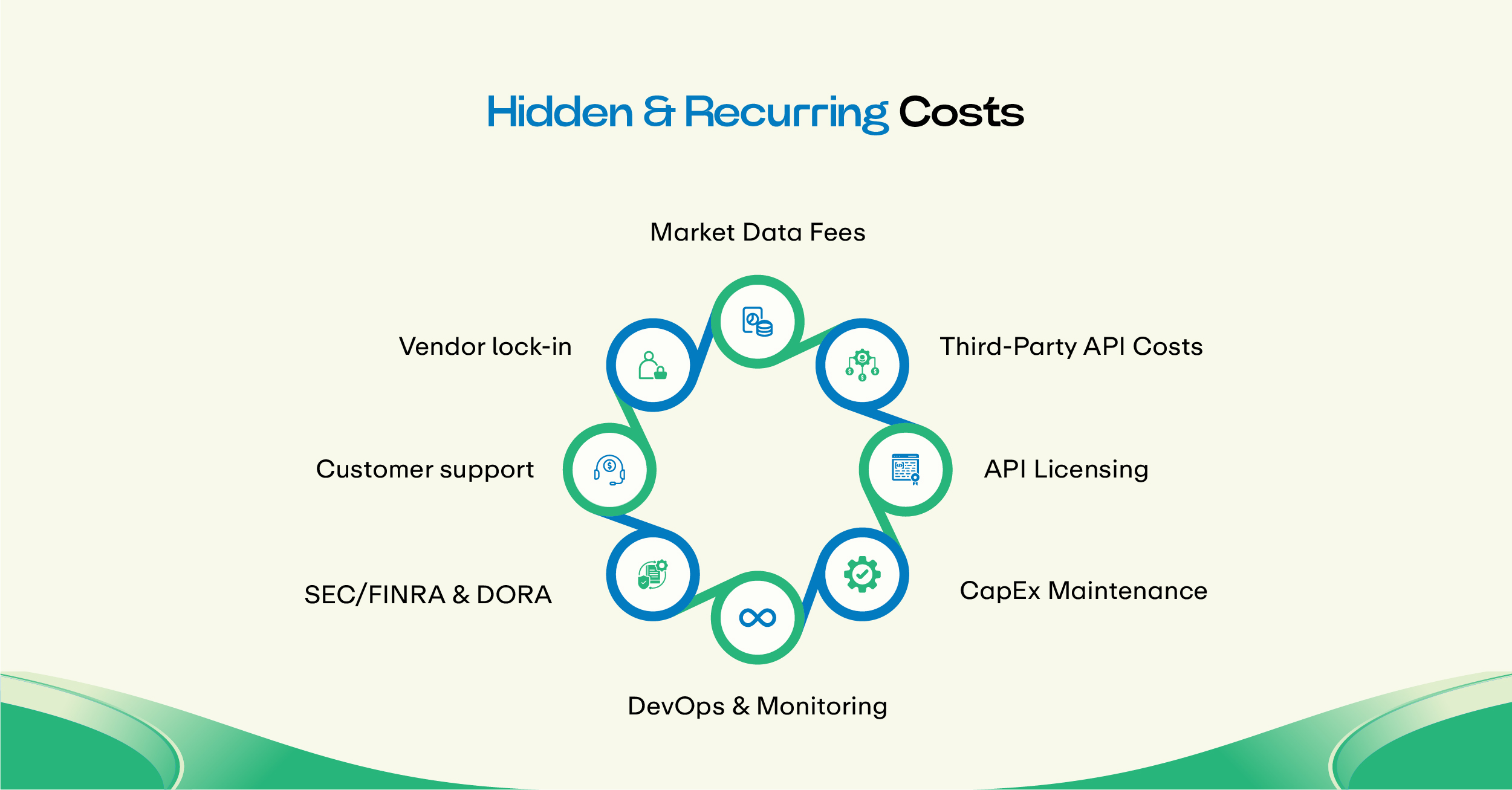
Market Data Fees – Third-Party API Costs – API Licensing Fees – Maintenance Cost – DevOps Cost – Compliance Cost
Building the software is just the start. When you build a trading platform, you face ongoing monthly bills. These operational costs, called OpEx, can surprise new founders. We help you plan for these recurring fees so your business stays profitable.
Market Data Fees (Bloomberg, Refinitiv, Polygon, redistribution fees)
You must buy data to show prices. If you show this data to users, you incur a market data redistribution fee. This is a strict legal requirement.
- Vendors like Bloomberg charge high fees.
- Fees apply per active user monthly.
Third-Party API Costs (The “Rent” You Pay)
Your app relies on outside tools to work. Every API integration charges a monthly fee. These services handle payments, emails, and identity checks, so you don’t have to build them.
- Usage fees grow with user count.
- Monthly subscriptions for access keys.
Market data: Bloomberg ($$$) vs Alpha Vantage ($)
Premium data is fast but expensive. Using free tools for market data API integration saves money but might be slower or less accurate for trading.
- Bloomberg offers professional real-time feeds.
- Alpha Vantage is suitable for testing.
Payment gateways: Stripe/PayPal vs MoonPay
You need a way to accept deposits. Traditional gateways handle cash well, while crypto-specific ones handle digital coins but charge higher percentage fees per transaction.
- Stripe charges around three percent in fees.
- MoonPay supports direct crypto purchases.
SMS/Email: Twilio/SendGrid per 10k notifications
Sending alerts costs money. Every time your user gets a login code or trade alert, the services charge a small fee that adds up quickly.
- Twilio charges per SMS sent.
- SendGrid bills based on email volume.
API Licensing: Plaid, Alpaca, Onfido, Chainlink
Some tools run your core functions. While your trading engine matches orders, these licensed APIs handle bank connections and identity checks that allow the trade to happen legally.
- Plaid connects to user bank accounts.
- Onfido verifies user identity documents.
The “15-20% Rule”- CapEx-based maintenance
Maintenance is never free. You should budget 20% of your initial stock trading app development cost each year to keep the software updated, secure, and online.
- Covers server hosting and updates.
- Includes bug fixes and patches.
DevOps, monitoring, and infrastructure maintenance
Servers need constant watching. Your DevOps team monitors the system to prevent crashes. They ensure the platform stays live even when thousands of users trade simultaneously.
- Uses tools like Datadog monitoring.
- Fixes server issues before crashes.
SEC/FINRA & DORA recurring compliance
Rules change often. Regulatory compliance costs include paying lawyers and auditors annually. They check your system to ensure you are not breaking new financial laws.
- Annual audits are a mandatory requirement.
- Legal teams review new updates.
Customer support cost (user volume dependent)
Users have problems that need answers. As you grow, you will need to hire more support staff. This cost scales directly with the number of active traders on your platform.
- Hire agents for 24/7 help.
- Zendesk software fees add up.
Vendor lock-in and egress cost traps
Moving data out is expensive. Cloud providers make it cheap to join but charge high fees to leave. This trap keeps you stuck with one vendor for years.
- Egress fees apply to data.
- Hard to switch cloud providers.
Security, Compliance & Regulatory Cost Drivers
Security is non-negotiable in finance today. The cost of trading platform license and regulatory compliance protects your business from lawsuits and hackers. Ignoring this saves money now, but it destroys your company later when the first breach occurs.
FINRA, SEC, KYC/AML costs
Obtaining licenses is expensive and slow. The cost of a trading platform license and compliance includes application fees and hiring officers to ensure you follow strict capital rules.
- Application fees range from $5k to $50k.
- Mandatory background checks for officers.
Fraud detection & anti-abuse systems
Hackers target financial apps constantly. Cybersecurity for trading apps must include tools that detect fake users and prevent account takeovers before money is stolen.
- Uses AI to spot fake logins.
- Costs rise with active user count.
Smart contract audits (Web3)
Code bugs in crypto are permanent. Financial data security in Web3 relies on expensive audits. Experts review every line of code to prevent millions in theft.
- Audit fees start around $10k per contract.
- One bug can lose all funds.
SOC2 / ISO27001 security readiness
Corporate clients demand these trust badges. Getting certified proves you handle data safely. It requires months of documenting every single internal process your team follows.
- Audit costs start at $20k annually.
- Mandatory for serving institutional clients.
DORA (EU Digital Operational Resilience Act) Compliance Costs
The EU now mandates strict resilience. DORA-compliant trading platform development ensures you can recover fast from attacks. You must prove your systems can survive severe outages.
- Mandatory for all EU financial firms.
- Fines reach 1% of global turnover.
Post-Quantum Cryptography (PQC) & Crypto-Agility Requirements
Quantum computers will break current encryption. Investing in a Quantum-resistant trading platform costs now includes your security keys to withstand the next generation of powerful hacking attacks.
- Replaces old RSA encryption keys.
- Future-proofs user data against decryption.
DORA-mandated “TLPT” (Threat-Led Penetration Testing) costs
You must pay good hackers to attack you. Threat-Led Penetration Testing simulates real crimes. It finds weak spots in your defense before the real criminals do.
- Simulates real-world ransomware attacks.
- Red teaming costs $30k plus.
Legal retainers and ongoing regulatory updates
Laws change faster than software. You need lawyers on speed dial. They interpret new rules and update your terms of service to keep you out of court.
- Hourly rates often exceed $500 USD.
- Reviews marketing for compliance issues.
Monetization – Recouping Your Investment
There is no uniformity in fees, unlike costs. Even before you operationalize the platform, you must strategize subscription plans for different audience types. The white label trading platform cost recovery demands a robust revenue strategy that meets your initial investment.
Transaction fees & spreads
This is the most common way to earn. You charge a small fee on every trade or add a markup to the price spread. It works best with high volume.
- Charge percentage per trade executed.
- Earn profit from bid-ask spreads.
Payment for Order Flow (PFOF)
Free apps often use this model. You route user orders to big market makers who pay you for the volume. It allows you to offer zero-commission trading to users.
- Market makers pay for orders.
- Enables zero-fee trading for users.
Premium tiers & advanced analytics
Serious traders pay for better tools. Offer a subscription plan that unlocks advanced charts or faster data. This creates a steady monthly income regardless of market trading volume.
- Charge monthly fees for pro features.
- Unlocks Level 2 market data.
Data-as-a-Service (DaaS) monetization
Your data is valuable gold. Hedge funds pay enormous sums for historical trade data. You can package this anonymized user activity and sell it to institutions via APIs.
- Sell historical pricing datasets.
- License real-time API access.
White-labeling your engine
Lease your tech to others. If you built a great engine, license it to new brokers. This offsets your original forex trading platform development costs by generating B2B revenue.
- Charge setup and monthly license fees.
- Let other brokers brand your tech.
ROI Timeline: How long it takes to recover your investment
Recouping costs takes time. Most platforms break even within eighteen months if they grow users steadily. Marketing spend plays a massive role in how fast you reach profit.
- Typical breakeven is 18 months.
- Depends heavily on the marketing budget.
Net Interest Margin (Interest on uninvested user cash)
Earn on idle money. Banks pay you interest on the cash users leave in their accounts. You keep a portion of this interest as profit before paying the user.
- Invest idle user cash safely.
- Keep the interest rate difference.
How to Reduce Costs Without Sacrificing Quality
Saving money does not mean building cheap software. Choosing the best technology stack to reduce trading platform development costs prevents waste. We show you smart ways to cut expenses while still delivering a powerful, secure product to your users.
Reusing prebuilt modules & SDKs
Do not code everything from scratch. Using ready-made code blocks drastically lowers the wallet management feature cost. It is safe, tested, and ready to deploy immediately to your platform.
- Integrate third-party crypto wallet SDKs.
- Reduces coding time by months.
Start with Web MVP
Mobile apps are expensive to approve. Starting with a responsive website saves early cash. You can launch fast, gather user feedback, and build the mobile app later.
- Avoids Apple App Store fees.
- Works on all devices instantly.
Crypto-agile architecture
Markets change fast. Designing flexible systems now prevents the 2026 trading platform development cost from exploding later. Your code should accept new tokens without needing a total rebuild.
- Use modular code for updates.
- Supports new blockchains easily later.
Smart vendor selection
Not all sellers offer fair prices, so you must compare vendors carefully. The overall software development cost also varies widely, as custom development of a trading platform usually costs more than buying a white-label matching engine.
- The license fees for white label software vary.
- Review and factor hidden support costs.
Hybrid outsourcing models
Hiring local experts for core design is smart. Then, let a remote team handle the heavy coding. This mix lowers the bill while maintaining high quality control.
- Hire local Project Managers only.
- Outsource bulk coding tasks offshore.
Iterative development strategy
Build small parts one by one. This agile method prevents big mistakes. The longer the bug persists, the bigger the cost. Therefore, resolving bugs early saves a lot of dollars.
- The release updates should be well-fragmented.
- Test user feedback every week.
Master Cost Summary Table
| Cost Category | Low-End Estimate | High-End Estimate |
|---|---|---|
| Core Development (MVP) | $45,000 | $80,000 |
| Advanced Features (AI, Social) | $35,000 | $150,000 |
| Security & Compliance | $20,000 | $60,000 |
| Infrastructure (Annual) | $10,000 | $50,000 |
| Third-Party APIs (Annual) | $15,000 | $40,000 |
| Total Year 1 Budget | $125,000 | $380,000+ |
Conclusion
Deciding to build a trading platform is a big financial step. You must balance upfront costs against future profits. Thoughtful planning prevents wasting money on features your users do not need yet.
We help you navigate these complex choices easily. By choosing the right team and tech stack, you secure a profitable future. Let us turn your vision into a successful business today.
Key Takeaways:
- Start with an MVP to save budget.
- Compliance costs must be planned early.
- Choosing the right tech prevents costly rewrites.
- Hybrid teams lower costs without losing quality.
FAQs
This price covers essential features such as user registration, basic stock charts, and buying capabilities, enabling early adopters to test your product.
Replicating Robinhood requires complex features like commission-free trading logic, real-time data, and a slick user interface that attracts millions of users.
Crypto apps need blockchain integration and secure wallets, which adds technical complexity compared to standard stock market data connections.
This is the engine of your app. It handles order matching, user data security, and server logic, so it is the biggest expense.
Buying a ready-made license saves months of coding time. It significantly lowers your initial budget compared to building custom software from scratch.

Bhavin Umaraniya
Bhavin Umaraniya is the CTO at Tuvoc Technologies, with 18+ years of experience in frontend and web software development. He leads tech strategy and engineering teams to build scalable and optimized solutions for start-ups and enterprises.

Have an Idea? Let’s Shape It!
Kickstart your tech journey with a personalized development guide tailored to your goals.
Discover Your Tech Path →Share with your community!
Latest Articles
When to Choose a White Label Real Estate App Development Company and Why?
Most real estate businesses we talk to aren't short on leads or deals. Even your search for a white-label real…
Real-Time Payment Infrastructure Architecture: Why Money Can No Longer Move at Yesterday’s Speed
Blog Summary Money still moves through infrastructure built for another era Consumer expectations are reshaping payment system priorities Real-time payments…
Cost to Develop a Real Estate App Like Zillow or Trulia
This Blog Explains: Cost Breakdown: Understand what actually increases Zillow-like app development expenses Infrastructure Reality: Learn why MLS systems change…