Is Your Architecture Ready for 10x Growth or Built to Break?

Bhavin Umaraniya
Uncategorized
Published : May 7, 2026
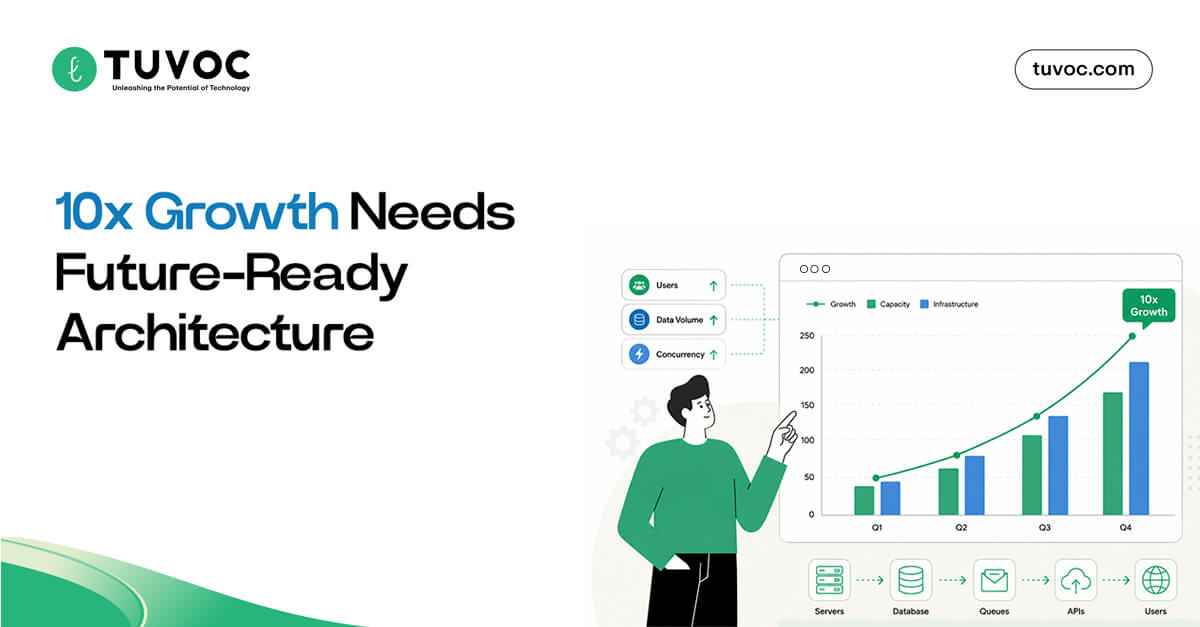
Most engineering teams don’t realize why systems fail under growth, not load, until rising costs and instability make it difficult to fix cleanly.
Not because of traffic spikes; they come and go. But because growth accumulates with more users, more data, and more interactions, all of which are pressuring decisions made when the system was smaller.
Response times stretch, and queues take longer to drain, while costs rise without a clear reason. It doesn’t mean systems collapse suddenly, but that’s what makes them dangerous.
Most scalable backend architectures appear stable until growth pushes them beyond the conditions they were originally designed for.
This blog breaks down why that happens, where systems actually start failing, and how to recognize it before growth turns into a problem.
Why systems fail under growth, not load (and pass load tests)
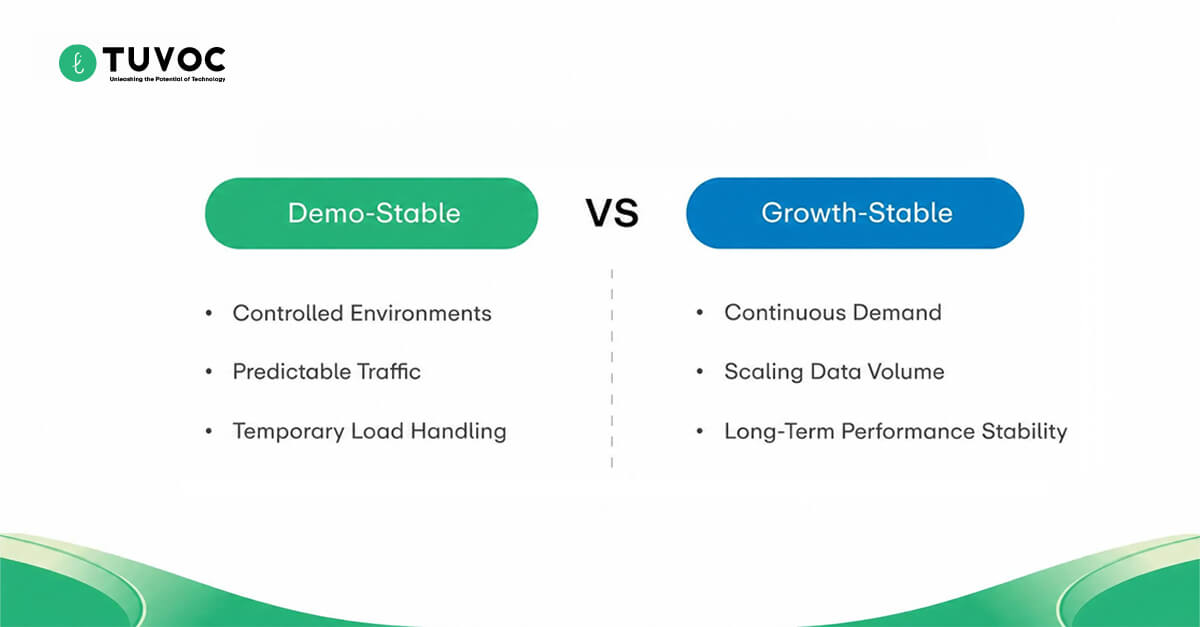
Systems pass load tests because those tests simulate temporary stress. Why systems fail under growth, not load, is that growth applies sustained pressure, continuously increasing data volume and system interactions. That’s why systems pass load tests but fail in production at scale; long-running demand exposes bottlenecks and concurrency limits that short, controlled tests don’t reveal.
Load testing puts your system under strain for a defined window, then stops. The system recovers, reports green, and the team moves on. What it never tests is what happens when that pressure doesn’t stop, when user volume climbs week over week, database rows multiply, and API calls stack without a recovery window anywhere in the system.
That’s the difference between a system that is demo-stable and one that is growth-stable.
Demo-stable systems perform under known, predictable conditions. They hold up in controlled environments, during staged launches, or under test scenarios. Growth-stable systems are built to absorb continuous pressure, the kind that doesn’t arrive as a spike and doesn’t give your team a clean moment to fix things before the next wave hits.
Most teams discover architectural limits only after growth has already changed business expectations.
The timing trap: why you discover this too late
Teams discover scalability limits too late because growth increases demand gradually, not suddenly. There’s no clear failure point; systems appear stable until they cross a threshold, turning a strategic question into an urgent problem.
Almost all the time, teams don’t identify architectural limits, especially upon discovering continuous growth. The core question they don’t ask until urgency hits is “how do I know if my architecture can handle 10x user growth?” Fixing the systems amidst growth is significantly riskier and extremely expensive.
The cruel part is that the system gives no obvious warning. It worked yesterday. It worked this morning. Growth doesn’t send a calendar invite.
Hidden Bottlenecks: Where Systems Quietly Fail
Hidden bottlenecks in high-concurrency systems don’t sit in obvious places like CPU or memory. They emerge in how systems coordinate work across databases, queues, and APIs, where small inefficiencies compound under sustained load and eventually turn into system-wide failures.
The problem is that teams never look for the hidden bottlenecks where they actually are, where the systems perform concurrent tasks. But in CPUs, RAM, and raw servers, the ceiling never hits.
Databases handling simultaneous reads and writes. Queues processing event streams. APIs managing compounding request volumes. Small inefficiencies at these layers don’t stay small under growth.
At low traffic, an inefficient query costs microseconds. At 50,000 requests per second, the same query creates contention. Connections pile up. Rows lock. Transactions stall. Everything upstream starts backing up. Under sustained concurrency, coordination delays begin compounding across the system.
Most teams don’t find these limits until growth forces the discovery. By then, the bottlenecks aren’t just technical; they become operational, structural, and expensive.
The system handled expected traffic well, but concurrency patterns changed once growth became continuous.
Where High-Concurrency Systems Fail First
High-concurrency system designs typically fail first in three areas: database locking, queue backpressure, and API latency. These components create cascading failures as increasing load amplifies small inefficiencies across the system.
Under high-concurrency pressure, systems don’t fail everywhere at once. They fail in specific places first. Database locking turns routine queries into traffic jams. Queue backpressure builds when message processing lags behind production. API latency compounds when handshake overhead becomes a structural tax at scale.
Each issue looks isolated until it isn’t. One slow queue backs up an API. One locked row stalls a queue. What begins as a minor inefficiency doesn’t stay contained. It spreads until the entire system feels it.
Why “it’s working fine” is a dangerous signal
Uptime vs. scalability metrics reveal a critical gap, which is that uptime measures past availability, not future capacity. This is why uptime is a misleading indicator of system health; systems can appear stable at current load while being structurally unprepared for sustained growth and increasing concurrency.
This aligns with principles outlined in Google’s Site Reliability Engineering practices, where availability alone is not considered a measure of system resilience under changing demand.
A system running at 99.9% uptime today says nothing about whether it can handle tomorrow’s growth. Stability at the current scale and the ability to absorb future demand are entirely different properties, and most dashboards measure only one.
“It’s working fine” is one of the most expensive sentences in engineering leadership. Not because it’s wrong about today. It usually isn’t. It’s expensive because it gets used as evidence about tomorrow.
Green dashboards reflect past stability, not how the system behaves as concurrency and operational pressure increase. A system can report perfect uptime right up to the moment it can’t. And the gap between “working fine” and “completely overwhelmed” is often a single growth curve, not a gradual warning. By the time uptime drops, the architectural problem is already months old.
Uptime vs Scalability: What Metrics Actually Tell You
| Metric | What It Shows | What It Misses |
|---|---|---|
| Uptime | Past availability | Future capacity under growth |
| Latency | Current response speed | Behavior under sustained concurrency |
| CPU / RAM | Resource usage | Coordination bottlenecks |
| Error Rate | Failures at current load | Thresholds under scaling |
The band-aid trap: why scaling fixes don’t scale
Adding more servers doesn’t fix scalability problems. Rather, it increases capacity, but it doesn’t address the bottlenecks underneath the architecture. Scaling a system with concurrency constraints only amplifies inefficiencies, turning structural limitations into higher costs and complexity.
A tightly coupled architecture with concurrency bottlenecks doesn’t become scalable with more compute. Instead, the issue compounds quietly. Every temporary fix makes future modularity harder.
Teams end up maintaining the fixes as much as the system itself. Technical debt builds with each quick decision, narrowing the window for doing it properly.
What happens when scalability fails (the real cost)
The real cost of a scalability failure for a business isn’t downtime but revenue loss, user churn, and missed growth opportunities. As demand exceeds system capacity, technical debt and the cost of inaction escalate into failures that directly impact business performance at critical moments.
The damage becomes visible during high-demand moments, when delayed responses and instability directly affect conversion, retention, and operational continuity. Decisions postponed earlier turned into urgent problems later.
Scalability failures surface when demand spikes, product launches, and marketing campaigns begin. Then the system performance directly translates into revenue and retention.
The system doesn’t just fail like that, but at the moment growth finally arrives. The trouble begins because users don’t wait, the market does not pause, and competitors double down.
If you are a startup, costs remain invisible; downtime for enterprises can burn up to one million dollars per hour, which is outrageous but doesn’t capture the churn. It doesn’t calculate the loss of trust and opportunity.
Reports such as IBM’s Cost of a Data Breach highlight how system failures extend beyond downtime into long-term financial impact, operational disruption, and loss of trust.
Cost of Scalability Failure: What It Actually Impacts
| Impact Area | What Happens | Business Consequence |
|---|---|---|
| Revenue | System fails during peak demand | Lost transactions and missed growth windows |
| User Experience | Slowdowns or outages | User drop-off and reduced retention |
| Trust | Repeated instability | Brand damage and lower customer confidence |
| Engineering | Firefighting replaces development | Slower roadmap and delayed releases |
| Opportunity | Competitors remain available | Market share shifts elsewhere |
How scalability failures reduce engineering velocity
Engineering firefighting vs. feature velocity becomes a forced tradeoff when systems fail under scale. The teams’ focus shifts from developing new capabilities to fixing production issues. It reduces delivery speed and increases long-term technical debt.
When systems break under load, engineering focus shifts from building to recovery. Sprints get hijacked. Milestones slip. The work that mattered most gets pushed aside. That shift compounds over time. Every delay increases competitive exposure. What looks like a short outage often turns into weeks of lost momentum.
The real cost isn’t just downtime. It’s the velocity you don’t get back.
Early warning signs your system is approaching its limit
The signs your system is hitting a scalability wall often appear sporadically, not as failures. Common early warning signs of scalability failure reside in rising latency, increasing infrastructure costs without proportional throughput gains, and in growing engineering effort.
Scalability limits usually surface through operational drift rather than outright outages.
In isolation, each looks manageable. A small latency increase gets blamed on a deployment. A spike in cloud costs gets attributed to a campaign. A few days spent fixing production issues feels like normal operational noise. But these signals rarely occur alone. They pile up.
Latency creeps first, usually during peak concurrency. Costs follow, as teams add resources to manage symptoms. Then velocity slows, not because productivity dropped, but because more engineering time is spent keeping the system stable.
By the time all three are visible together, the system isn’t approaching a limit. It’s already there. Systems don’t collapse without warning. They degrade first. The problem is that degradation often gets mistaken for normal growth.
The resilience gap: when systems slow before they fail
To identify hidden bottlenecks in a high-growth system, you should focus on incremental performance drift, not on outright failures. These shifts indicate underlying constraints such as slower response time, increasing query latency, and inefficient queue processing, before the system breaks.
Complete failure is rarely the first signal. What shows up earlier is subtle.
Response times increase without a clear cause. Queries take slightly longer under concurrent load. Queues are processed just a bit slower than they were before. Nothing breaks, but efficiency drops.
That gap between “working” and “working well” is where structural limits start to surface. The resilience gap is the distance between what your system can handle today and what growth will demand next. And it closes faster than most teams expect.
Next: why platforms break at scale
Your system may not be failing yet. But if these signals are present, it’s already under strain. The next question is not whether it will break, but when, and under what conditions.
In the next blog, we’ll look at why fast-growing platforms break at scale, even with strong engineering teams, and what they miss before it happens.
FAQs
Load is temporary traffic pressure that subsides. Why systems fail under growth not load is different, growth is continuous, compounding demand that permanently increases concurrency, data volume, and system interactions without recovery windows.
Load tests simulate controlled, time-bound stress. High concurrency system design failures emerge under sustained growth because real production continuously compounds request volume, database interactions, and queue pressure beyond what any test replicates.
A scalable backend architecture for high-traffic applications shows no latency creep, stable infrastructure costs, and consistent engineering velocity under increasing demand, without requiring structural rework as user volume compounds.
Response times climbing during peak hours is usually the first signal. Then infra costs rise, but throughput doesn’t follow. Engineers stop shipping and start fixing. These aren’t separate problems. That’s one scalability wall showing itself in three places.
More servers handle more requests. They don’t fix how those requests are orchestrated. Database locks, backed-up queues, tight coupling, none of that changes with additional compute. Adding more servers doesn’t fix scalability problems as hardware was never a problem.

Bhavin Umaraniya
Bhavin Umaraniya is the CTO at Tuvoc Technologies, with 18+ years of experience in frontend and web software development. He leads tech strategy and engineering teams to build scalable and optimized solutions for start-ups and enterprises.

Have an Idea? Let’s Shape It!
Kickstart your tech journey with a personalized development guide tailored to your goals.
Discover Your Tech Path →Share with your community!
Latest Articles

When to Choose a White Label Real Estate App Development Company and Why?
Most real estate businesses we talk to aren't short on leads or deals. Even your search for a white-label real…

Real-Time Payment Infrastructure Architecture: Why Money Can No Longer Move at Yesterday’s Speed
Blog Summary Money still moves through infrastructure built for another era Consumer expectations are reshaping payment system priorities Real-time payments…
Cost to Develop a Real Estate App Like Zillow or Trulia
This Blog Explains: Cost Breakdown: Understand what actually increases Zillow-like app development expenses Infrastructure Reality: Learn why MLS systems change…