Use Cases of Custom Software Development for Startups in 2025
Jitendra Rathod
Custom Software Development
Published : Nov 13, 2025

What Is Custom Software Development for Startups?
All startups start with a bunch of possibilities. Founders believe their idea is revolutionary. To achieve success, they start with ready-made software. However, software development for startups begins where off-the-shelf tools hit their limit.
Custom software development services are not just about developing software; but engineering technology that adapts to your vision, purpose, and dreams. It is a pillar on which startup founders can build their business DNA. For their tech partner, it is about building a growth engine that scales as the business expands.
How Custom Software Fits Early-Stage Startup Goals
Every start-up wants to avoid stumbling blocks at all costs. Therefore, there are 4 best software development strategies for early-stage startups to achieve sustainable growth.
Speed to Market:
Develop, ensure quality, and launch MVPs quickly, with custom features and iterative releases, to validate demand before full-scale development.
User Experience:
Built to take initial reviews into account, the product is designed to be functional, users are not going to stop using it, and they have confidence in the brand.
Scalability:
Develop a scalable architecture that can handle increased user volume, data load, and feature complexity as the enterprise grows post-launch.
Investor Confidence:
Reveal business maturity through proprietary technology flexibility, which includes long-term vision and careful capital deployment.
When startups should avoid custom builds
Although custom software development is flexible, not all founders can opt for it for various reasons; some of them are mentioned below.
- When a small budget can’t support multi-phase development cycles.
- When the product has not yet been tested in the real market demand.
- Off-the-shelf software is helpful for initial market launch.
- When software development oversight isn’t available.
- The deployment deadline is too close to the module iterations.
- Long-term maintenance cost estimations aren’t available yet.
Takeaway: Custom builds provide a startup with control, flexibility, and product identity. We shall next compare the two in the context of actual start-ups.
How Does Custom Software Differ from Off-the-Shelf Solutions?
For a custom software development company, the difference is immensely vast. Similarly, All startups have crossed the same crossroad; create something unique or purchase something ready-made. It is not only about cost but also about control, scalability, and competitive edge.
In the real world, the battle of custom software vs. off-the-shelf solutions for startups centers on flexibility and ownership. Ready-made tools make it easy to get started in 10 minutes, though customization is limited. Tailor-made software adapts to your plan, allowing you to establish features, performance, and user experience to your comfort.
Custom Build Vs Off-the-Shelf
The comparison of these two paths is commonly conducted on the basis of speed, cost, scalability, and the lasting impact on startups. The differences between the two approaches on six practical points are as follows.
| Factor | Custom Build Solutions | Off-the-Shelf Solution |
|---|---|---|
| Ownership | Complete ownership of code, data, and roadmap. Full control over integrations and future upgrades. | Limited access or licensing restrictions with vendor-controlled updates. |
| Flexibility | Fully adaptable to business model and evolving product vision | Predefined structure limits flexibility beyond core features. |
| Scalability | Scales seamlessly with user growth and product complexity. | Scaling may require external plugins or costly upgrades. |
| Time to Launch | Requires more planning and development time before deployment. | Quick to deploy; ready-made features available instantly. |
| Cost Efficiency (Long Term) | Higher initial investment but lower long-term cost through ownership and optimization. | Lower upfront cost, but recurring license and upgrade fees over time. |
| Competitive Edge | Enables unique features that differentiate your startup in the market. | Generic functionality; limited ability to create unique customer experiences. |
Takeaway: Custom builds offer flexibility and control. Off-the-shelf tools can’t offer the same. Find out why 2025 startups are embracing custom software to expand.
Why Should Startups Choose Custom Software Development in 2025?
Next-era startups come with more than a fast pace because they require flexibility. Software development in startups is no longer an option as technologies converge and customer expectations change. Building custom software is about adding value for the future by creating not just a tool, but a business model.
Tailored software ensures startups align with changing market dynamics, individualize user experiences, and build data integrity. With an innovation-driven market, the most vital thing is to have your technology and have your path.
Key 2025 factors driving demand
A number of market forces are driving the move towards custom solutions. These software development trends for startups 2025 are shaping how upcoming businesses are developing, testing, and scaling products.
AI Integration
Foundations are implementing intelligent automation to reduce reliance on human resources and improve decision precision, whether product line- or operation-related.
Data Privacy and Compliance
The world is becoming increasingly regulated when it comes to information, which is driving startups to develop their own frameworks to gain control and ensure safety in every deal.
User Personalization
Customized online experiences are more engaging and convert better, so differentiate your competitive niche with a custom UX design.
Scalable Infrastructure
Cloud-native architectures support startups’ elasticity needs and performance immediately, with zero-cost rebuilds and no vendor lock-in.
API-first Ecosystems
API-based interoperability empowers the startup’s agility and freedom to be innovative without being tied to a specific software model.
Investor Focus on IP Ownership
Venture investors currently prioritize startups with proprietary codebases, as this asset class is seen as a primary driver of valuation.
Real startup examples showing “why now” matters
The recent business successes reveal how bespoke solutions generate growth momentum. Custom software use cases for startups illustrate why timing is a key factor of scaling impact in 2025.
Notion (Productivity SaaS):
Custom databases and a flexible UI layer enabled the addition of features based on user requests, growing to 40M+ users by focusing on adaptability.
Plaid (FinTech):
Developed bespoke security and API architecture, which created compliance cover across financial companies, making it a trusted party in enabling global fintechs.
Tempus (HealthTech):
Built in-house custom data analytics pipelines to process patient data more quickly, revolutionizing the process of diagnostics and raising a large Series G round.
Shopify (E-commerce platform):
The Custom-built store became a complete SaaS platform supporting more than 2 million businesses on an extensible architecture.
Takeaway: Future startups, in 2025, will prevail through the control of flexible, scalable, and intelligent technology. That is how tailor-made software changes industries with applications.
Key Use Cases of Custom Software Development for Startups in 2025
Today, technology is not viewed as a backup system by startups; it is the heart and blood of startups. The actual narrative of custom software development use cases for startups in 2025 is that young companies are finding solutions to complex problems through bespoke digital innovation.
We may use the example of the new generation of FinTech, HealthTech, SaaS, E-commerce, and niche startups that implement technology in various ways by using custom software. Nonetheless, they all have the same target in mind: accelerated, more vivid, and more sustainable development
FinTech: compliance automation and predictive analytics
Challenge: AI-driven software development for startups enables businesses to automate compliance, detect anomalies and fraud, and deliver personalized financial services content.
Insight: Banks make loan-related decisions, converting user data into insight using predictive analytics.
Impact: Besides retaining a mass customer base, banks spent 40% less time on compliance.
HealthTech: Data Security and Telehealth Scalability
Challenge: Healthcare start-ups handle sensitive patient information and rapidly evolving delivery models. With Cloud-based applications for startups, they establish medical records and expand telehealth services globally.
Insight: Encrypted API and distributed cloud storage enhance interoperability.
Impact: 60% faster patient onboarding and a more conformant posture are achieved.
SaaS & Productivity Tools: Multi-Tenant Architecture for Growth
Challenge: Productivity startups aim to deliver to multiple consumers without disruption. Multi-tenant architecture delivers the performance, security, and cost efficiency required at all levels through SaaS development for startups.
Insight: It also helps roll out feature updates without interrupting operations.
Impact: This reduces maintenance overheads and enables deployments at least 70 percent faster
E-commerce: Logistics and Personalized UX
Challenge: Internet-based retail companies are competing on speed and experience. Unified systems designed around user-centric software design streamline order fulfillment, inventory management, and consumer recommendations.
Insight: They transform all customer engagements into insights that spur more innovative logistics and retention tactics.
Impact: 35 percent rise in the number of repeat purchases using a customized shopping experience.
Niche Startups:
Challenge: AdTech, EdTech, and PropTech are among the fields where emerging startups apply Startup software solutions that leverage integrated AI and IoT to deliver domain-specific insights.
Insight: These systems are automated workflow and real-world-input-based analysis systems used to deliver accurate operational improvements.
Impact: 3x efficiency improvement in the business processes and customer points.
Takeaway: One of the startup’s problems is transformed into a quantifiable growth prospect by custom software. Let us crack the code of the real cost of custom builds in 2025.
How Much Does Custom Software Development Cost for Startups in 2025?
The affordability dilemma is a question every startup has to answer before taking the custom route. The fact is that the development of cost-effective software solutions for small startups depends on their purpose, objectives, and technical sophistication.
Custom software built on a scalable architecture is attracting eyeballs and money from startup founders in 2025. Instead of controlling costs, startups are focusing more on generating value from each development dollar.
Major cost factors startups must plan for
When planning software development outsourcing, startups are advised to map all cost variables early. Project budgets and overall efficiency are dependent on six key variables.
Project Scope: A larger product scope means more effort, integrations, and a longer schedule.
- Precise requirements save time.
- Avoid feature creep early.
Technology Stack: Current structures are more expensive and enhance security and scalability.
- Pick sustainable tech options.
- Balance cost with performance.
Design Complexity: UI or animations. Advanced UI or animation makes design times and testing longer.
- Keep UX clean and functional.
- Test with real users first
Team Experience: There are competent team developers or niche experts who increase the initial price but lower the rework.
- Hire for quality, not quantity.
- Value long-term reliability.
Development Model: Use a suitable fixed price; develop the MVP; expand projects with hourly or agile suites.
- Match the model with flexibility.
- Track deliverables regularly.
Maintenance and updates: This is the post-launch cost for maintenance, expansion, and constant improvement.
- Plan a recurring budget early.
- Schedule periodic audits.
These factors can help startups plan costs correctly and prevent overruns in later life-cycle stages.
Average Cost Ranges by Region or Project Size
In addition to features and their complexity, the development team’s location, experience, and expertise, along with outsourcing timing, determine the custom software development cost. The real-world view is explained below.
| Region / Project Type | Average Project Cost (USD) | Average Hourly Rate (USD) |
|---|---|---|
| North America | 100,000–250,000 | 80–150 |
| Western Europe | 80,000–180,000 | 60–120 |
| Eastern Europe | 50,000–120,000 | 40–80 |
| Asia (India, Vietnam) | 30,000–100,000 | 25–60 |
| South America | 40,000–110,000 | 35–70 |
| Africa | 25,000–80,000 | 20–50 |
These figures represent the mean market trends from the best outsourcing reports. The real cost of custom software development is determined by team strength, choice of technology, and product inclusivity.
Takeaway: To reduce costs, startups should plan development thoroughly. Costs also often force startups to calculate ROI in actual terms.
What ROI Can Startups Expect from Custom Software Development in 2025?
Startups in 2025 are assessing technology based on results rather than hard work. The ROI of custom software development for startups is determined by its ability to boost revenue, efficiency, and user retention with technology.
Contemporary startups do not only quantify returns in terms of profit; they also quantify them in terms of flexibility, speed, and informational decision-making. Custom software, when created strategically, can reap returns several times the original value in two to three years of scaling.
Typical ROI metrics startups can measure
Bespoke software is the computer heart of change. These six prominent metrics are used to quantify digital transformation for startups in practice.
- Revenue Growth: The growth in new revenue obtained by means of features, subscriptions, or direct digital channels during a given period.
- Customer Retention: Measures how customized experiences and better service result in greater user loyalty and repeat purchases.
- Operational Efficiency: Assesses lower human effort and cost-saving in terms of automation, optimization of workflow, or integration.
- Time To Market: The time-to-market of a new product or update is the time interval between successive product releases.
- Customer Acquisition Cost (CAC): CAC evaluates marketing and sales data insights (Cost and outcome) through automated lead tracking.
- Employee Productivity: Track individual and team performance and team collaboration using digital monitoring tools to enhance productivity in a cohesive work environment.
Case Snapshot: Startup ROI from MVP to Scale
Actual achievements indicate how scheduled MVP development should be translated into tangible expansion. These MVP development use cases for startups highlight ROI patterns across industries.
- A fintech startup created a Fintech MVP lending application to launch in 6 months, resulting in a 25% cost reduction and 40% better customer onboarding.
- A SaaS startup built its MVP on a modular system, reducing upgrade costs by 35% and doubling subscription retention in 1 year.
- An app-based HealthTech startup created a teleconsultation system with AI triage, significantly reducing patient response time by half and increasing active users by 2x in 8 months.
Every case demonstrates that the payback of custom construction is quantifiable and sustainable as long as the plan is in place and being implemented.
Takeaway: A reliable tech partner like Tuvoc helps you pull development costs down while ensuring sustainable growth and ROI. New tech trends in 2025 direct us in the exact direction; let’s check them out.
Which Software Development Trends Will Shape Startups in 2025?
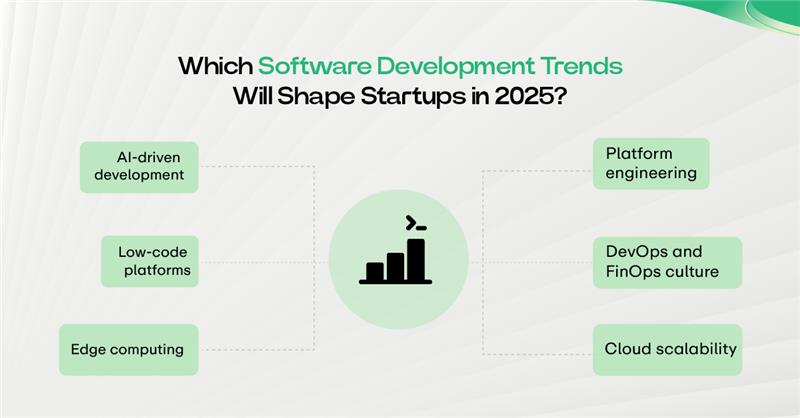
The face of technology in 2025 has changed drastically. Not only are they accelerating the software development, but they are also building capabilities and stress at the same time. These software development trends for startups 2025 will outline how entrepreneurs will develop, grow, and remain competitive in the latest digital economy.
AI-driven development:
AI-driven software development for startups is now a fulcrum of the whole development process. From code generation to testing and bug fixing, investment and time-to-market are quickly improving.
The ongoing tech shift enables even a tiny team to deliver enterprise-grade quality while cutting development time by 40%.
Low-code platforms:
Agile development for startups is increasingly becoming synonymous with low-code development. Building prototypes without code suits both developers and founders. These platforms are pushed on startups to enable faster pivots.
They save resources, enhance business-tech team collaboration, and reduce MVP delivery timeframes by a large margin.
Edge computing:
The current tech stack for startups is moving out of the cloud. Despite the virtual distance, edge computing ensures data is processed close to users, significantly reducing latency.
As AI, IoT, and automation are making huge strides, adopting edge computing can enhance the cost-benefit ratio and take user experience and operations efficiency a few notches higher.
Platform engineering:
The scalable software solutions have now been based on platform engineering concepts. New startups are developing internal platforms that integrate development, deployment, and monitoring through automation and shared infrastructure.
This enhances consistency and delivery speed, allowing developers to invest in innovation rather than wasting time on duplicated setup.
Cloud scalability:
The emergence of cloud-based applications for startups defines operational agility. Scalable cloud models enable startups to increase capacity immediately as demand increases, without affecting performance.
Such flexibility provides a uniform user experience, reduces maintenance effort, and helps to create predictable cost structures during periods of fast growth.
DevOps and FinOps culture:
DevOps and FinOps are being combined through lean software development practices. Startups are working to combine engineering effectiveness and financial transparency to operate sustainably and in a data-driven way.
Such a culture enhances teamwork, reduces release times, and helps teams efficiently use cloud assets by providing real-time cost visibility.
Takeaway: Startups can respond to evolving tech trends with agility and easily achieve the desired growth pace. Let’s identify the best ways to select the right offshore development company for startups.
How to Choose the Right Offshore Software Development Partner for Your Startup
Recognizing and choosing the right custom software development partner helps you not only grow the business but also increase ROI. In order to choose the right software development partner, you require a group that comprehends your aspirations, keeps up with your rate, and fits with your expansion vision.
A good offshore partner is an alliance that can exercise technical expertise, communicate effectively, and understand the culture. As of 2025, startups are also finding partners who code but also think beyond short-term scaling and innovation.
Why offshoring software development works for startups
For contemporary founders, outsourcing software development is a viable way to stretch their budgets without compromising quality. Offshore teams have technical breadth, experience, and twenty-four-hour productivity.
We find offshoring to be more cost-saving at Tuvoc. It is a form of collaboration that allows the startup to focus on its vision while we focus on technical accuracy.
Key criteria to evaluate before you partner
Selecting the appropriate offshore partner involves not only evaluating capability but also the area of congruence. The following are the six primary criteria to consider when you hire dedicated developers who can bring sustainable value to startups.
- Technical knowledge: Survey experience in frameworks, tools, and similar projects. Request applicable case studies.
- Transparency in communications: hold candid communication, share periodic growth reports, and consider feedback for project implementation.
- Scalability and flexibility: Be able to offer on-demand scalability for workforce and technology with flexibility in planning to deployment.
- Cultural harmony: Find common values and a pattern of working without conflict and confusion.
- Security compliance: Check compliance with data protection, IP ownership, and international development standards.
- Side support: Select teams that provide updates and after-sales support to maintain expansion.
A trusted partner is like part and parcel of your startup, turning short-term ventures into long-term development.
Takeaway: Tuvoc helps startups grow their businesses effectively through high-quality, trustworthy offshore development. This is how it all ends.
Conclusion
Innovative startups are much quicker to win. The ability of founders to use software development for startups intelligently in building products that are adaptable, scalable, and able to drive change will only be successful in 2025.
Off-the-shelf software is a luxury but the key to achieving long-term growth. Startups can turn ideas into permanent digital ecosystems with the right strategy, vision, and a reliable technological ally.
Tuvoc assists startups in designing, developing, and expanding software tailored to their specifications, delivering concrete business results and long-term benefits. We should develop your next big solution.
FAQs
Custom buildings are better at increasing the growth of software startups because they increase the efficiency, user experience, and scaling of software. They help startups to deal with technology and reduce reliance, and in the process, growth, which is natural.
In Smooth MVP Software Development, we advise that one should find a partner that is specialized in fast prototyping, lean sprints, and iterative development, which has to be validated before committing a lot of resources.
To be able to have reliable hosting, scalability, and built-in development assistance, most startups resort to Cloud-based applications on AWS, Google Cloud, or Azure.
The cost to create cost-efficient software to cover the needs of a small startup varies between 30,000 USD and 100,000 USD, depending on the complexity and area covered, and likely the scalability after use in the long run.
The typical on-demand engagement cases in startups through custom software creation would be FinTech automation, HealthTech data platforms, SaaS, and custom e-commerce in 2025.

Jitendra Rathod
Jitendra Rathod is the Founder & CEO of Tuvoc Technologies, with 18+ years of experience in full-stack development, no-code platforms, and emerging technologies like Python and AI/ML. He helps startups and enterprises with smooth project deliveries using modern technologies and agile development practices.

Have an Idea? Let’s Shape It!
Kickstart your tech journey with a personalized development guide tailored to your goals.
Discover Your Tech Path →Share with your community!
Latest Articles
When to Choose a White Label Real Estate App Development Company and Why?
Most real estate businesses we talk to aren't short on leads or deals. Even your search for a white-label real…
Real-Time Payment Infrastructure Architecture: Why Money Can No Longer Move at Yesterday’s Speed
Blog Summary Money still moves through infrastructure built for another era Consumer expectations are reshaping payment system priorities Real-time payments…
Cost to Develop a Real Estate App Like Zillow or Trulia
This Blog Explains: Cost Breakdown: Understand what actually increases Zillow-like app development expenses Infrastructure Reality: Learn why MLS systems change…