Trading System Architecture 2026 | From Microservices to Agentic Mesh

Bhavin Umaraniya
Finance
Published : Dec 16, 2025
Exclusive Key Takeaways:
- Agentic mesh replaces microservices to minimize network hop latency.
- Edge-native compute moves execution logic closer to exchange matching engines.
- Rust removes garbage-collection overhead, enabling the system to be deterministic and perform at peak efficiency.
- The passive failover has been replaced with active-active replication to ensure zero downtime.
Introduction: Why Is Trading System Architecture Shifting in 2026?
The legacy trading software architecture is collapsing under the 2026 market speeds. We are moving away from fragmented, chatty microservices toward unified, low-latency meshes that prioritize legacy and autonomous execution over centralized orchestration.
Why Does Architecture Define Performance in Modern Markets?
Your trading platform architecture dictates execution speed and reliability. A bloated stack adds milliseconds, killing alpha. Performance is now a function of how efficiently your architecture minimizes network hops and data serialization costs.
- Architecture determines critical path latency.
- Clean code ensures consistent throughput.
What Are the 2025 Bottlenecks (Latency, Fragility, Over-Fragmentation)?
Legacy stacks face massive scalability challenges in trading systems due to chatty microservices. Fragmented logic creates fragility, while multiple network hops introduce unacceptable jitter and nondeterministic behavior during high-volatility market events.
- Network hops increase tail latency.
- Fragmentation causes system-wide fragility.
The 2026 Mandate: From Failover to Anti-Fragility
Every forward-thinking financial software development company must shift strategies. Passive recovery is too slow; 2026 demands active/active resilience, with state replicated instantly to ensure continuous operation despite individual component failures.
- Active replication ensures zero downtime.
- State consistency prevents trade loss.
Core Patterns in Financial Trading System Architecture: From Microservices to Agentic Mesh
Modern trading system architecture is evolving beyond passive microservices. We are shifting toward agentic meshes in which autonomous components negotiate execution locally, drastically reducing the latency caused by centralized orchestration and excessive network hops in legacy systems.
Why Are Generic Microservices Dying and “Macroservices” Rising?
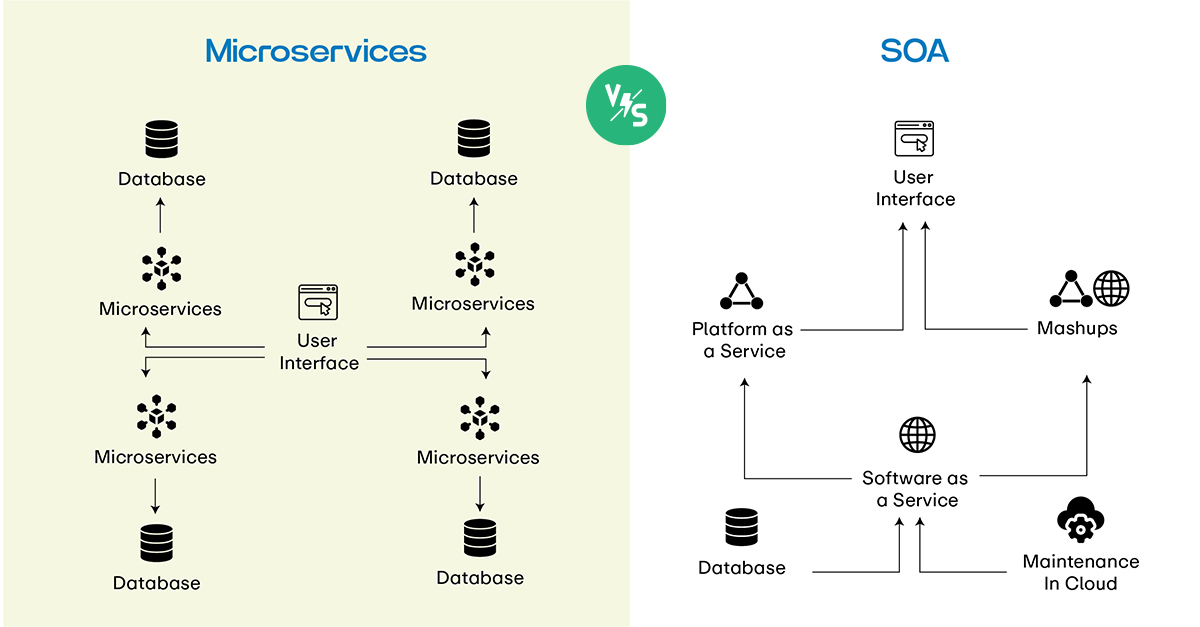
Generic microservices for trading platforms are failing because “chatty” communication creates unacceptable latency. The overhead of serializing data across too many tiny services undermines the performance gains needed in modern high-frequency environments.
Service Chatting Overload
Excessive inter-service communication floods the network. Trading platform microservices must avoid constant JSON serialization and HTTP overhead that clogs bandwidth and delays critical market data processing.
- Reduce JSON serialization overhead.
- Minimize inter-service network noise.
Network Hop Reduction
Every network hop adds latency. In distributed systems, we reduce hops by collocating related logic, ensuring data travels the shortest physical path to the matching engine.
- Collocate logic to reduce latency.
- Shorten physical data travel paths.
Function Consolidation
Strategic custom trading platform development now favors “macroservices.” We consolidate tightly coupled functions into single deployment units to eliminate the network cost of splitting them apart.
- Merge coupled functions.
- Eliminate internal network costs.
Latency Path Simplification
Modern trading software architecture patterns simplify the execution path. We remove unnecessary proxies and gateways, creating a direct, deterministic line from market signal to trade execution.
- Remove unnecessary proxy layers.
- Ensure direct execution pathways.
How Does an Agentic Mesh Enable Autonomous, Self-Healing Systems?
An agentic AI architecture for finance enables components to act autonomously. Instead of waiting for a central brain, agents discover peers and self-heal, maintaining uptime without manual intervention during partial system failures.
| Feature | Microservices (The 2024 Standard) | Agentic Mesh (The 2026 Requirement) |
|---|---|---|
| Coordination | Orchestrated: A central “brain,” or API Gateway, directs traffic. | Choreographed: Autonomous agents negotiate peer-to-peer (P2P). |
| Communication | Request/Response: Synchronous HTTP/REST calls (high latency). | Fire-and-Forget: Asynchronous event streams & gossip protocols. |
| Failure Mode | Fragile: If the orchestrator fails, the flow stops. | Anti-Fragile: Agents self-heal via Leader Election (Raft). |
| State Management | Database-Centric: CRUD updates to a central SQL/NoSQL DB. | Event-Sourced: Immutable logs appended to distributed ledgers. |
| Latency Cost | High: Multiple network hops and serialization penalties. | Low: Shared memory or optimized binary streams. |
Decentralized Discovery (Gossip Protocols)
Agents use gossip protocols for discovery. In a space-based architecture (SBA), nodes constantly share state updates, allowing the system to map itself dynamically without a central registry.
- Nodes share state updates dynamically.
- Map system without a central registry.
Negotiation Protocols (Contract Net)
Agents negotiate tasks using Contract Net. Stock trading app system design benefits as idle nodes bid for processing tasks, ensuring optimal load balancing without a central bottleneck.
- Idle nodes bid for tasks.
- Balance the load without central bottlenecks.
Conflict Resolution (CRDTs)
CRDTs handle data conflicts automatically. Backend architecture for trading uses these data structures to merge updates from different nodes, ensuring mathematical consistency without locking the database.
- Merge updates without database locks.
- Ensure mathematical data consistency.
Leader Election (Raft Consensus)
Raft Consensus manages leadership. The technical architecture of a trading platform relies on this to instantly elect new leaders if a primary node fails, guaranteeing continuous order processing.
- Elect new leaders instantly.
- Guarantee continuous order processing.
Why Is Event-Sourcing Becoming the Immutable Ledger for 2026?
Event sourcing provides a perfect audit trail. By storing every state change as an immutable event, we can replay market conditions exactly to debug crashes or verify compliance, creating a tamper-proof financial ledger.
- Store state changes as events.
- Replay events to verify compliance.
Why Is Centralized Orchestration Being Replaced by Agent-to-Agent Negotiation?
Rigid orchestration is too slow. The trading platform system design is shifting toward agent negotiation, in which innovative components respond to local data immediately rather than waiting for commands from a distant central server.
Local Autonomy Models
Agents possess local autonomy. Your trading software tech stack should empower nodes to make execution decisions based on local data, removing the latency of asking permission.
- Make decisions on local data.
- Remove the latency of central requests.
Decentralized Intent Propagation
Intent propagates via events. In event-driven architecture, a trade intent is broadcast once, and relevant agents react immediately, decoupling the sender from the specific execution logic.
- Broadcast trade intent once.
- Decouple sender from execution logic.
Context-Aware Decision Making
Decisions are context-aware. Algorithmic strategies embedded in agents adapt execution behavior based on real-time volatility and liquidity data present at that specific network node.
- Adapt behavior to real-time volatility.
- Use local node liquidity data.
Failure Isolation Domains
Domains isolate failures. Fault tolerance is ensured; once a given agent fails, the negotiation protocol is used to reroute traffic to a healthy peer, thereby avoiding a snowballing effect.
- Route traffic to healthy peers.
- Prevent cascading system crashes.
Data & Messaging Architecture: From Feed Handlers to Kappa Streams
Data architecture is pivoting from monolithic feed handlers to decentralized market data architecture. We process normalized streams using Kappa pipelines, ensuring raw exchange data is available for both real-time execution and historical replay without duplication.
How Do Data Feed Handlers Decode FIX/FAST/SBE/ITCH?
Handlers normalize diverse inputs into a uniform real-time market data feed. We parse ASCII strings or decode binary offsets instantly to minimize the “wire-to-read” latency gap before pricing logic triggers.
FIX Feed Structure and Tag Interpretation
The fix protocol uses a Tag=Value format. We use zero-allocation parsers to scan tags without creating garbage, mapping standard IDs to internal fields for rapid order routing.
- Scan tags without creating garbage.
- Map standard IDs to fields.
FAST Compression and Template Processing
The fix protocol for trading systems uses FAST compression. We interpret delta-encoded integers via templates to significantly reduce bandwidth on high-volume links.
- Interpret delta-encoded integers via templates.
- Reduce bandwidth on high-volume links.
SBE Message Layout and Binary Encoding
Binary protocols (ITCH/OUCH) enforce fixed offsets. This allows direct memory access without parsing, offering the fastest deserialization path for latency-sensitive trading.
- Direct memory access without parsing.
- Fastest path for latency strategies.
ITCH Event Streams and Order Book Updates
The market data pipeline ingests ITCH streams. “Add Order” messages update the book state immediately, ensuring our internal view matches the exchange exactly.
- Update the book state immediately.
- Match the exchange view exactly.
How Do You Build and Maintain Multi-Level Order Books?
Quote consolidation merges fragmented liquidity. We maintain separate books for every venue, then synthesize a composite “Top of Book” (BBO) to determine the actual global price and available volume.
Price-Level Aggregation
The order management system needs aggregated levels. We group orders by price in O(1) time, presenting a unified view of liquidity at every tick.
- Group orders by price O(1).
- Present a unified liquidity view.
Depth Management
We store depth in a low-latency in-memory data grid (IMDG). Trading engines query the complete book state concurrently without locking the primary ingestion thread.
- Query the book state concurrently.
- No locking ingestion thread.
Liquidity Tiers
The trading app architecture components visualize liquidity tiers. We separate orders by size, allowing traders to see hidden liquidity walls that influence short-term price direction.
- Separate orders by size.
- Reveal hidden liquidity walls.
Snapshot Diff Strategy
We use time-series databases (KDB+) to store snapshots. Instead of saving every tick, we save periodic full books and apply deltas to reconstruct historical states for analysis.
- Save periodic full book snapshots.
- Apply deltas for reconstruction.
When Should You Use Protobuf/gRPC Instead of JSON for Internal Comms?
Use protocol buffers (gRPC). Protobuf is binary and typed, unlike JSON, and when a message is small (recently, data messages have been 10x smaller than in practice), it is 5x smaller. When the message is large (as is often the case with data messages), it is 10x smaller, which is critical for high-throughput inter-service communication.
- Binary format reduces message size.
- Typed schema speeds parsing.
| Protocol | Type | Parsing Speed | Message Size | Best Use Case |
|---|---|---|---|---|
| JSON | Text (Human Readable) | Slow (~5,000 ns) | Large (Verbose) | External Public APIs, Web Dashboards. |
| Protobuf (gRPC) | Binary (Schema-based) | Fast (~200 ns) | Small (Compressed) | Internal Service-to-Service communication. |
| FIX | Text (Tag=Value) | Medium (~2,000 ns) | Medium | Legacy Inter-Bank routing & Client Connectivity. |
| SBE/ITCH | Binary (Raw Bytes) | Instant (~20 ns) | Tiny (Minimal) | The “Hot Path” (Market Data & Matching Engine). |
Why Is Kappa the Future of Stream-Based Trading Pipelines?
Kappa architecture vs. lambda simplifies pipelines. Kappa treats all data as a stream, using a single log (like Kafka) for both real-time processing and historical replay, eliminating code duplication.
Real-Time Stream Ingestion
The WebSocket API handles real-time ingestion. We push normalized updates to clients and algos simultaneously, ensuring all users see the same price action.
- Push updates to clients simultaneously.
- Ensure consistent price action.
Replay and Reprocessing Architecture
Our backtesting engine architecture relies on replay. We rewind the stream log to feed the exact sequence of market events into the strategy for validation.
- Rewind the stream log for replay.
- Feed the exact market event sequence.
Handling Out-of-Order Events
Backtesting requires handling out-of-order events. We use event-time timestamps rather than processing-time to ensure that late-arriving data does not corrupt the historical simulation of trading performance.
- Use event-time timestamps.
- Prevent corruption of simulation.
Unified Pipeline for Hot and Historical Data
The rest API provides historical access. External tools query the same view that the stream populates, accessing both hot and cold data through a single interface.
- Query the unified materialized view.
- Access hot and cold data.
How Does “Data Mesh” Enable Domain-Level Data Ownership?
Data mesh for trading firms decentralizes ownership. Domains like “Equities” or “FX” own their data pipelines, exposing clean products to the organization rather than dumping raw logs into a lake.
Defining Risk-as-a-Product
We treat risk management systems as a product. The risk team publishes exposure streams, allowing desks to consume pre-computed Greeks without recalculating from raw data.
- Publish calculated exposure streams.
- Consume pre-computed Greeks.
Federated Computational Governance
The best database for trading platform governance is a federated one. We enforce schema standards globally while allowing individual trading desks to choose their optimal storage engines.
- Enforce schema standards globally.
- Allow optimal storage choice.
Self-Serve Data Infrastructure
Developers provision their own topics and storage using Terraform modules, removing the bottleneck of waiting for a central DBA team to approve resource requests.
- Provision topics via Terraform.
- Remove central DBA bottlenecks.
Polyglot Output Ports
The API gateway manages polyglot output. It translates streams into REST or gRPC, allowing diverse consumers to access the same domain data in their native language.
- Translate streams to REST/gRPC.
- Allow diverse consumer access.
Trading Engine & Order Management System Architecture
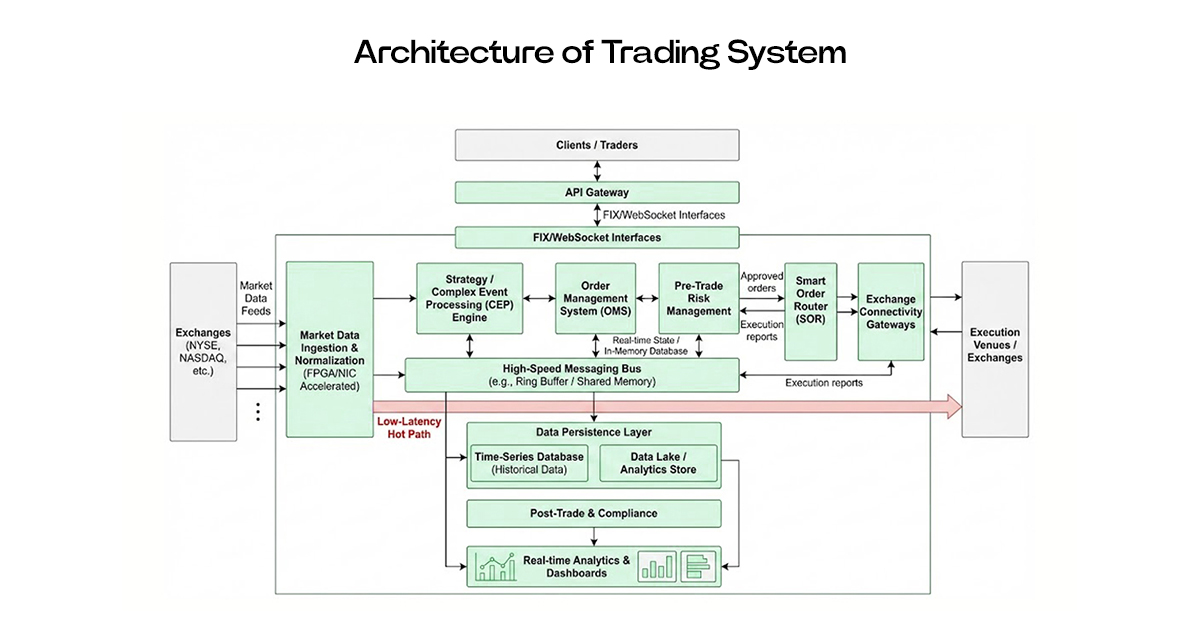
A trading engine architecture coordinates market data ingestion, decision logic, and execution under strict latency constraints. The order management system tracks state transitions, validates orders, and ensures consistency across venues during high-throughput trading conditions.
In modern trading order management system architecture, OMS components are kept off the execution hot path. They operate asynchronously, maintaining order state, risk checks, and lifecycle events without blocking deterministic trade execution.
This separation allows trading engines to remain single-purpose and fast, while OMS layers provide resilience, auditability, and recovery. Together, they form the operational backbone of scalable, low-latency financial trading platforms.
Execution & Routing: Architecting the “Hot Path.”
The “Hot Path” is the critical nanosecond loop where trades execute. Modern trading order management system architecture separates this path from slower components, stripping away locking mechanisms, garbage collection, and OS jitter to achieve pure, deterministic speed.
What Are the Leading Matching Engine Models (Single-Thread vs. Partitioned)?
The core order matching engine drives performance. We must choose between the simplicity of single-threaded sequential models or the scalability of partitioned models to handle the immense throughput required by 2026 volatility levels.
Single-Thread Sequential Processing
We implement the disruptor pattern to process events sequentially. By pinning the engine to a single CPU core, we eliminate context switching and lock contention, guaranteeing deterministic execution order.
- Pin the engine to a single CPU core.
- Eliminate locks and context switching.
Symbol-Based Partitioning
We divide the memory to achieve high throughput. We slice the order book by symbol (e.g., AAPL vs. TSLA) and run them in separate cores, allowing them to run in parallel without racing over the global data.
- Shard order books across CPU cores.
- Parallelize processing without data races.
Venue-Based Routing Segmentation
The execution management system segments traffic by venue. Dedicated threads handle routing logic for specific exchanges (e.g., NYSE vs. NASDAQ), preventing slow responses from one venue from blocking orders destined for another.
- Isolate threads for specific exchange venues.
- Prevent slow venues from blocking global traffic.
Memory-Resident Order Books
Low-latency trading systems keep data resident. We store the entire order book in CPU cache or RAM, avoiding disk I/O entirely to ensure every match occurs at memory-access speeds.
- Store the whole order book in RAM.
- Avoid disk I/O for matching.
Why Does CQRS Improve Execution Determinism?
Command-query responsibility segregation (CQRS) separates write and read paths and assigns responsibilities to each. The high-speed command logic (where trades are placed) and the query logic (where history is viewed) are separated to prevent slow reporting queries from delaying trade execution.
- Separate trade execution from data queries.
- Prevent reporting from blocking critical trades.
How Does Smart Order Routing (SOR) Optimize Market Execution?
Smart order routing logic dynamically fragments orders. The SOR analyzes liquidity across fragmented venues in real-time, splitting large parents into child orders to capture the best price while minimizing market impact and signaling risk.
- Split parent orders to minimize impact.
- Capture the best price across fragmented venues.
How Does the “Sidecar” Pattern Enable Non-Blocking Compliance?
We use sidecars for regulatory compliance. Instead of placing slow compliance checks directly in the hot path, a sidecar process handles logging and monitoring asynchronously, ensuring that essential oversight does not add latency to the trade.
Zero-Blocking Asynchronous I/O
The low-latency trading architecture requires non-blocking I/O. The sidecar fetches execution reports over the wire and writes them asynchronously to disk, so the principal thread of the trading process does not have to wait while the file system writes them. Capture execution reports off the wire.
- Write to disk without blocking the thread.
Policy Enforcement Points (PEP)
Sidecars act as PEPs for pre-trade risk checks. They enforce risk limits (e.g., max order value) in parallel with the routing logic, rejecting violations instantly without a centralized, slow risk server.
- Enforce risk limits in parallel processes.
- Reject violations without central server calls.
Traffic Mirroring for Surveillance
Microservices architecture for trading uses traffic mirroring. We copy inbound and outbound packets to a surveillance sidecar, enabling compliance teams to analyze market abuse patterns in real time without touching the live trade flow.
- Copy packets to the surveillance sidecar.
- Analyze abuse without impacting trade flow.
Sidecar-to-Sidecar mTLS
We use immutable infrastructure with sidecar security. All internal traffic between sidecars is encrypted via mTLS, offloading the heavy cryptographic handshake from the trading application logic to the infrastructure layer.
- Encrypt internal traffic via sidecar mTLS.
- Offload crypto work from app logic.
How Does Autonomous Queue Management Reduce Contention?
Independent queues are actively controlled via backpressure. This queue tells producers upstream to slow down (backpressure) rather than blocking, eliminating buffer bloat and limiting the extra CPU contention that causes random fatalities during latency spikes.
- Signal back pressure to retard upstream producers.
- Prevent buffer bloat and CPU spikes.
Designing Low-Latency Trading System Architecture: The Physics of Speed
Infrastructure physics defines speed. A robust high-frequency trading architecture ignores standard networking rules, bypassing the kernel and processing packets directly on hardware to shave microseconds and eliminate the nondeterministic jitter that destroys arbitrage strategies.
Why Are Co-Location and DMA Essential for Sub-Millisecond Execution?
High-frequency trading relies on physics. By placing servers in the exchange data center and using Direct Market Access (DMA), we eliminate the physical travel time of light through fiber, achieving the lowest possible wire latency.
- Minimize physical distance to exchange.
- Bypass broker infrastructure altogether.
How Do Hot-Path vs. Cold-Path Topologies Improve Determinism?
Algorithmic trading architecture splits topology. We isolate the “Hot Path” (execution) on overclocked, pinned cores while relegating the “Cold Path” (logging, compliance) to separate resources, preventing background tasks from interrupting critical trading threads.
- Isolate execution on pinned cores.
- Offload logging to separate resources.
How Do Kernel-Bypass Techniques (DPDK, RDMA) Reduce Jitter?
The existence of a kernel bypass is compulsory for speed. It gives the application access to the raw data from the Network Interface Card (NIC), bypassing the slow, interrupt-intensive Linux kernel networking stack, which introduces random, unexpected latency spikes.
| Technology | Latency Profile | CPU Overhead | Implementation Complexity | Primary Use Case |
|---|---|---|---|---|
| Standard Socket | 10 – 50 µs (Microseconds) | High (Context Switching) | Low (Standard OS) | Web Servers, Reporting, UI Backends. |
| DPDK (Kernel Bypass) | 2 – 5 µs | Medium (Polled Mode) | High (Custom Drivers) | Order Gateways, Risk Checks. |
| RDMA (Zero Copy) | < 1 µs | Low (CPU Bypass) | Very High (Hardware Dependency) | Server-to-Server State Replication. |
| FPGA (Hardware) | < 800 ns (Nanoseconds) | Zero (Offloaded) | Extreme (Verilog/VHDL) | Market Data Decoding, Pre-Trade Risk. |
DPDK User-Space Packet Processing
As core components of a low-latency trading system, DPDK libraries poll the NIC continuously in user space. This polling eliminates the expensive context switching of interrupt-driven processing, keeping CPU caches hot.
- Poll NIC continuously in the user space.
- Eliminate expensive CPU context switches.
RDMA Zero Copy Transfer
RDMA enables nanosecond latency transfers. It allows memory-to-memory data movement between servers without involving the CPU, freeing up processor cycles for complex trading logic while data moves instantly.
- Move memory without CPU involvement.
- Free CPU for trading logic.
VMA Kernel Acceleration Layer
VMA accelerates tick-to-trade times. It acts as a transparent library that intercepts socket calls and offloads them to user-space hardware drivers, accelerating legacy applications without requiring a complete code rewrite.
- Intercept socket calls transparently.
- Accelerate apps without rewriting code.
NIC Offload Capabilities
Learning how to handle millions of trades per second requires hardware help. Modern NICs filter packets and calculate checksums on-card, ensuring the CPU only processes relevant market data, not noise.
- Filter packets directly on hardware.
- The CPU processes only relevant data.
How Do FPGAs and SmartNICs Accelerate the Trading Hot Path?
FPGA trading architecture embeds logic in silicon. By programming trading algorithms directly onto the chip, we process market data and trigger orders in hardware, achieving consistent, deterministic performance that software can never match.
Hardware-Level Packet Filtering
FPGAs ensure low-latency filtering. They discard irrelevant multicast packets at the gate level before they ever reach the PCIe bus, ensuring the host server never wastes cycles on unwanted symbols.
- Discard irrelevant packets at the gate.
- Save host server CPU cycles.
On-Chip Pre-Trade Risk Checks
FPGAs perform checks in nanoseconds. We implement hard limits on-chip, allowing orders to pass compliance validation instantly without the round-trip latency penalty of a software-based risk server.
- Implement hard limits on-chip.
- Validate compliance without a latency penalty.
TCP/IP Offload Engine (TOE)
Even a hybrid cloud trading architecture benefits from TOE. The TCP Offload Engine manages the complex TCP state machine on the hardware, ensuring reliable connection handling without burdening the application processor.
- Manage TCP state on hardware.
- Relieve the application processor’s burden.
Direct Market Data Decoding
We use direct decoding. The FPGA parses raw exchange protocols (such as ITCH) into normalized internal formats immediately upon arrival, providing ready-to-use data structures to the trading strategy.
- Parse raw protocols on arrival.
- Present ready data to the strategy.
Why Is Edge-Native Compute Becoming the Execution Standard?
Edge-native trading systems move compute to the source. Instead of backhauling data to a central cloud, we deploy lightweight execution containers directly into exchange colocation facilities, minimizing the physical distance to the matching engine.
- Deploy containers in colocation facilities.
- Minimize distance to the matching engine.
How Does PTP Time Sync Enable Sub-Microsecond Accuracy?
The new standard is the Precision Time Protocol (PTP). It coordinates the clocks throughout the distributed system to sub-microsecond precision using hardware timestamps, enabling event correlation and one-way latency calculation.
- Sync clocks to sub-microsecond accuracy.
- Calculate precise one-way latency.
Scalability & Reliability: Designing for Horizontal Scale
Scalability is the defining test of custom fintech software development. We design systems that scale horizontally, adding nodes to handle volatility spikes without re-architecting, ensuring reliability remains absolute even as market data throughput increases by orders of magnitude.
How Does Horizontal Scaling Work for Trading Workloads?
Cloud-native trading systems scale horizontally to absorb shocks. We dynamically provision stateless execution nodes based on real-time queue depth, ensuring the platform handles massive volatility bursts without ever degrading processing latency.
- Scale execution nodes based on load.
- Process bursts without latency degradation.
What Are Modern Models of Failover (Active-Active vs. Passive)?
When the dilemma is about cloud vs. on-premises trading platforms, we reject passive models. We use active-active replication, where geographically separated clusters process identical feeds simultaneously to ensure zero recovery time (RTO=0).
- Process identical feeds in parallel.
- Guarantee zero recovery time (RTO).
How Do High-Throughput Logging & Observability Support Compliance?
High-throughput logging enables precise reconstruction. We use asynchronous ring buffers to capture every state change on NVMe drives, ensuring strict regulatory compliance without ever blocking critical hot-path execution threads.
- Write logs asynchronously without blocking.
- Meet strict regulatory compliance needs.
How Will Predictive & Self-Healing Systems Define 2026 Reliability?
The reliability depended on self-healing in 2026. Predictive AI checks telemetry for pre-failure signals, e.g., jitter, automatically draining and recycling degrading nodes in advance of failures, recharacterizing maintenance as proactive.
- Identify issues before system failure.
- Recycle failing nodes without downtime.
How Do Distributed Nodes Maintain Global Consistency?
The global consistency of the modern fintech software architecture is guaranteed. Distributed consensus algorithms such as Raft ensure that all nodes can follow the sequence of states even in the face of split-brain failures in geographically distributed systems.
- Sync state using Raft consensus.
- Eliminate split-brain across regions.
Security & Future-Proofing: Rust, Zero Trust, and Quantum
The future of the Rust trading system design is secure by default. We are replacing memory-unsafe C++ with Rust’s ownership model and implementing Zero-Trust architectures to protect against internal threats, ensuring that 2026 systems remain resilient against next-generation cyberattacks.
Why Is Zero-Trust Becoming Mandatory in Trading Environments?
A zero-trust security architecture assumes breach. We verify every request explicitly, regardless of origin, eliminating the “soft center” of legacy networks where a single compromised perimeter firewall enabled attackers to move laterally unrestrictedly.
- Verify every request explicitly.
- Prevent unrestricted lateral movement.
How Does a Service Mesh Deliver Universal mTLS?
We use a service mesh (Istio/Linkerd) to abstract security. It injects sidecars that automatically encrypt all traffic, ensuring mutual authentication without requiring developers to write complex cryptographic logic into the application code.
Control Plane for Policy Management
Fintech software development services rely on control planes. This centralized layer distributes security policies to every proxy, ensuring that access rules are updated globally in seconds without redeploying any services.
- Distribute security policies globally.
- Update rules without redeploying.
Data Plane for Traffic Enforcement
Legacy microservices lacked enforcement. The data plane intercepts every packet, enforcing mutual TLS encryption and access policies at the wire level to ensure no unauthorized traffic ever reaches the application.
- Enforce mTLS at the wire level.
- Block unauthorized application traffic.
Certificate Rotation Workflow
Your trading platform’s technical architecture must rotate keys. The mesh handles short-lived certificate issuance and rotation automatically, significantly reducing the attack window compared to static keys that might be compromised for months.
- Rotate certificates automatically.
- Reduce credential attack windows.
Identity and Policy Propagation
Modern trading software architecture propagates identity. We pass user context and claims through the mesh headers, ensuring that every downstream service knows exactly who initiated the trade request and acts accordingly.
- Pass the user context in headers.
- Verify identity at every hop.
How Do You Architect for Post-Quantum Cryptography?
Post-quantum cryptography in fintech prepares for Q-Day. We are designing “crypto-agile” systems today that allow us to swap out current encryption algorithms for quantum-resistant lattice-based standards without rewriting the core platform.
- Swap algorithms without rewriting.
- Adopt lattice-based encryption standards.
How Does Dynamic Secrets Management Replace Static Credentials?
We eliminate hardcoded passwords. Applications authenticate to a vault at runtime to lease temporary, dynamic credentials that expire automatically, ensuring that leaked source code never exposes valid production database keys.
- Lease temporary credentials at runtime.
- Prevent exposure of static keys.
Why Is Rust Replacing C++ in Critical Trading Modules?
Memory safety is ensured through Rust. It eradicates different classes of bugs, such as buffer overflows and race conditions, even in its compiler code, which is oriented toward compile time, providing performance on par with C++ and mathematically proven stability.
- Eliminate buffer overflows at compile.
- Deliver C++ performance with safety.
| Feature | C++ (The Legacy King) | Rust (The 2026 Challenger) |
|---|---|---|
| Memory Safety | Manual: Prone to buffer overflows and leaks. | Guaranteed: The Compiler enforces safety at build time. |
| Performance | Native: The benchmark for raw speed. | Native: Matches C++ speed with zero garbage collection. |
| Concurrency | Complex: Data races are common and hard to debug. | Fearless: The “Ownership” model prevents data races by default. |
| Ecosystem | Mature: 30+ years of HFT libraries (STL, Boost). | Growing: Modern tooling (Cargo) but fewer legacy finance libs. |
| Verdict | Best for maintaining legacy HFT cores. | Best for building new, secure, crash-proof engines. |
Conclusion
The future of trading systems architecture in 2026 requires radical change from passive microservices to autonomous, agentic meshes. Companies that continue with centralized orchestration will suffer uncontrolled latency penalties, while edge-native implementations and Rust-based security will take market share with their high performance and deterministic reliability.
The development of these new-generation systems would involve expert engineering human capital that could traverse kernel-bypass engineering and concurring protocols for decentralization. In such a high-stakes, competitive environment, institutions need to hire fintech software developers with rich technical skills to design low-latency solutions. These self-healing systems will be the future of the financial industry.
Key Takeaways:
- Agentic meshes replace chatty microservices to minimize critical path latency.
- Edge-native compute deploys execution logic directly to exchange colocation centers.
- Active-active replication guarantees zero recovery time during critical system failures.
- Rust provides memory safety without sacrificing the speed of C++.
FAQs
This architecture does not use centralized microservices but instead relies on simple, autonomous agents that actively negotiate, reduce network hops and latency, and provide active-active resilience to market volatility.
Monoliths offer low latency but high risk and fragility. Microservices offer agility but introduce network latency. 2026 architectures blend them into “macroservices” for balance.
Start with a kernel-bypass execution core, build a reliable Kappa-based data pipeline, and wrap the platform in a zero-trust security mesh for scalable performance.
It allows firms to plug in “best-of-breed” components, such as specific execution engines or risk modules, without being locked into a single vendor’s ecosystem.
You build new “macroservices” around the edges of the legacy monolith, slowly routing traffic to the new system until the old core is decommissioned.

Bhavin Umaraniya
Bhavin Umaraniya is the CTO at Tuvoc Technologies, with 18+ years of experience in frontend and web software development. He leads tech strategy and engineering teams to build scalable and optimized solutions for start-ups and enterprises.

Have an Idea? Let’s Shape It!
Kickstart your tech journey with a personalized development guide tailored to your goals.
Discover Your Tech Path →Share with your community!
Latest Articles

Future of Real-Time Bidding: Privacy, AI & Cookieless Programmatic
Key Takeaways: The traditional latency-based ad structure has given way to client-side control and on-device logic execution. Identity resolution models…
Inside the RTB Ecosystem | SSPs, DSPs, Ad Exchanges & Data Flows
Key Takeaways Core Mechanics: We define the exact hardware and software routing the money across networks. Supply Origins: You will…
How to Build a Custom RTB Platform | Architecture, Cost & Timeline
Key Takeaways Scale Requirement: You need massive monthly ad spend to justify the fixed engineering costs of building. Control Factor:…