DSP Optimization Strategies to Maximize Campaign ROI

Manoj Donga
AdTech
Published : Feb 5, 2026
Key Takeaways
- Moving Targets: Optimization isn’t about finding a static “winning” bid; it’s about adjusting to a market that shifts every hour.
- Math vs. Strategy: You provide the intent, but the machine executes the high-dimensional math that no human trader could realistically track.
- Signal Quality: Performance lives and dies by the fidelity of your ad performance analytics and how fast they feed back into the bidder.
- Smarter Scaling: Modern demand side platform companies are built to automate the “grunt work” of inventory selection so you can focus on the big picture.
What DSP Optimization Means in a Programmatic Buying Context
In a DSP environment, your DSP optimization strategies have to account for thousands of variables, all operating within the real-time decision constraints of a programmatic buying system, such as weather, device latency, and even the tilt of a phone, all within the time it takes a browser to blink.
Demand side platform companies have basically turned media buying into a data science problem where the goal is surgical impression valuation. optimization is really about narrowing the gap between a raw bid request and a profitable outcome through a relentless, sub-millisecond feedback loop. It’s less about “tuning” and more about engineering a decision-making engine that knows when to walk away from an auction.
Take a look at how this logic actually looks when translated into a basic Python decision gate for a bidder:
Python
# Bid Optimization Decision Logic
def calculate_bid_value(prob_of_click, target_cpa, cpm_cap):
# What is this impression actually worth to us?
raw_value = (prob_of_click * target_cpa) * 1000
# We never want to pay the full value; we want the clearing price.
shaded_bid = raw_value * 0.85
return min(shaded_bid, cpm_cap)
# Resulting bid based on a 1.2% pCTR and a $10 CPA target
bid = calculate_bid_value(0.012, 10.00, 15.0)
print(f”Calculated Bid: ${bid}”)
Optimization as Continuous Adjustment, Not One-Time Setup
Too many traders treat programmatic media buying optimization like a slow cooker: set it and forget it. That’s a mistake. Because auction density and competitor floor prices are essentially a moving target, your setup starts decaying the moment you hit “launch.”
You have to move toward a state where the system is learning from every lost bid. It’s about high-velocity loops. If you aren’t adjusting for hourly shifts in win rates, you’re probably overpaying for traffic that doesn’t convert.
- Fluid Pacing: Changing spend speed based on when your specific audience is actually active.
- Bid Shading Tweaks: Constantly hunting for the lowest price that still secures the win.
How DSP Optimization Differs from Manual Campaign Tuning
The real divide in automated vs. manual DSP optimization comes down to the sheer volume of data points involved – one of the key considerations when choosing the right DSP for an advertising business. Manual tuning is what we used to do, adjusting a few site lists or blacklists once a week.
Automation is different; it’s calculating the value of a single user in a single zip code on a specific app version, which is just… impossible for a human brain to do at scale. Traders still provide the “why,” but the machine handles the “how” with a level of granular math that would break a spreadsheet.
- Dimensionality: Machines can weigh 500+ signals per bid; humans can barely juggle five.
- Cold Logic: Algorithms are not meant for the benefits of publishers. Their job is to execute the trade.
Automated vs. Manual Optimization
| Optimization Type | Best For… | Key Performance Lever | Human Role |
|---|---|---|---|
| Automated (AI) | High-volume traffic, sub-millisecond bidding | Bid shading, pCTR calculation | Setting the guardrails |
| Manual | Niche audiences, new product launches | Blacklists, supply path filtering | Strategic pivot & intent |
Budget Pacing Strategies Across Campaign Lifecycles
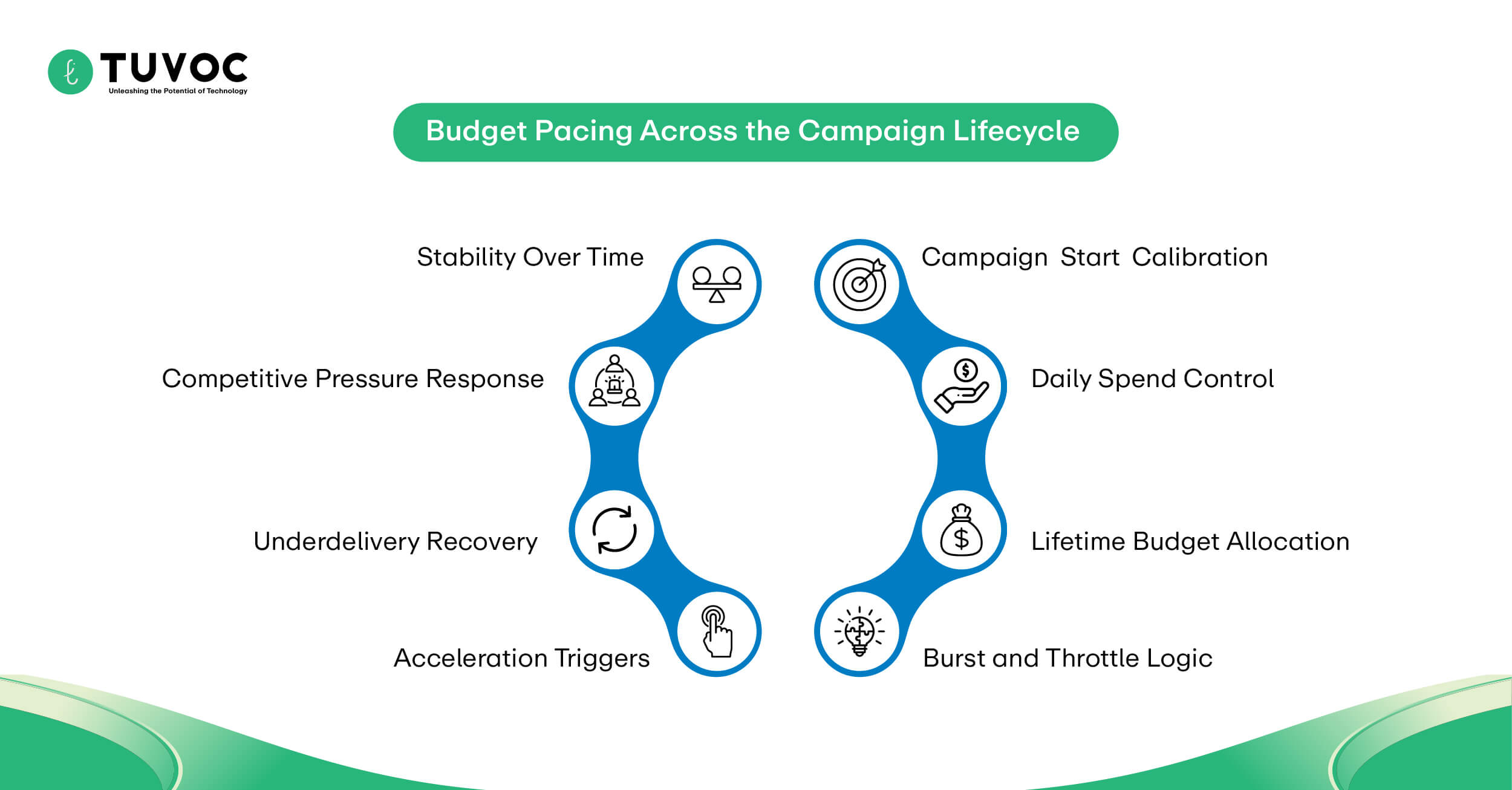
Pacing isn’t just about spending the cash. It’s really about controlling velocity so you don’t blow the whole budget by lunch or, even worse, miss the late-night crowd because your bidder went to sleep early. Most traders get obsessed with the total dollar amount, but the real magic in DSP optimization strategies is how that money actually flows across the flight.
If you spend too fast at the start, you are basically paying a “speed premium” for traffic that might not even be that good. Then there’s the other side: being too timid and ending up with massive under-delivery. Nobody wants to be scrambling to spend 40% of their budget in the final six hours.
Pacing Strategies: Daily vs. Lifetime
| Pacing Model | Spend Velocity | Performance Impact | Risk Level |
|---|---|---|---|
| Daily Cap | Constant/Even | Misses late-night high-intent peaks | Low (Safe) |
| Lifetime | Fluid/Aggressive | Prioritizes ROI over the clock | Medium (Vanish risk) |
| ASAP | Maximum | Often hits “bottom-of-barrel” inventory | High (Margin killer) |
Daily vs Lifetime Budget Pacing Models
The difference between daily and lifetime pacing usually boils down to how much you trust the machine. A daily budget is a hard ceiling. It forces the system to spread spend across 24 hours even if the “best” users aren’t actually online at 4 AM. It feels safe, but it’s often a bit of a drag on performance.
Lifetime models are different. They let the bidder go heavy on a Tuesday if the conversion signals are actually there, then pull back on a quiet Wednesday. It’s better for ROI, but it takes some serious nerve to see a huge chunk of your budget vanish in the first two days of a two-week flight.
- Hard Guardrails: Daily caps are there to stop accidental overspend when traffic spikes for no reason.
- Fluid Scaling: Lifetime models just let the math do the talking instead of watching the clock.
Handling Spend Acceleration and Underdelivery Scenarios
If you’re looking at a dashboard and realize you’ve only spent 5% of the budget but the campaign is half over, you’ve got to figure out how to fix DSP underdelivery issues without just buying garbage. Usually, the problem is that you’ve throttled the bidder too much.
Too many niche filters, bids that are way too low, or some massive blacklist that’s effectively killed your reach. And the “ASAP” button is a trap. All it does is tell the DSP to buy the bottom-of-the-barrel stuff that every other bidder already said “no” to.
- Opening the Gates: Sometimes, just killing a few restrictive frequency caps is enough to jumpstart things.
- Floor Checks: You might just need to hike your base bid to actually win a seat at the table in those high-density auctions.
Pacing Trade-offs During High-Competition Periods
When Black Friday or the end of the quarter hits, it’s a total bid storm. Knowing how to prevent programmatic overspending in those windows is basically a survival skill.
Everything gets more expensive, and your pacing logic has to be smart enough to see that a $20 CPM today is probably a waste if you can get the same user for $6 next week. It’s a balance. You want to be there for the peak, but not if it kills your overall profitability.
- Selective Math: Tightening up so you only bid on the absolute highest-confidence users when prices are peaking.
- Smart Throttling: Using pacing controls to back off during the most expensive hours of a holiday weekend.
Temporal Variability and Its Impact on Pacing Stability
The internet is “lumpy.” People don’t browse in a straight line, and algorithmic pacing has to deal with the fact that a rainy Tuesday morning looks nothing like a sunny Saturday afternoon.
If the pacing engine doesn’t get this variability, it’s going to constantly over-correct and mess up your delivery. When inventory drops off, the bidder shouldn’t panic and start hiking bids to compensate. It should just wait for the cycle to reset.
- Dayparting: Matching your spend to the actual hours your people are likely to buy.
- Feedback Loops: High-frequency tweaks to make sure the bidder doesn’t get stuck in a “death spiral” of losing every auction.
Bid Adjustment Techniques Used to Improve Win Efficiency
Winning an auction is easy if you have a bottomless pit of cash, but doing it efficiently—that’s where most people trip up. Bid adjustment isn’t about just hitting the “buy” button; it’s about the art of the shave. You are trying to find that razor-thin margin where you win the impression but pay exactly one cent more than the guy behind you.
Modern bid shading algorithms have basically automated this second-guessing. Instead of you manually guessing what a site is worth, the system looks at historical clearing prices and pulls your bid back just enough to save the margin. It’s a game of chicken played at a million miles an hour.
Leveraging Bid Shading as a Budget-Stretching Tactic
The whole AI-driven bid shading vs. manual floor pricing for ROI debate is kind of a relic of the past, honestly. Manual floors are rigid; they don’t care if the user on the other end is a high-value whale or a bot. Shading is smarter.
It looks at the auction landscape in real-time and says, “Hey, we can probably win this for $3.50 even though our max is $5.00.” It stretches your budget by finding those “discounts” across thousands of auctions. If you aren’t using it, you’re effectively donating your margin to the SSP.
- Margin Protection: Automatically reducing bids to the predicted clearing price to avoid overpaying.
- Dynamic Response: Shifting bid levels based on the current competitiveness of specific inventory pockets.
Bid Multipliers and Their Effect on Auction Density
Understanding how to use bid multipliers effectively is like having a finger on the volume button. You can increase and decrease volume at your discretion. When a certain zip code or device or wi-fi appears, you ask DSP to identify those signals and push ads a little more aggressively. Basically, the strategy remains the same; intensity increases.
But be careful. If you stack too many multipliers, you end up with a bid that’s artificially high, pushing you into auction densities where you’re competing against enterprise spenders with way more leverage.
- Stacking Signals: You can juice the bid for high-performers without actually hiking the base floor for every other impression in the flight.
- Negative Adjustments: Honestly, just use negative multipliers to back out of the overpriced, low-conv stuff that’s eating your margin.
Managing Win-Rate Decay Without Overbidding
When you start asking, “Why is my DSP win rate dropping?” The first instinct is usually to just hike the bid. Don’t do that. Usually, a dropping win rate is a sign of “win-rate decay,” where the auction environment has shifted, maybe a new big spender entered the room or the publisher changed their floors.
You need to diagnose whether you’re losing because you are too cheap or because the inventory you’re chasing has become a crowded house. Sometimes the answer is to find a different supply path rather than just throwing more money at the same wall.
- Win-Rate Audits: Checking if the decay is across the board or just on specific high-value domains.
- Supply Path Pivoting: Moving spend toward less contested exchanges to maintain reach without the price hike.
Balancing Automated Optimization with Manual Control
There’s this constant friction between trusting the machine and wanting to grab the steering wheel yourself. DSP optimization strategies have evolved to the point where AI-driven ad bidding can process more signals in a second than a human could in a year, but that doesn’t mean you just walk away. You are there to set the intent, while the bidder handles the high-frequency execution – an important distinction for teams evaluating how to build a custom DSP platform.
If you micro-manage every bid adjustment, you are basically breaking the machine’s ability to learn. On the flip side, leaving it on total autopilot without checking the headers is a great way to watch your budget disappear into a black hole of “technically correct” but useless traffic. It’s a messy partnership.
When DSP Algorithms Should Be Left to Self-Optimize
Most of the time, AI-driven DSP optimization works best when it has room to breathe. If you have a high-volume campaign with plenty of conversion data, the bidder is actually pretty good at finding those weird, non-obvious patterns in the noise.
It might find that users on a specific browser version in a specific suburb convert at 3X the rate. Trying to “fix” that manually usually just introduces human bias. You have to let the probability models run their course before you decide the machine is “wrong.”
- Data Density: Algorithms need a steady stream of wins and losses to actually build a reliable predictive model.
- Complex Signal Matching: Machines are better at seeing the connection between obscure variables like device battery life and purchase intent.
Scenarios Where Manual Intervention Becomes Necessary
Even the smartest agentic bidding system can’t account for real-world chaos like a sudden PR crisis or a competitor’s flash sale that isn’t in the data yet. If you see a major external shift, you have to step in. The algorithm only knows what’s happened in the past; it doesn’t know that your brand just got a massive shoutout on a late-night show.
You intervene to pivot the strategy, not to win a single auction. Sometimes you just have to pull the plug or pivot the targeting before the machine catches on.
- Black Swan Events: Machines fail when reality breaks away from historical patterns too quickly.
- Contextual Shifts: Humans are still better at recognizing when a “safe” site suddenly becomes a toxic environment for a specific ad.
The Hidden Cost of Overriding Automated Optimization Loops
Every time you manually override a bid, you’re essentially resetting the machine’s learning curve. It’s particularly tricky when you’re trying to figure out how to optimize DSP ads for AI purchase agents or other emerging tech.
If you keep changing the rules, the bidder can’t establish a baseline. The “hidden cost” is the loss of efficiency that happens when the algorithm gets confused by contradictory manual commands. You end up paying more for the same reach because the bidder has lost its confidence score.
- Baseline Reset: Manual tweaks often wipe out days of algorithmic training, forcing the DSP back into “exploration” mode.
- Decision Conflict: Overlapping manual rules and automated goals create a “bidding friction” that drives up your effective CPM.
Audience, Creative, and Inventory Optimization Levers
Look, optimization hits a wall fast if you are only staring at bid prices. You’ve got to account for where people are in that messy cross-device journey, because reaching someone on their phone while they’re distracted is a waste compared to hitting them on a desktop when they’re actually ready to buy. It’s about the person, the visual, and the environment all lining up at once.
Privacy is the big hurdle now, obviously. Data clean rooms are basically the only way to do this without getting into trouble, since they let you match signals without actually touching the scary PII stuff. It’s a cleaner way to see if your “top-tier” audience is actually just a bunch of people who already converted three days ago.
Audience Segment Performance and Diminishing Returns
Most data-driven targeting strategies fail because they ignore the saturation point. You find a niche that works, you dump more money in, and suddenly your CPA doubles because you are just harassing the same 50,000 people over and over.
The bidder is trying to force an impression on a user who’s already decided they don’t care. It’s about knowing when a segment is just “cooked.” If frequency goes up and your conversion rate stays flat, you are just burning cash.
- Segment Decay: You have to watch for that specific moment when a golden audience list starts producing nothing but junk.
- Lookalike Burnout: Just because an audience is “similar” doesn’t mean they have the same intent as your core buyers.
Creative Fatigue Indicators and When to Rotate Assets
You can have perfect targeting, but if a user sees the same banner twenty times, they stop seeing it entirely. Dynamic creative optimization helps, sure, but it’s not magic. When your CTR starts cratering but your win rate is still high, the market is telling you that your creativity has become background noise.
Rotating assets is about a mental reset. You need a fresh visual to snap someone out of their “banner blindness” before the whole campaign just stalls out.
- Engagement Drop-off: Finding that specific frequency cap where a user just tunes out the brand.
- Asset Refresh: Using automated tests to swap out headlines before the creative resonance hits zero.
Supply Path Optimization (SPO) as a Performance Lever
If you want to know how to reduce programmatic ad waste with supply path optimization, you have to look at the middleman. Every extra hop between the DSP and the publisher takes a cut of your budget.
SPO is just about cutting out the “noisy” paths that charge high fees for inventory you can get cheaper through a direct route. It’s a transparency play. You are auditing the supply chain to make sure your dollar is actually buying pixels, not just paying for someone’s server costs.
- Path Consolidation: Moving your spend through the most direct and cheap exchange routes you can find.
- Fee Transparency: Ghosting those SSPs that hide extra “tech taxes” in their auction logic.
Contextual Signals as a Constraint on Audience Optimization
Audience data is great, but contextual targeting intelligence is what keeps your luxury car ad off a page about “the worst car crashes of the year.” The environment matters. Even if the user ID matches your target perfectly, the context of the page can make the message feel completely wrong—or even toxic.
You’ve got to layer the “where” over the “who.” Sometimes the content of the page is so relevant that the audience data doesn’t even matter that much.
- Environment Check: Making sure the page content doesn’t fight the actual emotional tone of your ad.
- Privacy Reach: Using page-level signals to find people when their ID is blocked or just not there.
Frequency Capping and Exposure Control as Performance Constraints
Most people think frequency capping is just about not being annoying, but it’s actually one of the most powerful levers for impression valuation. If you keep bidding on the same user who has already seen your ad ten times today, you aren’t “building awareness” but just setting fire to your CPM. The value of that eleventh impression is basically zero, yet the DSP will keep buying it unless you tell it to stop.
It’s about protecting your margin. By tightening the reins on how often a single ID sees your creativity, you force the bidder to go out and find “fresh” eyes that actually have awareness; you are a constraint that actually drives performance by preventing the machine from taking the path of least resistance.
Frequency & Exposure Control
| Frequency Zone | Marginal Value | Cost Behavior |
|---|---|---|
| Early exposure | High | Stable |
| Mid-exposure | Declining | Rising |
| Late exposure | Minimal | Inefficient |
Frequency as a Cost-Control Mechanism, Not Just Reach Control
The real goal here is to reach efficiency. Every time you block an overexposed impression, you are freeing up cash to bid on a new user who hasn’t seen your message yet. If you don’t cap it, the bidder will naturally gravitate toward the “easiest” impressions.
He may lean towards hyperactive users who see everything but buy nothing. It’s a math problem. You want to maximize unique reach without overpaying for users who have already reached their mental saturation point.
- Incremental Reach: Shifting budget away from “heavy users” to find new prospects who are actually in-market.
- Diminishing Returns: Recognizing the specific frequency count where the cost of another view outweighs the potential for a sale.
Identifying Overexposure Patterns Across Channels
This is where first-party data activation gets interesting. If you can see that a user is engaging with your emails or browsing your site, you probably don’t need to hit them with fifteen banners a day on the open web. Overexposure usually happens when your channels aren’t talking to each other, and you end up bidding against yourself for the same person’s attention.
You have to look for those patterns where a user is seeing the ad across their phone, laptop, and TV simultaneously. It’s a waste of resources if the message isn’t evolving with them.
- Cross-Channel Suppression: Using your own data to stop bidding on people who are already deep in the purchase funnel.
- Device Mapping: Understanding that three impressions on a phone and two on a tablet might actually be the same person reaching their limit.
Using Performance Signals and Metrics to Guide Optimization
Optimization is a guessing game if you don’t know which signals actually matter. In the current landscape, DSP optimization strategies have to move past basic vanity numbers and look at the actual plumbing of the buy. You are essentially sifting through ad performance analytics to find the difference between a bot clicking a link and a human actually showing interest in what you are selling.
It’s about signal fidelity. If your bidder is optimizing toward a metric that doesn’t correlate with real-world sales, you’re just training the machine to be exceptionally good at wasting your money. You have to be aggressive about what you measure and even more aggressive about what you ignore.
Reconciling DSP Metrics with Third-Party Attribution Signals
The real headache is scaling programmatic display ads without third-party cookies in 2026. What the DSP tells you in its own dashboard rarely matches what your internal CRM or third-party tools are seeing. You are often stuck trying to piece together a coherent story from fragmented signals, which makes attribution modeling for DSP campaigns feel more like forensic accounting than marketing.
The gap between a “view-through” conversion and an actual purchase is where the budget usually disappears. You need a way to verify that the bidder isn’t just taking credit for users who were already going to buy.
- Modeled Conversions: Relying on probabilistic data to fill the holes left by the death of the cookie.
- Verification Gaps: Always questioning the delta between platform reporting and your actual source of truth.
Moving Beyond CTR to Attention and Viewability Indicators
If you’re still obsessing over CTR, you’re probably just buying accidental mobile thumb-slips or bot traffic. Modern attention metrics are a much better signal because they actually try to measure if a human looked at the thing, rather than just checking if the pixels loaded in some invisible iframe.
Even the way people look at Amazon DSP performance metrics has shifted to favor these high-intent signals over the old-school click. Viewability? That’s just the table stakes. If the ad wasn’t on the screen for at least a few seconds, you didn’t buy an ad—you just made a donation to a publisher’s server costs.
- The Dwell Factor: It’s more about how long someone actually spent looking at the creative before scrolling past.
- Human-First Inventory: Filtering out the junk placements that “load” but stay hidden at the bottom of a page.
When Optimization Signals Become Misleading
Sometimes the machine gets too smart for its own good and starts “optimizing” toward the easiest possible win, like hitting people who are already at the checkout page. This is where incremental lift measurement is the only thing that saves you. If you don’t run holdout tests, you’ll never know if your DSP is actually driving new business or just sniping users who were already in the bag.
It’s a circular logic trap. The bidder sees a high conversion rate and pours more money in, but the “lift” is zero because those people didn’t need an ad to remind them to buy.
- Holdout Groups: Deliberately avoid ads to the most potent audience segment to evaluate the impact of the campaign.
- Conversion Cannibalization: Recognizing when the programmatic ad spend is stealing credits for organic search.
Common Optimization Trade-offs and Performance Plateaus
You eventually hit a point where the math just stops giving you those easy wins. Optimization isn’t a straight line up; it’s a series of trade-offs where pushing for more volume usually means sacrificing your margins. This is where budget fluidity becomes a massive factor. If your money is locked into rigid silos, you can’t chase the performance when a specific pocket of inventory suddenly gets hot.
The reality is that every campaign has a ceiling. Once you’ve squeezed the easy efficiencies out of the bidder, you’re left fighting for the last 5% of performance, and that’s usually where things get expensive and messy.
Scale vs Efficiency Trade-offs in Mature Campaigns
The biggest trap in programmatic is thinking you can scale forever without your CPA eventually blowing up. In high-density auctions, you quickly realize that “more” is always going to cost you a lot more than “some” did.
Once you try to dig deeper into the audience pool, the bidder has to start chasing impressions that aren’t exactly perfect just to keep the spend moving. It’s a real problem. You basically end up paying a premium for the privilege of being everywhere, even if half those eyeballs are just noise.
- The Scale Tax: Doubling your budget almost never doubles your results; it just makes the math a lot harder.
- Volume Friction: That moment the bidder stops cherry-picking the best deals and starts bulk-buying whatever it can find to hit the delivery goal.
Why Optimization Gains Flatten Over Time
You can only squeeze a lemon so much before you are just hitting the rind. Win-rate optimization usually peaks after a few weeks once the bidder has “figured out” the audience and the inventory landscape.
After that, you are mostly just fighting over the same pool of users with ten other DSPs who have the same data you do. The gains flatten because the low-hanging fruit, like the obvious bot traffic and the mispriced inventory, are already gone.
- Algorithm Saturation: The point where the bidder has already mapped every high-probability path and is just repeating itself.
- Competitive Parity: When your rivals’ bidders catch up to your pricing strategy, and the “discount” disappears.
Brand Safety Controls as a Ceiling on Optimization Gains
Everyone wants to be safe, but a high inventory quality score is basically a tax on your performance. The “cleanest” sites on the web are also the ones that every major brand is fighting over, which keeps the floors high and the win rates low.
If your safety settings are too tight, you are effectively banning yourself from 70% of the internet. It’s constant friction. You want to avoid the junk, but if you ban everything that isn’t a top-tier news site, your CPA is going to look like a phone number.
- Safety/Scale Gap: The inverse relationship between how “premium” a site is and how much reach you can actually afford.
- Over-Blocking: When your keyword blacklists are so broad that they start killing legitimate, high-converting traffic by accident.
When DSP Optimization Stops Delivering Incremental ROI
There’s a point where “more optimization” just becomes “moving the furniture around.” You can keep tweaking the bidder, but if you’ve already hit your CPA thresholds and the numbers aren’t budging, you are likely just fighting against the natural limits of the inventory pool. It’s a hard truth to swallow when you’ve been told the machine can always find more efficiency.
Sometimes the problem isn’t the bid; it’s the market. If everyone else is bidding $10 for the same user you’re trying to get for $6, no amount of algorithmic magic is going to bridge that gap without sacrifice. You are essentially just paying for the same result with more complex steps.
Recognizing Saturation in Audience and Inventory Pools
Saturation is the silent killer of programmatic campaigns. You’ve run the incremental lift analysis, and it’s showing that you are basically just hitting the same people who would have bought anyway. The bidder keeps winning auctions, but the “new” customers just aren’t there anymore because you’ve already reached the limit of that specific audience segment.
It’s about volume vs. value. If you keep pushing, the DSP will start buying lower-quality inventory just to satisfy your spend requirements, which effectively dilutes everything you’ve built.
- The Frequency Trap: When you see high frequency but a flat conversion line, you’ve officially run out of fresh eyes.
- Inventory Exhaustion: Realizing that the specific high-quality sites your audience visits only have so many slots per day.
Knowing When Optimization Can No Longer Compensate
The truth is, you can’t really optimize your way out of a product-market fit that’s just off. Or a creative asset that nobody wants to look at. Traders often lean on conversion lift metrics to find a hidden win, but if the baseline intent isn’t there, the bidder is just shouting into a void. Optimization is a multiplier, not a miracle worker.
If the win rates are high but the actual business impact is zero, it’s time to stop looking at the bidder and start looking at the offer. Sometimes the machine is telling you the truth, the audience just isn’t interested, no matter how much you tweak the bid.
- Credit Stealing: When the DSP claims conversions that are actually being driven by your search or social efforts.
- Negative Lift: Finding out that your ads are actually annoying people so much that they are less likely to buy than if you did nothing.
How Optimization Practices Vary by Channel and Format
You can’t just copy-paste your display settings into a CTV campaign and expect the math to work. The programmatic ecosystem is too fragmented for that. Display is a game of high-frequency clicks and immediate signals, while Video and CTV are more about long-term resonance and view-through impact. The way the bidder evaluates an impression has to change based on the screen size and the user’s physical context.
If you are optimizing for a “click” on a TV screen, you have already lost the plot. Each format has its own set of performance levers, and treating them as the same thing is how you end up with a high reach but zero actual business results. It’s about matching the optimization goal to the reality of how the media is consumed.
Channel Optimization Nuances
| Channel | Primary Metric | Focus of Optimization | Common Red Flag |
|---|---|---|---|
| Display | CTR / CPA | Audience layering & site lists | Accidental mobile taps |
| Video | Completion Rate | Creative length & skip-logic | Low “hook” rate |
| CTV | VCR / Attention | Fraud prevention & premium apps | 100% VCR (Bot signal) |
Display and Native Optimization Patterns
The display is still the workhorse, but it’s a noisy one. If you are following a step-by-step guide to Amazon DSP audience layering for ROAS, you know that it’s all about finding that specific intersection of intent and placement. Native is even trickier because the “optimization” isn’t just about the bid; it’s about how well the creative actually bleeds into the surrounding content without looking like a desperate ad.
You are constantly fighting for attention in a tiny box. Common sense suggests that in the absence of CRT, the bidder should move to other publishers before the budget is burned.
- Surgical Layering: The importance lies in leveraging segmented audience data to target banners at the most active customer segment.
- Creative Adaptation: Swapping headlines and images based on which specific native environment is actually driving the clicks.
Video and Connected TV (CTV) Optimization Nuances
CTV is a different beast because you are dealing with high-cost, high-impact inventory. Successful bidding strategies for high-conversion CTV campaigns usually focus on completion rates rather than clicks, since nobody is clicking their remote during a commercial break.
You also have to be paranoid about Connected TV (CTV) ad fraud prevention, as those high CPMs are a massive magnet for bot farms. It’s about verifying that the “big screen” experience is actually happening in a real living room. If the completion rates look too perfect, it’s probably a red flag.
- Completion Logic: Optimizing toward users who actually watch the full 30-second spot rather than skipping.
- Fraud Auditing: Using third-party verification to make sure your ads aren’t running on “ghost” apps that don’t exist.
Mobile App Campaign Optimization Under Post-IDFA Constraints
Mobile is basically the wild west now that ID-based tracking is mostly dead. Connected TV DSP optimization logic is actually starting to bleed into mobile because both now rely on privacy-first targeting strategies and contextual signals rather than individual user IDs.
You have to optimize for the “app environment” rather than the specific person. If the signals are dark, you lean on the metadata. App version, device model, and even the local weather become your primary levers for finding a conversion.
- App-Level Proxies: Basically just guessing intent based on the app category or the specific version when you can’t see the individual user ID.
- Privacy-First Bidding: Moving the cash toward inventory that doesn’t actually need intrusive tracking to prove it works.
How Tuvoc Supports DSP Optimization at Scale
Optimization is a resource hog, and most teams hit a wall because they simply don’t have the hands on deck – often triggering a broader build vs buy AdTech platform evaluation as scale and cost pressures increase.
Instead, we focus on the DSP optimization strategies that actually move the needle, providing the operational muscle to execute complex adjustments that most internal teams just don’t have time for.
It’s about filling the execution gap. We act as an extension of the trading desk, handling the granular analysis and the constant bid-shading tweaks that keep a campaign from stagnating.
Supporting Ongoing Optimization Without Replacing DSP Logic
We aren’t here to override the bidder’s native intelligence, especially when it comes to specialized environments like retail media network (RMN) optimization. The goal is to provide the guardrails and the strategic direction that the machine needs to stay on track.
We look for the patterns that the standard automated tools might miss, like weird inventory spikes or attribution mismatches. By layering our operational support over the existing system, we help you get more out of the tech you’ve already paid for.
- Strategic Guardrails: Setting the parameters so the machine doesn’t chase “cheap” retail impressions that don’t actually convert.
- Logic Augmentation: Helping the bidder understand the specific nuances of your product catalog without breaking the learning phase.
Operational Support for Complex Optimization Scenarios
When things get really complicated, like managing real-time bidding optimization across five different exchanges simultaneously, most teams start to crack. We step in to handle the heavy lifting of auditing the supply paths and checking the win-rate decay across every single line item.
It’s the kind of deep-level maintenance that usually gets ignored until something breaks. We’re focused on the “why” behind the numbers, ensuring that every bid adjustment is actually backed by a real-world business goal.
- Audit Cycles: Constant checking of the bid logs to make sure the “automated” shading is actually saving you money.
- Auction Forensics: Digging into the lost auctions to see if the problem is the bid price or just a messy supply path.
FAQs
Stability depends on spend velocity, signal volume, and how often controls are changed. Frequent interventions reset learning, while steady conditions allow patterns to form and ROI to normalize over time.
A plateau shows up when repeated adjustments stop changing outcomes. Spend increases shift distribution, but efficiency, lift, and downstream impact remain largely unchanged over time.
Reconciliation usually means selecting which system to rely on for specific decisions. Attribution tools explain influence over time, while DSP metrics reflect immediate optimization signals.
Bid shading rarely restores early efficiencies. It reduces overpayment on repeat patterns, helping stretch budgets, but it does not reverse competitive pressure in crowded auctions.
Win-rate decay occurs as inventory saturates and more bidders chase similar impressions. Scaling then requires higher bids or broader supply, both of which dilute efficiency.
Manoj Donga
Manoj Donga is the MD at Tuvoc Technologies, with 17+ years of experience in the industry. He has strong expertise in the AdTech industry, handling complex client requirements and delivering successful projects across diverse sectors. Manoj specializes in PHP, React, and HTML development, and supports businesses in developing smart digital solutions that scale as business grows.

Have an Idea? Let’s Shape It!
Kickstart your tech journey with a personalized development guide tailored to your goals.
Discover Your Tech Path →Share with your community!
Latest Articles

How to Build an Ad Fraud Detection System: Features, AI Models & Implementation Guide
Defining Requirements for an Ad Fraud Detection System How to build an ad fraud detection system that holds up in…

Future of Real-Time Bidding: Privacy, AI & Cookieless Programmatic
Key Takeaways: The traditional latency-based ad structure has given way to client-side control and on-device logic execution. Identity resolution models…
Inside the RTB Ecosystem | SSPs, DSPs, Ad Exchanges & Data Flows
Key Takeaways Core Mechanics: We define the exact hardware and software routing the money across networks. Supply Origins: You will…