Building a Retail Media Network | Sponsored Products & Vendor Portals

Manoj Donga
AdTech
Published : Jan 20, 2026
EXCLUSIVE TAKEAWAYS
- Retail is Low Margin, Ads are High: RMNs exist solely to subsidize 5% retail margins with 90% media margins.
- Logic Must Be Owned: Renting white-label ad tech surrenders your data valuation and yields to third-party arbitrage.
- Latency Kills Conversion: Middleware must resolve auctions server-side to prevent ad scripts from slowing down cart interactions.
- Portals Scale Revenue: You cannot grow beyond top-tier vendors without a self-service interface for the long tail.
The Strategic Definition: What a Retail Media Network Actually Is
Retail media often begins as a marketing initiative: a simple plan to sell banner placements on the homepage to partners. While this generates initial revenue, it treats the retailer’s most valuable asset as static placement inventory. Revenue scales only with available surface area, not with demand or intent.
A retail media network (RMN) is not a marketing channel; it is a data product. It transforms the retailer from a seller of goods into a seller of access, monetizing the exact moment of purchase intent.
A Retail Media Network (RMN) is a proprietary yield engine, not just a marketing interface. It represents a structural pivot. The retailer stops renting audience data to third parties and begins engineering the value internally. This model replaces external arbitrage with direct ownership. The execution relies on custom AdTech software development to secure the asset, rather than renting logic from a vendor.
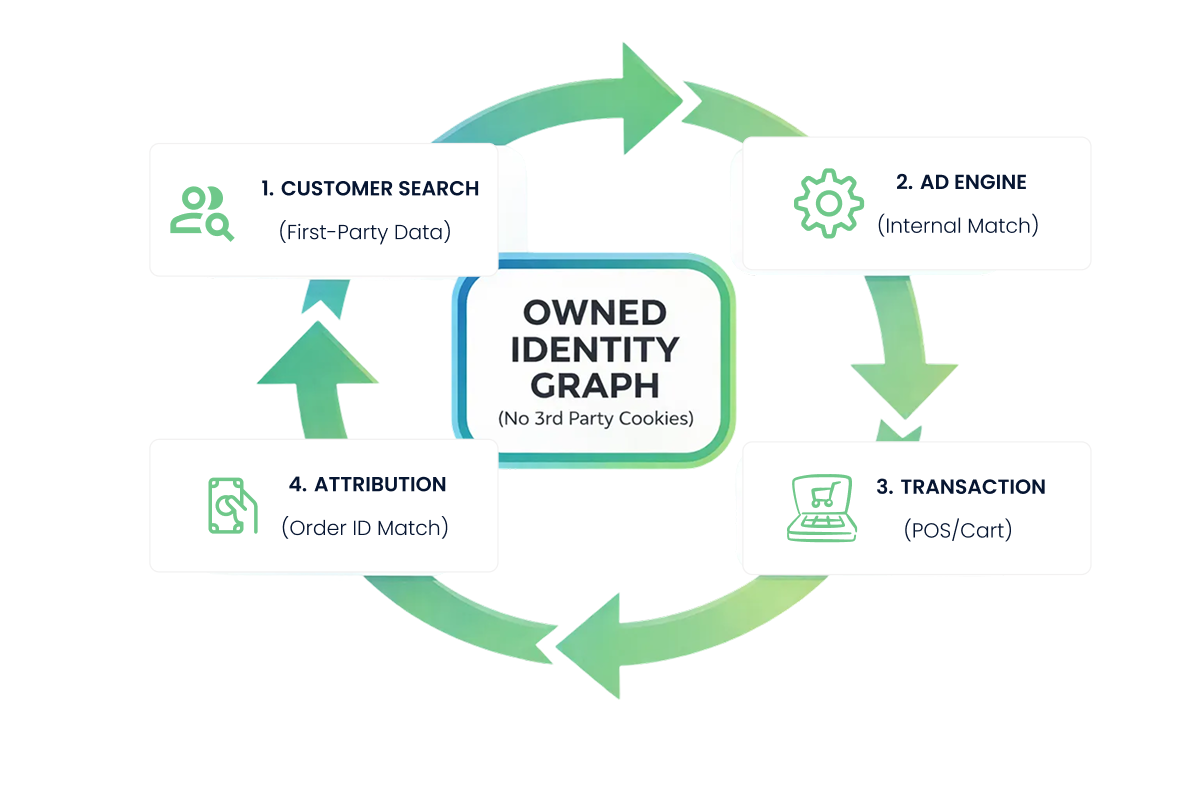
Unlike display networks that guess intent via cookies, an RMN leverages transaction data to engineer a closed loop. The retailer owns the inventory, the audience, and the attribution logic, creating a walled garden that rivals search engines in efficiency.
Beyond “Banner Ads”: Monetizing High-Intent Traffic
The common limitation in early RMNs is viewing them as “ads on a website.” In reality, they are specialized performance channels. Unlike social platforms, where users seek entertainment, a retail site is an environment of pure transaction intent.
When a brand pays for on-site advertising, they are not buying visibility; they are buying a shortcut to the “Add to Cart” button. This moves the conversation from “branding awareness” (low CPM) to “conversion performance” (high CPC), positioning the network as a direct driver of vendor revenue.
- Intent Monetization: Capturing value from the “buying mode” mindset.
- Shortest Path to Purchase: Ads appear directly in the transaction flow.
The Ecosystem Role: Why Brands Are Moving Budget to Retail
The shift of capital into the retail media ecosystem is a structural flight to safety. As third-party cookies deprecate and open-web targeting loses signal fidelity, retailer data remains the only reliable asset.
Brands are moving budget to retailers not just for sales, but for truth. Only the retailer knows who actually bought the product. By building an RMN, you provide the “Closed Loop” attribution that the rest of the market can no longer promise, making your walled garden the most valuable inventory on the internet.
- Signal Scarcity: Cookie deprecation forces ad spend toward first-party data owners.
- Closed-Loop Truth: Only retailers can prove a definitive link between ad spend and purchase.
The Economic Reality: Retail Media is a Software Business
Traditional retail is a game of physical logistics and shrinking margins, often capped at single digits. In contrast, building a retail media network introduces a high-margin software layer that fundamentally alters the company’s valuation and profit structure.
This is not just an operational add-on; it is a financial necessity. By treating shelf space as digital real estate, retailers create a zero-marginal-cost revenue stream that subsidizes the heavy operational costs of the core commerce business.
The Unit Economics of Goods vs. Pixels
| Metric | Traditional Retail Sales | Retail Media Network (RMN) |
|---|---|---|
| Gross Margin | 5% – 15% (Razor thin) | 70% – 90% (Pure Profit) |
| Marginal Cost | High (Manufacturing + Logistics) | Zero (Digital Replication) |
| Inventory Risk | High (Spoilage/OOS) | None (Virtual Inventory) |
| Valuation Multiple | 0.5x – 1x Revenue | 10x – 20x Revenue |
Ad Margins vs. Retail Margins
Physical SKUs incur heavy manufacturing and shipping costs, limiting net margins to roughly 5-10%. Retail media monetization sells digital inventory that costs effectively nothing to replicate, creating a profit engine that scales without proportional expense.
This shift allows ad revenue to flow directly to the bottom line. While retail volume drives top-line revenue, the media network becomes the primary driver of net income, stabilizing the business against market volatility.
- Margin Subsidization: Pure profit from ads stabilizes volatile retail operations.
- Valuation Multiples: Tech revenue is valued significantly higher than commerce revenue.
The Pivot from “Merchant” to “Platform”
A merchant optimizes for the sale of the product, focusing on inventory turnover. A platform optimizes for the value of the shelf space itself. A successful Retail Media Network strategy demands this fundamental shift in mindset.
Vendors are no longer just suppliers of goods; they become customers of data and access. This pivot requires engineering an ecosystem where brands compete for visibility, turning the store interface into a dynamic marketplace.
- Vendor Transformation: Suppliers become advertisers competing for premium placement visibility.
- Shelf Digitization: Every pixel becomes a monetizable piece of real estate.
The Sponsored Products Engine: Engineering the Auction
The core of a retail media network is the sponsored products platform, a high-velocity decision engine. Unlike static merchandising tools, this system evaluates thousands of eligible SKUs in milliseconds to using Programmatic Advertising Platform Development principles determine which product earns the right to appear.
It must balance relevance with revenue. The engine executes a real-time bidding negotiation between the vendor’s bid and the shopper’s intent, ensuring that the highest yield creates the best user experience without degrading organic conversion rates.
Static Merchandising vs. Algorithmic Auctions
| Feature | Legacy “Featured Items” | Programmatic Sponsored Products |
|---|---|---|
| Selection Logic | Manual Negotiation (Humans) | Real-Time Auction(Algorithms) |
| Pricing Model | Flat Fee/Slotting Fee | CPC-based bidding (Cost Per Click) |
| Relevance | Broad category alignment | Query- and behavior-specific |
| Fill Rate | Fixed allocation | Conditional, Demand-driven |
Why “Featured Items” Are Not Ad Units
Legacy retail sites rely on “featured items,” which are static placements negotiated manually by category managers. This approach is inefficient because it locks valuable shelf space regardless of the item’s performance or the shopper’s immediate context.
True sponsored products are dynamic ad units injected only when the math justifies it. The system calculates probability-to-buy in real-time, ensuring that a paid placement never displaces a higher-converting organic product.
- Static Inefficiency: Manual placements waste impressions on irrelevant, low-yield products.
- Dynamic Injection: Ads appear only when yield exceeds organic potential.
The Second-Price Auction Logic
Fixed-rate pricing fails to capture true market value, leaving money on the table. To maximize yield, modern networks utilize bidding & auction models like the Second-Price Auction, where the winner pays just one cent above the runner-up.
This mechanism creates a “truth-telling” equilibrium. Vendors bid their maximum willingness to pay without fear of overspending, allowing the retailer to discover the actual price floor of their inventory automatically.
- Truth Telling: Vendors bid aggressively without fear of significant overpayment.
- Price Discovery: The system finds the true market floor automatically.
The Ranking Algorithm: Protecting Conversion While Extracting Yield
A naive ad server simply prioritizes the highest bidder, assuming immediate revenue is the only metric. Sophisticated retail media architecture rejects this simplicity. It treats the ad slot as a potential liability that must be justified by conversion probability.
If an irrelevant ad disrupts the purchase flow, the retailer loses the transaction margin to gain pennies in ad spend. The algorithm acts as a governance layer, filtering bids to ensure they do not degrade the core shopping experience.
The “eCPM vs. Conversion” Conflict
There is a direct mathematical tension between maximizing ad yield and preserving organic sales. Integrating sponsored products with search results introduces a risk: displaying a high-bidding but low-converting item pushes down the products the user actually wants to buy.
The system must calculate the “Total Expected Value” for every slot. If the organic product offers a higher total margin probability than the ad’s bid, the engine must suppress the ad to protect the cart.
- Yield Conflict: High bids often mask low conversion relevance.
- Margin Priority: Algorithms prioritize total basket margin over ad revenue.
Relevancy Scoring
The referee of such a battle is the score of relevance, which was obtained completely based on past performance. Using the first-party data, the system gives a predictive probability rating to all SKU-keyword combinations using historical click-through and conversion data.
A high bid would not prevail with a low-quality mark. This is to make sure that a vendor does not brute force his or her way to a search result they do not belong in, in which the integrity of the search results page is maintained.
- Data Input: Historical purchase data defines predictive relevance scoring.
- Quality Gate: High bids fail against low relevance scores.
The Self-Service Vendor Portal: Automating Demand Capture
Scaling an ad business relies on removing human friction. A robust Retail Media Network (RMN) cannot survive on email threads and manual insertion orders; it requires a portal that allows thousands of vendors to inject demand simultaneously.
This automation shifts the operational burden from the sales team to the software. By exposing inventory via API, the system enables the “long tail” of smaller brands to participate, unlocking a revenue layer that manual sales teams ignore.
Moving from IOs to “Wallet-Based” Buying
Manual invoicing creates friction that kills participation for smaller vendors. A Self-service vendor advertising platform – similar to demand side platform development replaces this with a wallet model, where budget is pre-loaded or authorized, treating ad spend like a utility rather than a negotiated contract.
This allows for “always-on” campaigns. Vendors do not need to sign a new document to increase spend; they simply top up their balance, reducing the administrative latency between the decision to spend and the actual impression.
- Friction Reduction: Automated wallets remove manual contract negotiation delays.
- Continuous Spend: Top-ups enable uninterrupted, always-on campaign execution.
The Billing API Integration (Stripe/Invoicing Logic)
The vendor portal software must abstract the complexity of financial compliance. It integrates directly with payment gateways like Stripe to handle credit card authorization, ensuring that funds are secured before a single impression is served to the user.
Post-pay invoicing logic handles larger accounts. The system tracks accrued liability and generates compliant invoices automatically at month-end, syncing with the retailer’s ERP to reconcile the ad revenue against the vendor’s existing trade agreements.
- Secure Authorization: Funds verified before impression delivery starts.
- Automated Reconciliation: Invoices are synchronized with the ERP systems.
- Liability Tracking: Instant accrual tracking averts bad debt.
Campaign State Machines (Active, Paused, Exhausted)
A self-serve ad platform relies on a rigid state machine to manage the lifecycle. A campaign is not just “on” or “off”; it transitions through strict states—Pending Approval, Active, Paused, and Exhausted—based on real-time triggers.
The “Exhausted” state is critical. When the budget hits zero, the state machine must instantly sever the connection to the auction engine, ensuring the retailer never delivers free inventory due to a caching error or latency.
- Strict Transitions: Logic governs movement between campaign states.
- Instant Severing: Zero budget triggers immediate auction removal.
- Latency Prevention: Caching layers respect state changes instantly.
Budget Guardrails and Spend Velocity Control
Vendors fear overspending more than they desire visibility. A competent vendor advertising portal enforces strict pacing logic, distributing the budget evenly across the campaign duration rather than blowing the entire cap in the first hour of high traffic.
This velocity control protects the vendor’s ROI. By smoothing the spend, the system ensures the brand captures a representative sample of shoppers throughout the day, rather than just the morning rush, providing better data for optimization.
- Pacing Logic: Algorithms distribute spend evenly across time.
- ROI Protection: Prevents budget exhaustion during traffic spikes.
Preventing Runaway Spend (System-enforced caps)
The advertiser dashboard must provide an interface for defining hard caps. The backend enforces these limits as immutable constraints, rejecting any bid that would push the total spend even one cent beyond the authorized limit.
This requires an atomic counter in the database. In a distributed system with thousands of concurrent requests, the ad server must decrement the remaining budget accurately without race conditions, guaranteeing that the cap is mathematically respected.
- Immutable Constraints: Hard caps reject over-budget bid requests.
- Atomic Counters: Database locks prevent concurrent spend errors.
- Race Condition Safety: Distributed systems respect exact budget limits.
The “Proof” Layer: Real-Time ROAS Dashboards
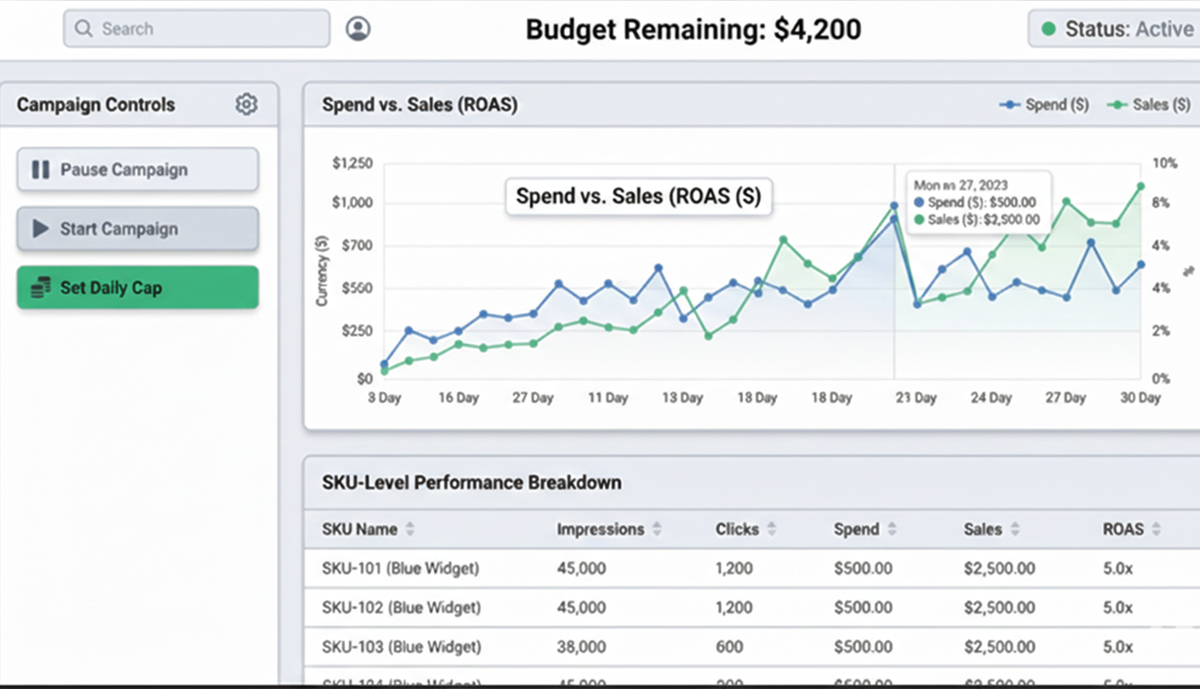
Trust is established through visibility. Ad performance dashboards built on ad exchange infrastructure replace vague monthly PDF reports with real-time analytics, giving vendors direct access to their impression data, click-through rates, and, crucially, the resulting sales figures.
This transparency creates a feedback loop. When a vendor sees the immediate impact of their spend on sales velocity, they are psychologically primed to increase their budget, shifting the relationship from “cost center” to “growth lever.”
- Real-Time Visibility: Vendors access live performance data immediately.
- Feedback Loop: Instant data drives increased ad investment.
Closed-Loop Attribution (Order ID matching)
The “Holy Grail” of retail media is closed-loop attribution. The system matches the unique Campaign ID of the clicked ad against the Order ID generated at checkout, providing deterministic proof that the ad caused the transaction.
This matching logic runs as a background process. It performs a scan of the transactions completed as well as searches the attribution window (e.g., 14 days). It attributes the sale to the particular unit of an advertisement, separating between the view-through and click-through conversions.
- Deterministic Proof: Ad clicks matched directly to transaction IDs.
- Attribution Windows: Logic defines valid conversion timeframes explicitly.
- Conversion Types: Distinguishes between views and clicks clearly.
The Hidden Infrastructure: Catalog Ingestion and Real-Time Sync
An ad server that does not understand inventory availability is a liability. A robust Retail Media Network (RMN) distinguishes itself from standard display networks by strictly adhering to physical reality. It must ingest the product catalog continuously, ensuring that the digital promise of an ad matches the physical stock in the warehouse.
This synchronization is the heaviest engineering lift. The system does not just cache the catalog once a day; it has to listen to the inventory stream. In case a product is sold out, the advertisement unit should disappear instantly so that the retailer does not incur the costs of clicks that cannot be converted.
Inventory Awareness (The “Out-of-Stock” Kill Switch)
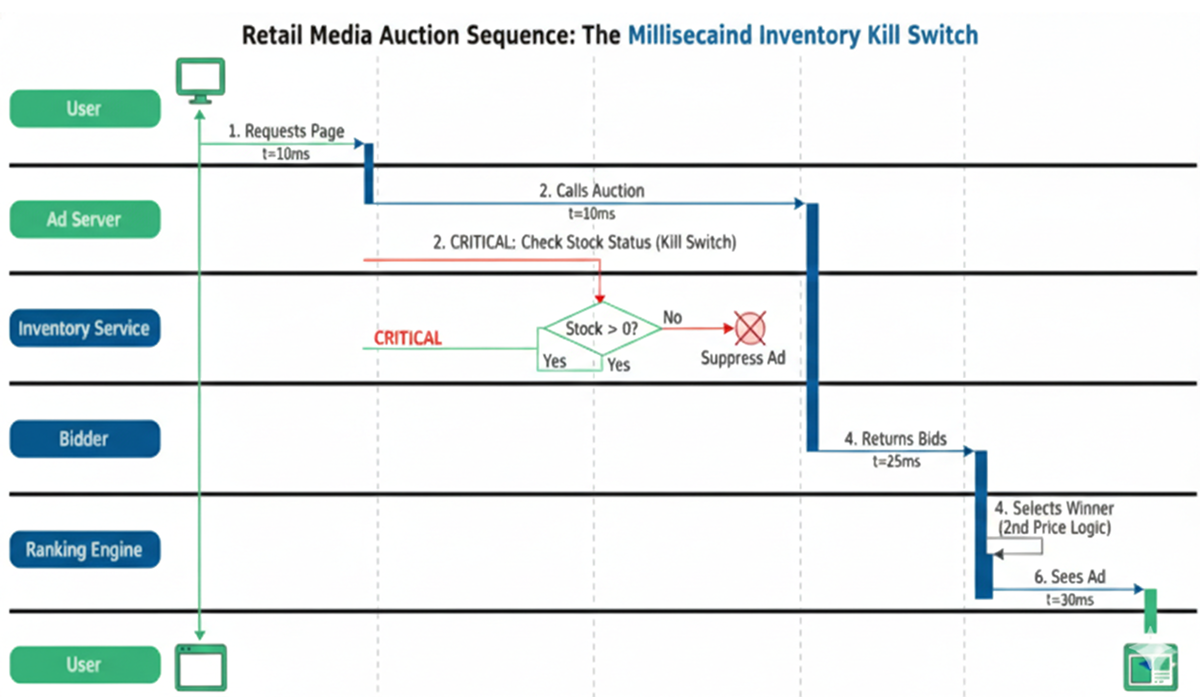
The fastest way to destroy trust is to serve an ad for an item the user cannot buy. Effective inventory management integration acts as a hard “kill switch” in the auction logic. Before a bid is even accepted, the system queries the stock level status.
If the count is zero, the candidate is disqualified instantly. This check protects the vendor’s budget and the shopper’s patience. It ensures that the commercial message is always actionable, maintaining the integrity of the shopping experience against the frustration of dead ends.
- Instant Suppression: Zero stock triggers immediate removal from auction eligibility.
- Budget Protection: Vendors never pay for clicks on undeliverable items.
Real-Time ERP Sync (Latency thresholds)
In retail media network development, the connection to the ERP is the critical heartbeat. The architecture requires an event-driven model where inventory changes are pushed to the ad server within milliseconds, rather than waiting for a slow batch update to run overnight.
This demands strict latency thresholds. If the sync lags by even ten minutes, a flash sale can deplete stock while ads continue to run. The engineering standard is “eventual consistency,” measured in seconds, not hours, to close the risk window.
- Event-Driven: Inventory updates push instantly to the ad server.
- Milliseconds Matter: Sync speed prevents advertising sold-out inventory.
- Flash Sale Safe: Architecture handles rapid depletion during high volume.
Failure Modes and Safe Defaults (Failing silently vs. failing visibly)
When the sync connection breaks, the retail media platform must know how to fail safely. The default state for an ad with unknown inventory status must be “hidden,” not “shown.” It is better to underserve impressions than to serve a broken experience.
This defensive coding prevents catastrophic UX failures. The system should degrade gracefully, reverting to organic results or fallback house ads rather than displaying a spinning wheel or a broken product page, ensuring the site remains functional even when the ad server is blind.
- Fail Safe: Unknown status defaults to hiding the ad.
- Graceful Degradation: The Site functions normally without ad server data.
- UX Priority: Protecting the user journey outweighs ad revenue.
Event Latency and Consistency Guarantees
Data consistency is the bedrock of trust. Standardized retail media measurement requires that an impression event on the client side be recorded on the server side with zero data loss, even if the user navigates away instantly.
This involves complex queuing logic. The system must capture the event asynchronously to avoid blocking the main thread but ensure it is persisted to the reporting database reliably. This guarantee ensures that the numbers the vendor sees match the invoice exactly.
- Zero Data Loss: Asynchronous capture ensures every impression is counted.
- Non-Blocking: Tracking scripts must not delay page rendering.
The Cost of Milliseconds (Impact on UX)
Latency is an undeniable obstacle to the conversation. Assuming a 200 ms response time in the ad server, the whole page will be loaded after another 200 ms. This delay causes a direct decrease in the performance of ROAS tracking since the user bounces off the page before the page is fully loaded and kills the potential worth of the ad placement.
Engineers must enforce a strict “time-to-glass” budget. If the auction cannot resolve within 50 ms, the system should abandon the request and render the page without ads, a latency safeguard typical of supply-side platform (SSP) development.
- Time Budget: Auctions must resolve within strict millisecond limits.
- Abandon Logic: Slow requests are dropped to save load time.
- Bounce Prevention: Fast rendering protects the user’s purchase journey.
Taxonomy Mapping (The SKU Resolution Problem)
The biggest challenge is that brands and retailers are in different languages. The SKU-level performance reporting is often fractured by the lack of alignment between the Brand SKU (GTIN) and the Retailer SKU (internal ID) that creates a gap between the bought ad and the product sold.
The infrastructure must maintain a dynamic translation layer. It maps the vendor’s catalog definition to the retailer’s internal inventory codes, ensuring that when a brand promotes a “family” of products, the system correctly identifies all relevant child SKUs.
- Identity Translation: Maps vendor GTINs to internal retailer IDs.
- Family Resolution: Links parent products to all child variants.
Normalizing Vendor Data (Brand SKU to Retail SKU map)
This normalization process enables granular SKU-level reporting. The system builds a persistent graph that links the ad creative to the specific inventory unit, handling complexities like size variants, color options, and multi-pack configurations automatically.
Without this map, attribution fails. You cannot prove that an ad for a “Medium Blue Shirt” caused the sale if the system tracks inventory as “Shirt-Blue-M.” This data hygiene is the invisible labor that makes the entire attribution model functional.
- Variant Handling: Links sizes and colors to one ad.
- Attribution Link: Connects ad creative to specific inventory unit.
- Data Hygiene: Cleans inputs to ensure reporting accuracy.
Why White-Label “Widgets” Fail the Amazon Standard
Many retailers attempt to shortcut the process by installing third-party widgets. While this deploys a vendor portal quickly, it permanently caps the asset’s value. The retailer becomes a landlord renting out pixels, rather than an owner of the monetization engine.
Amazon set the standard by owning the entire stack. A white-label solution introduces a middleman that extracts 15-30% of the yield and fragments the user experience. To achieve Amazon-level density, the retailer must own the code that serves the ad.
The Cost of Renting vs. Owning the Stack
| Dimension | White-Label Solution (Rent) | Proprietary Stack (Own) |
|---|---|---|
| Yield Capture | ~70% (implicit technology tax) | 100% (no revenue share) |
| Data Privacy | Shared across the network | Internal, walled garden |
| Valuation Impact | Accrues to the vendor | Accrues to the retailer |
| Latency Profile | Client-side execution | Server-side middleware |
Data Ownership vs. Data Rental
When you use a third-party provider, they ingest your transaction data to train their global algorithms. You are effectively feeding your competitors. True first-party data monetization requires keeping that intelligence inside your own firewall, not exporting it.
Ownership means the valuation stays on your balance sheet. If the tech provider owns the audience graph, they can raise prices or leave with your data. Building internal middleware secures the asset against external dependencies and platform risk.
- Asset Security: Internal stacks prevent data leakage to external competitors.
- Valuation Control: Owning the graph keeps equity value internal.
The Latency Cost of Third-Party Scripts
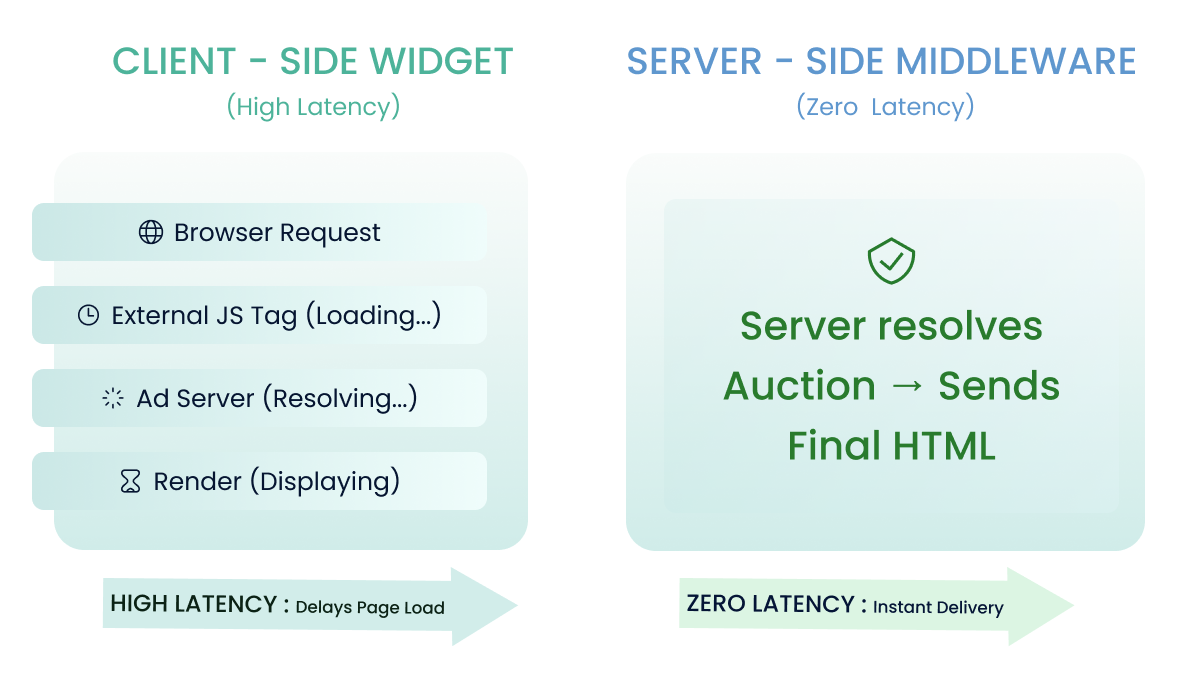
Third-party tags are client-side heavy. They force the user’s browser to load external JavaScript, slowing down the page load. This latency kills conversion rates, negating the revenue gained from the ad. A native build executes server-side.
Furthermore, client-side tracking is fragile. Ad blockers and browser privacy updates often sever the link between impression and sale. A server-side closed-loop attribution engine matches orders to ads in the backend, immune to browser restrictions or cookie deprecation.
- Speed Penalty: External scripts slow down page load significantly.
- Resilient Tracking: Server-side matching bypasses ad blockers and browser restrictions.
Conclusion: Owning the Margin Means Owning the Code
The mathematics of retail is unforgiving. Survival depends on monetizing buyer attention, not just selling goods. A Retail Media Network (RMN) is the only asset capable of bridging this margin gap.
Renting a solution solves the speed problem but destroys the profit model. True leverage comes from using AdTech development services to engineer a proprietary stack that keeps yields internal.
This is a software game. The retailer who owns the auction logic controls the valuation. Owning the margin requires owning the code, ensuring that your data serves your balance sheet.
Final Takeaways
- Server-Side Logic Protects Conversion: Client-side scripts kill speed; middleware executes auctions without latency.
- First-Party Data Requires Walled Gardens: Leaking data to white-label providers destroys your long-term valuation.
- Automation Unlocks the Long Tail: Self-service portals allow thousands of small vendors to spend their budget.
- Media Margins Subsidize Retail Operations: High-margin ad revenue is the structural hedge against commerce volatility.
FAQs
White-label solutions take a 30% revenue share. Building keeps 100% yield and secures your data valuation assets.
Combine a React frontend, Stripe billing, and a campaign state machine to automate vendor workflows efficiently.
Sponsored ads inject dynamic SKUs based on search intent and stock, whereas display ads serve static banners.
Matches User IDs from the app to Loyalty IDs at POS to prove ads drove offline purchases.
The major characteristics are automated invoicing, real-time performance analytics, and agency- and brand-centered multi-user controls.
Manoj Donga
Manoj Donga is the MD at Tuvoc Technologies, with 17+ years of experience in the industry. He has strong expertise in the AdTech industry, handling complex client requirements and delivering successful projects across diverse sectors. Manoj specializes in PHP, React, and HTML development, and supports businesses in developing smart digital solutions that scale as business grows.

Have an Idea? Let’s Shape It!
Kickstart your tech journey with a personalized development guide tailored to your goals.
Discover Your Tech Path →Share with your community!
Latest Articles
When to Choose a White Label Real Estate App Development Company and Why?
Most real estate businesses we talk to aren't short on leads or deals. Even your search for a white-label real…
Real-Time Payment Infrastructure Architecture: Why Money Can No Longer Move at Yesterday’s Speed
Blog Summary Money still moves through infrastructure built for another era Consumer expectations are reshaping payment system priorities Real-time payments…
Cost to Develop a Real Estate App Like Zillow or Trulia
This Blog Explains: Cost Breakdown: Understand what actually increases Zillow-like app development expenses Infrastructure Reality: Learn why MLS systems change…