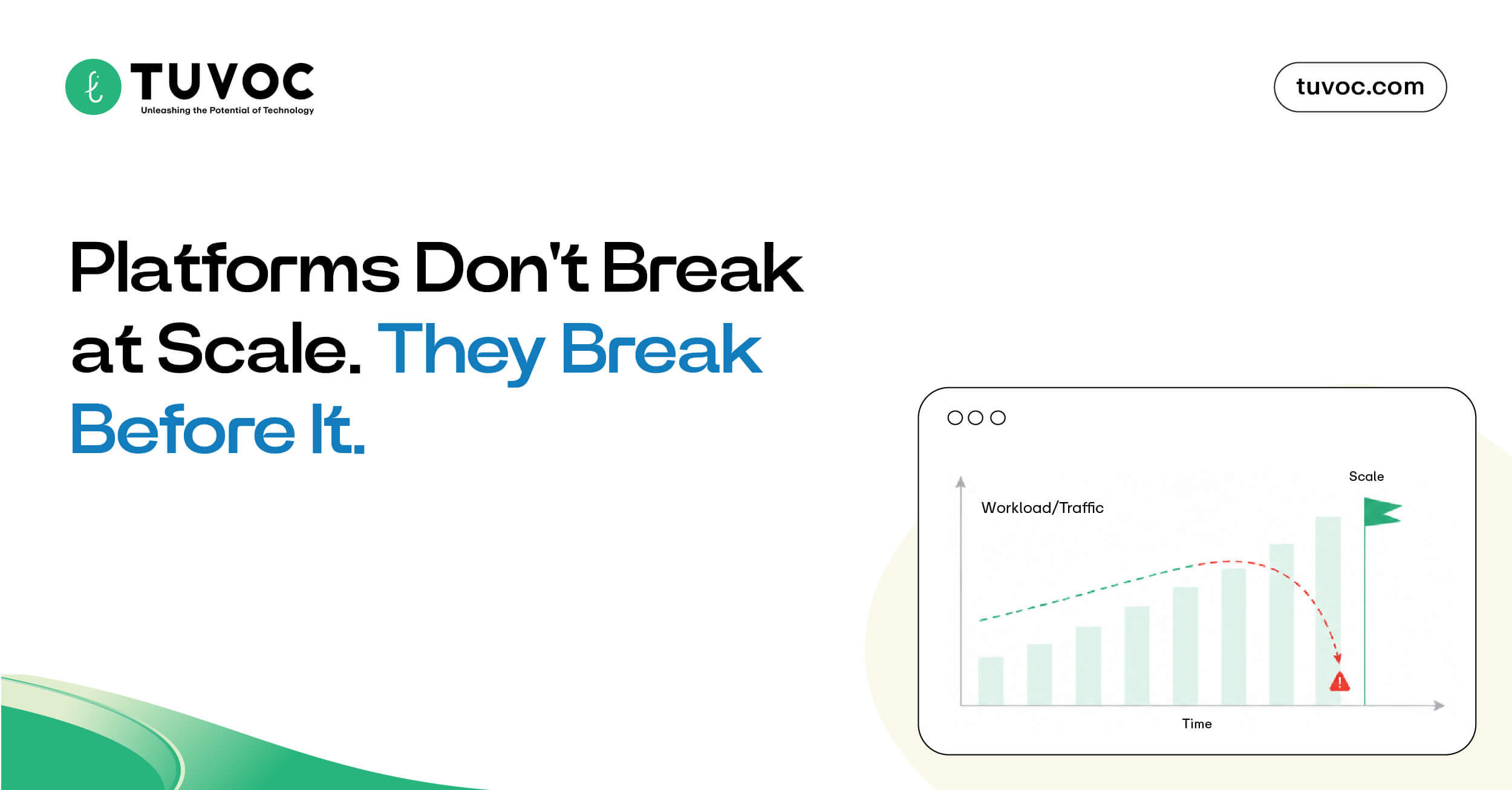
Platforms Don’t Break at Scale. They Break Before It.

Bhavin Umaraniya
Finance
Published : May 18, 2026
Blog Summary
- Pre-existing ceilings:Growth exposes constraints already embedded inside platform architecture
- Synchronous dependencies:Latency amplification spreads quickly through tightly coupled request paths
- Observability degradation:Telemetry pipelines lose reliability during sustained production pressure
- Deployment slowdown:Shipping velocity weakens before large-scale instability becomes obvious
Architectural scaling failure patterns emerge when system performance collapses under growth pressure that exposes structural fragility already present inside the platform, including synchronous dependencies, coordination bottlenecks, and observability gaps that existed long before traffic volume increased.
Most distributed platforms appear stable while operating within the concurrency assumptions they were originally designed around. As request distribution changes and dependency depth expand, latency amplification, deployment friction, and infrastructure contention begin surfacing in ways that lower-scale environments never revealed clearly.
This blog examines how distributed systems accumulate hidden operational stress before incidents become visible at scale. The focus is on measurable failure mechanics such as deployment velocity degradation, observability instability, synchronous dependency pressure, and nonlinear latency behavior that gradually push platforms toward architectural limits.
Across large distributed platforms analyzed by Tuvoc Technologies, deployment validation windows commonly expanded 2.3x once service coordination crossed roughly 30 independently deployable components.
Growth Doesn’t Create Fragility, Exposes
Many distributed systems scaling challenges only become visible after traffic patterns shift beyond the conditions the platform was originally optimized for. Additional concurrency exposes coordination limits, dependency pressure, and latency accumulation that remained operationally manageable at lower load ranges.
A platform may run reliably for months before instability appears during rapid growth. In most cases, the underlying architecture was never validated against substantially different request distribution patterns, service interaction depth, or sustained concurrency behavior across dependent infrastructure components.
What architectural assumptions become dangerous during rapid growth?
Synchronous request paths are usually among the first assumptions that become operationally expensive under sustained concurrency. A dependency chain that appears harmless at moderate traffic can accumulate substantial latency once multiple downstream services begin waiting simultaneously across shared execution paths.
Deployment velocity degradation starts quietly when dependency coordination grows faster than release workflows were originally designed to handle. Rollback validation expands, release sequencing becomes slower, and service dependency checks gradually introduce operational friction before severe instability becomes externally visible.
- Call chain depth: Sequential dependencies compound latency during sustained request concurrency
- Release coordination overhead: Service growth gradually extends deployment validation and rollback duration
The Compounding Cost of Synchronous Architecture Under Load
Many synchronous architecture performance problems begin appearing only after concurrency reaches a level the request model was never realistically designed to sustain. Blocking service dependencies increase wait time across every connected execution path instead of containing latency locally within one request.
Under sustained traffic growth, synchronous systems rarely degrade in a linear way. A moderate increase in request volume can trigger disproportionate latency expansion once thread pools, timeout windows, and downstream dependency queues begin accumulating pressure simultaneously across multiple services.
Why does a single slow dependency make every service slow at peak load?
Most microservices scalability bottlenecks begin when one downstream dependency slows enough to hold execution threads open faster than requests can clear from the queue. Healthy services eventually lose processing capacity because blocked threads remain occupied waiting for upstream completion.
Timeout behavior compounds quickly inside synchronous request chains. Google SRE suggests that a single 500ms delay across dependent services can multiply total waiting time across the execution path, especially once retries and queued requests begin stacking under sustained concurrency pressure.
- Thread pool saturation: Blocking dependencies gradually consume execution capacity across connected services
- Timeout propagation chain: Sequential delays amplify latency throughout synchronous service dependencies
How do you measure synchronous dependency risk before a load event exposes it?
A meaningful infrastructure scalability assessment requires visibility into tail latency behavior rather than average response time alone. Systems operating with stable median latency can still accumulate severe synchronization pressure inside high-percentile request paths under moderate load.
Dependency mapping also becomes incomplete when service relationships are documented without synchronous call depth. The operational risk is not only which services communicate, but how many blocking dependencies exist sequentially inside the same execution path.
- P99 divergence signal: Tail latency separating sharply from median indicates coordination pressure
- Synchronous call depth: Dependency chains reveal latency accumulation before production instability appears
Why does horizontal scaling fail to solve coordination bottlenecks?
Many high-concurrency system design failures persist even after additional replicas are introduced because the constrained resource usually remains shared underneath the expanded compute layer. More service instances often increase coordination pressure instead of distributing it cleanly.
Stateful dependencies such as databases, distributed locks, and shared connection pools typically reach contention limits before compute utilization becomes saturated. Under these conditions, horizontal scaling expands interaction complexity faster than throughput capacity across the platform.
- Connection pool contention: Additional replicas increase competition for shared infrastructure resources
- Distributed coordination overhead: Service expansion raises synchronization complexity across dependent systems
Observability Debt Accumulates Silently Until It Doesn’t
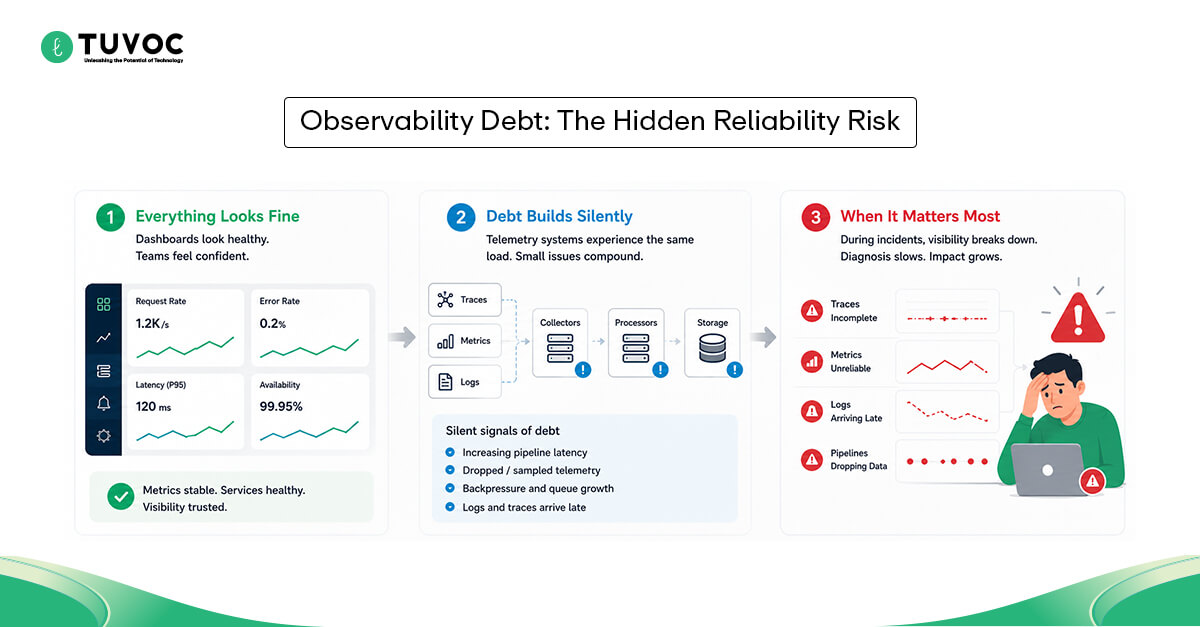
In enterprise platform reliability engineering, observability debt emerges when production telemetry no longer reflects actual system behavior under stress conditions. As concurrency increases, trace collectors, metric exporters, and log pipelines begin experiencing the same infrastructure pressure affecting the application itself.
This creates a failure pattern where operational visibility degrades during the exact moments accurate diagnosis becomes most necessary. Dashboards may continue showing stable metrics while trace latency increases, logs arrive late, and telemetry pipelines silently begin dropping critical diagnostic signals.
What happens to distributed tracing accuracy when services are under sustained load?
Most observability debt in distributed systems becomes visible first through degraded trace accuracy during sustained production pressure. Grafana explains that sampling systems that appear reliable during normal traffic often fail to capture representative failure paths once incident concurrency begins overwhelming telemetry pipelines.
Queue saturation inside tracing infrastructure also introduces orphaned spans where downstream services lose parent context before trace propagation completes. The resulting dashboards display fragmented request visibility, making causal relationships significantly harder to reconstruct during active incidents.
- Trace sampling distortion: Incident traffic reduces visibility into actual failing request paths
- Orphaned span propagation: Queue pressure fragments distributed trace continuity across services
What does accumulated observability debt look like before a crisis makes it obvious?
Platforms lacking resilient high-throughput architecture design usually show visibility degradation before large-scale instability becomes externally visible. On-call engineers often learn about incidents through user reports or secondary communication channels before monitoring systems reflect meaningful operational failure signals.
Alert fatigue becomes another early indicator when monitoring noise consistently exceeds actionable diagnostic value. Once engineers stop trusting dashboard alerts, instrumentation may still exist technically while operational visibility has already become unreliable under production conditions.
- Monitoring signal degradation: Delayed dashboards weaken confidence during active production anomalies
- Runbook correlation complexity: Multi-service log tracing indicates insufficient end-to-end instrumentation
Deployment Velocity as the First Casualty of Scaling Debt
Early deployment velocity degradation usually appears before major production instability becomes externally visible. Release pipelines begin slowing down as dependency coordination expands, rollback validation grows more complex, and test reliability weakens across increasingly stateful distributed services.
Martin Fowler’s Microservices Guide explains that these symptoms are frequently mistaken for tooling inefficiency or operational overhead when they are actually indicators of architectural strain. As service interaction depth increases, every deployment introduces additional synchronization requirements that gradually make releases harder to validate, revert, and stabilize safely.
What makes rollback recovery slower in highly distributed systems?
In large-scale platform scalability architecture, rollback recovery becomes slower once deployments begin modifying shared state across interconnected services. Schema migrations, queue contracts, cache structures, and versioned payload formats introduce dependencies that cannot always revert cleanly in parallel.
Partial rollback conditions create additional coordination risk when newer service versions continue communicating with reverted components expecting older request structures. Under these conditions, compatibility gaps can propagate failure silently even after the original deployment has technically been reversed.
- Schema compatibility pressure: Stateful migrations complicate rollback sequencing across dependent infrastructure
- Version coordination drift: Partial reverts introduce inconsistent behavior between interconnected services
What a Platform Looks Like Three Months Before a Scaling Crisis
Effective scaling debt management begins by recognizing operational patterns that appear long before visible platform instability arrives. Queue latency increases gradually, tail response times widen, infrastructure utilization becomes less efficient, and on-call pressure rises under otherwise routine traffic conditions.
| Signal | What It Usually Indicates |
|---|---|
| P99 divergence from P50 | Latency coordination pressure |
| Queue depth above 70% | Reduced recovery headroom |
| Rising cost-per-request | Infrastructure inefficiency growth |
| Deployment slowdown | Coordination complexity expansion |
| Retry logic proliferation | Platform trust degradation |
| Alert fatigue | Observability reliability decline |
These signals rarely emerge simultaneously at first. A platform may continue operating without major incidents while coordination overhead, latency accumulation, and resource contention steadily increase underneath normal production behavior. By the time failures become externally obvious, measurable architectural pressure has usually existed for months.
Which infrastructure metrics signal architectural ceiling pressure before engineers notice it manually?
Meaningful infrastructure cost optimization at scale depends on tracking efficiency metrics rather than infrastructure growth alone. Cost-per-request increasing consistently without proportional traffic expansion often indicates the platform is consuming more coordination overhead per throughput unit than before.
Queue utilization patterns also reveal architectural pressure earlier than incident dashboards typically do. Sustained queue depth above operational headroom during non-peak periods reduces recovery capacity before concurrency spikes or dependency slowdown events begin affecting production traffic.
- Cost-per-request expansion: Rising throughput cost indicates increasing coordination inefficiency across infrastructure
- Queue saturation pressure: Persistent non-peak utilization removes operational recovery headroom early
What do engineering team patterns reveal about platform architectural health that dashboards don’t?
A visible growth compression point often appears first through behavioral changes in how engineers interact with the platform itself. Defensive retry logic, expanded timeout handling, and increasingly cautious integration patterns usually emerge before infrastructure dashboards indicate severe instability.
Reliability workload distribution can also reveal architectural pressure that monitoring systems fail to capture directly. As deployment confidence weakens and release coordination grows more fragile, engineering effort gradually shifts toward stabilization behavior instead of predictable delivery flow.
- Defensive integration patterns: Retry-heavy service communication reflects declining platform confidence internally
- Release confidence erosion: Off-peak deployments indicate growing operational coordination sensitivity
The visible outage usually arrives long after the underlying architectural pressure becomes measurable.
Next: Why leadership misses scaling collapse.
FAQs
A scaling problem means capacity is insufficient for current demand. An architecture problem means the system model itself becomes unstable under higher concurrency, even after additional infrastructure capacity is introduced.
As distributed systems grow, failures propagate across multiple dependent services simultaneously. Retries, queue pressure, latency amplification, and fragmented telemetry make it increasingly difficult to isolate one clear causal failure path.
Synchronous microservices hold execution threads open while waiting for downstream responses. When one dependency slows, blocked requests accumulate across connected services until queues overflow and latency propagates system-wide.
Architectural scaling debt is the growing mismatch between the load a platform was originally designed for and the concurrency conditions it currently operates under without corresponding architectural adaptation over time.
Platforms should reassess architecture once P99 latency diverges significantly from P50, deployment coordination becomes increasingly fragile, and infrastructure efficiency declines under traffic patterns previously considered operationally stable.

Bhavin Umaraniya
Bhavin Umaraniya is the CTO at Tuvoc Technologies, with 18+ years of experience in frontend and web software development. He leads tech strategy and engineering teams to build scalable and optimized solutions for start-ups and enterprises.

Have an Idea? Let’s Shape It!
Kickstart your tech journey with a personalized development guide tailored to your goals.
Discover Your Tech Path →Share with your community!
Latest Articles

When to Choose a White Label Real Estate App Development Company and Why?
Most real estate businesses we talk to aren't short on leads or deals. Even your search for a white-label real…

Real-Time Payment Infrastructure Architecture: Why Money Can No Longer Move at Yesterday’s Speed
Blog Summary Money still moves through infrastructure built for another era Consumer expectations are reshaping payment system priorities Real-time payments…

Cost to Develop a Real Estate App Like Zillow or Trulia
This Blog Explains: Cost Breakdown: Understand what actually increases Zillow-like app development expenses Infrastructure Reality: Learn why MLS systems change…