In AdTech, Growth Should Increase Revenue, Not Cost

Manoj Donga
AdTech
Published : May 27, 2026
Blog Summary
- Rising Costs: More traffic should not mean a bigger bill
- 600K QPS Reality: High volume handled at nearly $100 operational cost
- The Real Problem: Inefficient systems are eating into growing revenue
- Tuvoc’s Approach: Growth that improves margins, not weakens them
Every second, an AdTech platform can process lakhs of ad requests, bids, and data calls simultaneously. That volume, around 600,000 queries per second, is what AdTech infrastructure cost optimization is actually built around, keeping that activity affordable as it grows. Programmatic ad spend globally crossed $200 billion in 2023 per Statista, and the operational burden underneath that number is only getting heavier.
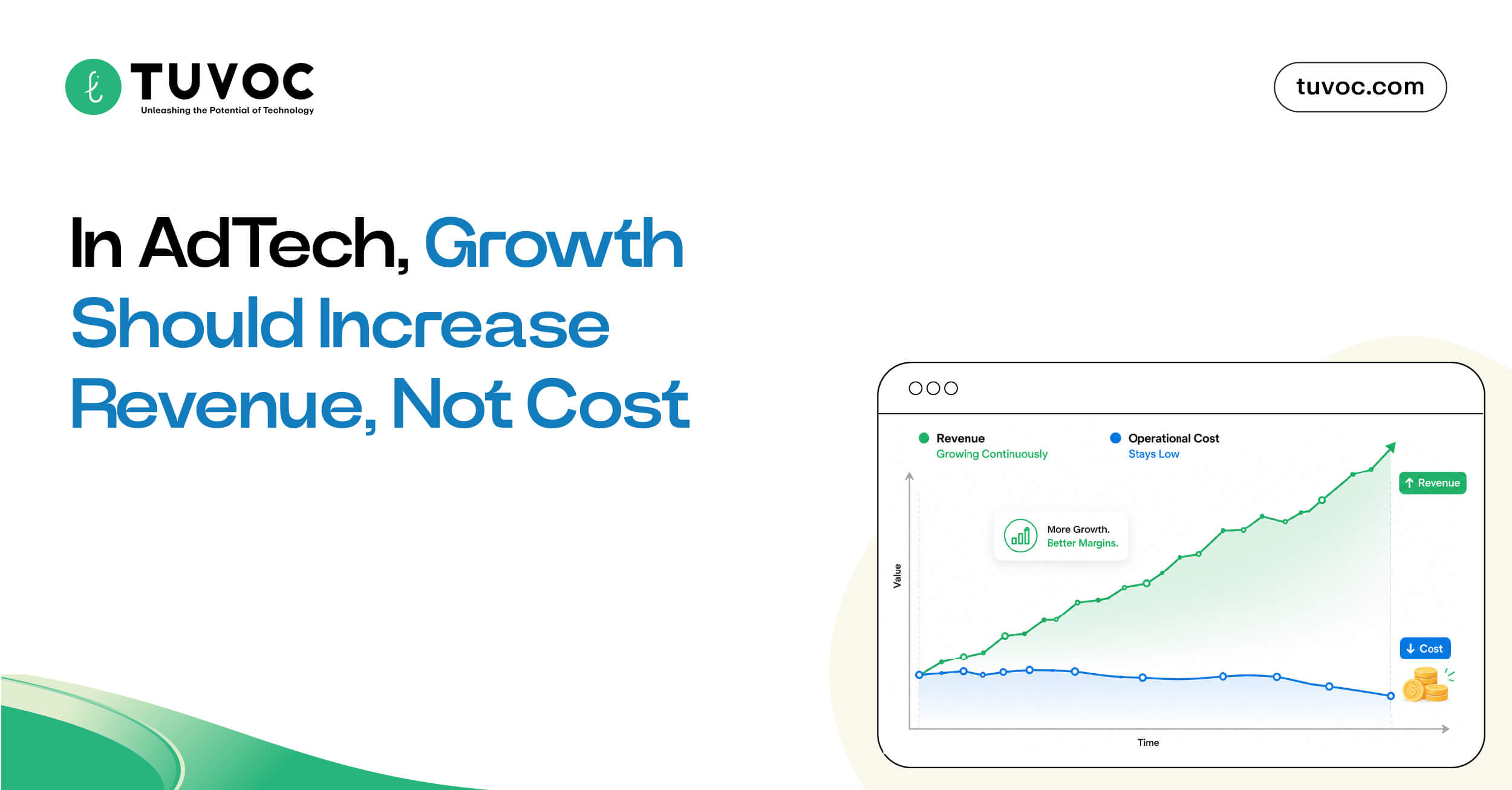
The title says something most people in this industry quietly disagree with. Because in reality, when traffic goes up, cost goes up too. McKinsey flagged that most digital platforms see operational costs grow 1.5x to 2x faster than revenue during high-growth phases. Revenue grows, but the bill grows right alongside it, sometimes faster. Most companies just accept that as how things work. This blog says otherwise.
We cover why operational cost rises with traffic, where the leakage actually happens, and how Tuvoc’s AdTech software development kept nearly 600K QPS running at a highly nominal infrastructure cost, without sacrificing speed or consistency, or accuracy anywhere in the process.
Growth Economics Comparison
| As Traffic Grows | Most AdTech Platforms | Tuvoc Approach |
|---|---|---|
| Infrastructure Cost | Rises aggressively | Remains operationally lean |
| Response Speed | Slows under pressure | Maintained near 30ms |
| Traffic Spikes | Cost escalation | Stable during 150K spikes |
| Request Volume | Requires scaling overhead | ~600K QPS maintained |
| Data Processing | Delays accumulate | Real-time and consistent |
| System Weight | Operational bloat increases | 150KB lightweight SDK |
| Growth Outcome | Margins weaken | Profitability improves |
Why Does Revenue Growth Often Increase Operational Cost Instead of Profit?
To reduce AdTech operational costs, the real problem is not growth itself; it is how inefficiently most systems handle growing activity. Forrester research shows AdTech platforms processing high request volumes see operational overhead increase non-linearly past certain traffic thresholds. Tuvoc handled nearly 600K QPS while keeping operational costs around $100.
Most platforms are built for a certain level of activity. When traffic crosses that, the system strains, costs climb, and profitability quietly weakens. Growth starts feeling like a liability. That is the contradiction most AdTech businesses have simply stopped questioning.
600K Queries Per Second: Real Impact on a Growing Business
Every ad request, every bid, every data call your platform handles is a query. Businesses running high QPS AdTech systems process these by the lakhs every second, and each one carries a small but real operational cost. At scale, those small costs compound fast.
That compounding is exactly where most platforms lose money. Nearly six lakh queries hitting the system per second should push spend through the roof, but Tuvoc kept that cost surprisingly low at that volume. The system stayed lean because it was built to stay lean, not just built to handle load.
Most platforms assume bigger volume means bigger bills. That assumption is what silently kills margins. When the system underneath is built right, higher usage should actually improve cost efficiency. More activity across the same operational base means better returns per query, not worse ones.
- Cost vs. Volume: Higher QPS should not mean proportionally higher spend
- Profitability Signal: Operational cost near $100 at peak volume is the real benchmark
Why Traffic Spikes Quietly Become One of the Most Expensive Problems in AdTech
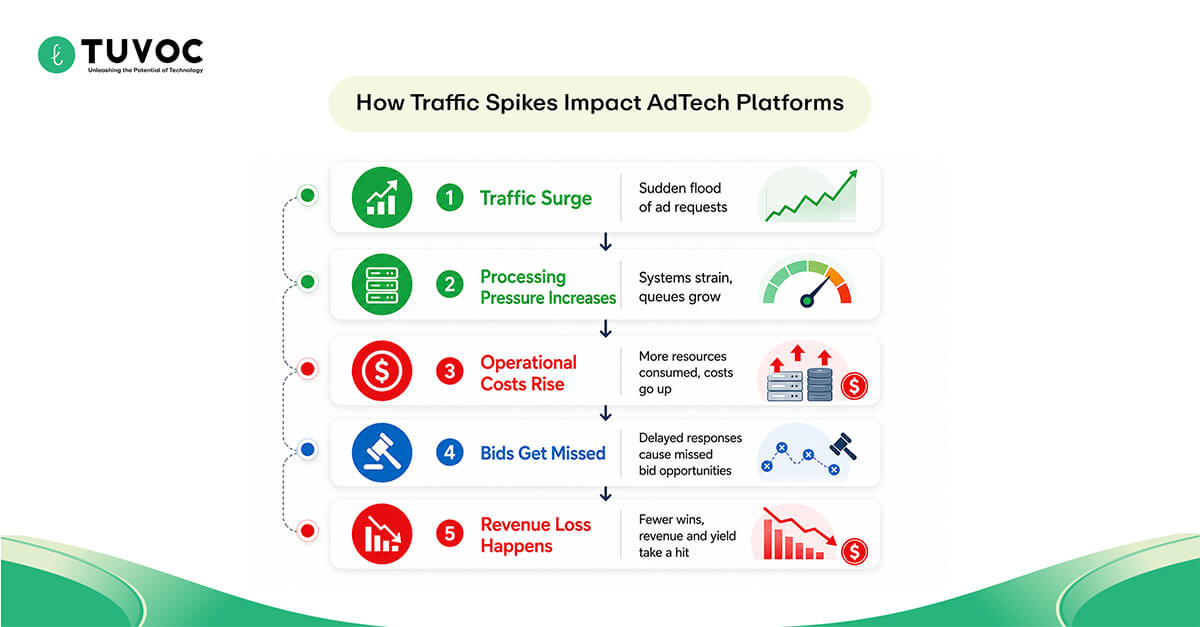
Poor AdTech traffic spike management is expensive because most systems are sized for regular demand, not sudden surges. Akamai’s research found traffic can surge 3x to 10x above baseline within minutes during major events. When that hits, processing pressure shoots up, costs follow, and revenue opportunities slip. Tuvoc maintained stable handling even during 150K spikes.
The unpredictability is the actual problem. A platform can run fine all day, then a campaign goes live, or a live event starts, and suddenly requests triple in seconds. Most systems either slow down badly or start costing significantly more just to stay functional during that window.
Traffic Spikes Impact on Revenue, Cost, and System Performance
Spikes don’t give a warning. One moment, the system is handling normal volume; the next moment, a campaign goes live and requests a jump by lakhs in seconds. Handling traffic spikes in AdTech is basically about surviving those few minutes without the platform falling behind or burning money.
That sudden pressure is where most platforms start bleeding. Tuvoc consistently absorbed 150K spikes without the usual cost escalation or slowdown, which means monetization kept running normally during the exact moments when most competitors would have been struggling to stay stable.
When a platform wobbles during a spike, the revenue impact is immediate. Bids don’t complete. Ad decisions come too late. The money that should have come in during that window just doesn’t, and there’s no recovering it later. High-demand moments are basically the most expensive time to have an unstable system.
- Spike Cost: Sudden surges quietly inflate operational spend per request
- Revenue Window: Missed bids during spikes mean unrecoverable revenue loss
Why Systems Slow Down as Data Requests Increase
The challenge with low latency AdTech systems is that most platforms were never built to stay fast under sustained pressure. As request volume grows, processing takes longer, responsiveness drops, and the system starts lagging behind real activity. Tuvoc maintained response times near 30ms even at massive volumes.
What Slower Response Times Actually Cost
| System Behavior | Business Impact |
|---|---|
| Slower bid response | Missed auction opportunities |
| Delayed processing | Lower monetization efficiency |
| Queue buildup | Revenue decisions arrive late |
| Rising latency | Reduced platform responsiveness |
| Traffic pressure | Operational cost increases |
| Inconsistent speed | Lower conversion of requests into revenue |
Slowness doesn’t send an alert. Traffic grows, and response times stretch a little, then a little more. Nobody notices until margins have already been quietly thinning for weeks. By that point, it’s not a technical problem anymore; it’s a revenue problem that just looks like one.
Speed Directly Impacts Stability, Consistency, and Revenue
An ad auction runs in the time it takes a page to load. For low latency real-time bidding, that’s the whole window available to make a decision, place a bid, and confirm it. Thirty milliseconds is not a technical target; it’s roughly the outer limit before the opportunity closes.
At P99 near 30ms, Tuvoc kept that decision window intact even under heavy load. Most systems start stretching well past that threshold as volume climbs, which means a growing percentage of requests stop converting into actual revenue, quietly, without any visible system failure.
The damage from the slow response is not dramatic. No crashes, no alerts. Just a steadily declining share of bids that actually complete in time, margins thinning with every additional second of delay. Speed is not a performance metric here; it is a direct input into how much revenue the platform captures per day.
- Bid Timing: Slow response means missed auction windows, not just slower pages
- Margin Erosion: Every extra millisecond reduces effective monetization per request
Why Bigger Systems Often Become Less Efficient Over Time
A lightweight AdTech SDK matters because heavier systems carry more operational burden with every request they process. More weight means more cost, slower responses, and compounding inefficiency as traffic grows. Tuvoc kept its SDK at 150KB, slim enough to stay fast without the usual overhead.
Most systems get heavier over time without anyone deciding that. Features get added, layers accumulate, and the processing footprint quietly grows. Each individual addition seems small. Together, they slow everything down and push operational costs higher than they need to be.
Heavier Systems Quietly Increase Operational Cost
Consider that there is a delivery van. A lightly loaded van trips faster and consumes less fuel, which costs less per trip as the number of trips increases. Lightweight SDK performance works the same way. Less processing weight per request means the system handles more activity without spending proportionally more to do it.
At 150KB, Tuvoc’s SDK stays lean enough that each request moves through without unnecessary overhead. That size is not a design constraint; it is a cost decision. Heavier SDKs require more processing per call, which adds up fast when you’re handling lakhs of requests every second.
A bloated system does not fail visibly. It just costs more per unit of activity than it should, and that gap widens as traffic grows. Lean processing is basically what keeps the cost curve from pulling away from the revenue curve over time.
- Weight vs. Cost: Heavier processing layers increase spend per request silently
- Lean Advantage: Smaller SDK footprint means lower overhead at any volume
What Real-Time Processing Actually Means for Revenue
Real-time AdTech data processing means the system is working on data while activity is still happening, not after. When processing falls behind, revenue decisions get made on outdated information, and monetization efficiency quietly drops. Tuvoc maintained real-time, consistent, accurate processing throughout.
Delayed data is not always obvious. The platform keeps running, numbers keep coming in, but the decisions being made are based on what was happening a few seconds ago. In AdTech, a few seconds is enough for the opportunity to already be gone.
Long Data Queues Quietly Reduce Revenue Efficiency
When data starts piling up faster than it gets processed, a queue forms. The longer that queue gets, the older the data being acted on. For real-time data processing in AdTech, an aging queue is basically a slow leak in revenue efficiency that rarely shows up on any dashboard.
Most platforms process what they can, when they can. Data that arrives during a busy window just waits. By the time it gets processed, the moment it was relevant has already passed. Tuvoc kept that gap between data arriving and data being used narrow enough that it basically did not exist.
The commercial impact is not dramatic on any single day. But across billions of daily requests, even a small percentage of decisions made on delayed data adds up to a meaningful revenue gap. Faster processing does not just improve speed; it improves how many opportunities the platform actually converts.
- Queue Risk: Delayed data means revenue decisions based on stale information
- Processing Accuracy: Real-time consistency directly improves monetization per request
How Tuvoc Helps Growth Increase Profitability Instead of Cost
Profitable AdTech scaling means handling more activity without operational costs climbing at the same rate. Most platforms lose that balance well before reaching serious volume. Tuvoc processed nearly 6 billion daily requests while keeping responsiveness stable and cost behavior commercially sustainable throughout.
Operational Efficiency Snapshot
| Metric | Tuvoc Outcome |
|---|---|
| Queries Per Second | ~600K QPS |
| Daily Requests | ~6 Billion |
| Response Speed | P99 near 30ms |
| Traffic Spike Stability | 150K spikes absorbed |
| SDK Weight | 150KB |
| Processing Quality | Real-time, consistent, accurate |
| Operational Cost | ~$100 |
That number is not the point. The point is what it costs to get there. Most businesses at that volume are spending heavily just to stay functional. The fact that efficiency held at that scale is what makes the growth story financially meaningful, not just operationally impressive.
With 6 Billion QPD, Revenue Grows Faster Without Cost
Six billion daily requests means roughly every ad call, data signal, and bid decision across a full day of platform activity. For scalable AdTech infrastructure, that volume is where most systems start showing their real cost behavior, and most of them get expensive fast.
At nearly 600K QPS feeding into roughly 6 billion daily requests, Tuvoc kept operational costs from escalating proportionally. That gap between volume and cost is where profitability actually lives. Most platforms never find it because their systems were never built to stay lean at that level.
Growth does not have to mean a rising cost curve. When the system underneath stays efficient, higher volume means better returns per request, not worse ones. That is the contradiction this whole blog is built around, and that is exactly what those numbers reflect in practice.
- Volume vs. Spend: 6B daily requests handled without proportional cost escalation
- Profitability Gap: Efficiency at scale is where real margins are made or lost
Conclusion
Most AdTech businesses treat rising operational costs as something that just comes with growth. More traffic, more spend. That assumption rarely gets questioned because it looks like a normal pattern from the outside.
The contradiction is that growth itself is not what makes systems expensive. Inefficient systems underneath the growth are what drive AdTech infrastructure cost optimization conversations in the first place. Remove that inefficiency, and the cost curve stops chasing the revenue curve.
That is what profitable AdTech growth actually looks like in practice. Not just bigger numbers, but better margins at bigger numbers. Tuvoc’s approach does not just handle scale; it makes scale financially worth having.
FAQs
Most systems need more processing power as requests increase. That extra processing costs money. The system was never built to stay lean under growing load.
Platforms are sized for normal demand. When sudden spikes hit, the system strains to keep up, and that strain quietly increases operational spend per request.
More requests mean more pressure on processing. Most systems were not built to absorb that without slowing. Response times stretch, and monetization responsiveness drops with it.
It means the system acts on data while the activity is still happening. Not a few seconds later. Timing is what makes those decisions commercially useful.
By the time the delayed data gets processed, the relevant moment has passed. Ad decisions made on stale information miss opportunities that cannot be recovered afterward.
Manoj Donga
Manoj Donga is the MD at Tuvoc Technologies, with 17+ years of experience in the industry. He has strong expertise in the AdTech industry, handling complex client requirements and delivering successful projects across diverse sectors. Manoj specializes in PHP, React, and HTML development, and supports businesses in developing smart digital solutions that scale as business grows.

Have an Idea? Let’s Shape It!
Kickstart your tech journey with a personalized development guide tailored to your goals.
Discover Your Tech Path →Share with your community!
Latest Articles

When to Choose a White Label Real Estate App Development Company and Why?
Most real estate businesses we talk to aren't short on leads or deals. Even your search for a white-label real…

Real-Time Payment Infrastructure Architecture: Why Money Can No Longer Move at Yesterday’s Speed
Blog Summary Money still moves through infrastructure built for another era Consumer expectations are reshaping payment system priorities Real-time payments…
Cost to Develop a Real Estate App Like Zillow or Trulia
This Blog Explains: Cost Breakdown: Understand what actually increases Zillow-like app development expenses Infrastructure Reality: Learn why MLS systems change…