For more than a decade at Tuvoc, we have been building custom AdTech SDK development solutions for publishers, mobile app companies, and AdTech platforms whose existing SDK infrastructure is slowing their business down and restricting revenue growth.
When pricing logic, auction rules, and first-party data decisions no longer align with your business, a custom SDK becomes the next step for your advertising infrastructure.
Partner with Tuvoc to build a custom SDK engineered around your auction logic, monetization model, and long-term business goals.
Talk to Our AdTech Experts














Third-party advertising SDKs are built to support early-stage monetization. They work well until advertising operations begin demanding more than standardized SDKs were designed to handle. New auction strategies, pricing models, and first-party data decisions expose those limits. A custom SDK is built around the way your business actually operates.
Your business keeps launching new products, partners, and monetization opportunities, but your SDK still moves on your vendor’s release schedule. Every delayed update slows execution, postpones revenue opportunities, and reminds you that your roadmap isn’t entirely yours.
New pricing experiments, auction rules, and ad formats become part of your roadmap, but the SDK continues working exactly as it did on day one. Revenue strategy keeps evolving while the software behind it does not.
Auction outcomes determine yield, yet the decision-making logic often sits inside vendor-managed code. When bids underperform, or pricing behaves unexpectedly, there is little visibility into what happened and even less opportunity to improve it.
Privacy changes made first-party data more valuable than ever, but many third-party SDKs still treat it as another identifier passed into an auction. The customer context your business collects gradually loses influence before bid decisions are even made.
Privacy requirements continue changing across platforms and regions, but third-party SDK updates rarely arrive on your schedule. Every delay extends the time between a regulatory change and your ability to respond with a compliant release.
Generic SDKs include capabilities designed for thousands of businesses, not just yours. As traffic grows, unused modules, additional dependencies, and unnecessary processes consume resources, increase maintenance effort, and gradually affect application performance.
Our custom AdTech SDK development services cover every stage of the SDK lifecycle including, building from scratch, migrating an existing SDK, modernizing aging architecture, or extending what already works. We solve each one so advertising businesses build faster, monetize sooner, and scale without infrastructure holding them back.
Hire Expert Developers
Custom ad SDK development starts where third-party options stop. When bid floor logic, auction sequencing, and demand partner controls need to belong to your business, we architect the full SDK layer from the request pipeline outward.

We run the replacement SDK in parallel with your live stack during AdTech SDK migration, validating auction behavior against real traffic before a single impression route through the new build. Revenue keeps flowing throughout.

Ad SDK modernization targets the specific layers causing degradation, whether synchronous bid requests, bloated dependency trees, or outdated auction evaluation patterns. Performance recovers without a full rebuild or revenue interruption.

We build ad mediation SDK development around an adapter layer that separates demand partner connections from auction logic. Each new SSP or DSP integrates through a standardized interface without touching the core bid evaluation layer.

Our header bidding SDK development replaces sequential waterfall evaluation with a parallel auction where all DSPs and SSPs bid simultaneously within a configurable timeout. The highest available bid wins every impression instead of the first acceptable one.

First-party data SDK integration moves audience signals into the auction request before it fires. Segment-level floor prices and demand partner selection then reflect actual user value rather than demographic proxies pulled from third-party sources.

Our SDK maintenance and support covers OS compatibility updates, API updates from demand partners, and IAB specification changes across every release cycle. The SDK stays current without pulling your engineering team off their core roadmap.

Cross-platform mobile advertising SDK development replaces separate iOS, Android, and CTV codebases with a shared abstraction layer that normalizes auction behavior across all surfaces. Every compliance update ships once and applies consistently across platforms.
The core job of a real-time bidding SDK is to sustain performance under peak traffic while activating first-party data and maximizing monetization, along with enforcing privacy at the architecture level. The problem is that most SDKs manage only one aspect, while failing in the other three at the production level. Our SDK addresses all four aspects and improves auction performance, operational efficiency, and long-term revenue growth.

Low-latency ad serving depends on bid evaluation happening at the request. Local bid caching and timeout-aware fallback logic keep auction resolution under 50ms, so demand partners stay in the auction and revenue does not drop from timeout-driven losses.

Sequential waterfall evaluation means each demand partner bids only after the one above it passes. A header bidding auction replaces that with simultaneous evaluation across all partners within a single configurable timeout window, so the highest available bid wins every impression instead of the first acceptable one.

Adding a new demand partner should not require changes to core auction logic. An adapter layer abstracts each partner connection behind a standardized interface, so new SSP or DSP integrations are self-contained modules. The auction core stays stable regardless of how many partners connect to it.
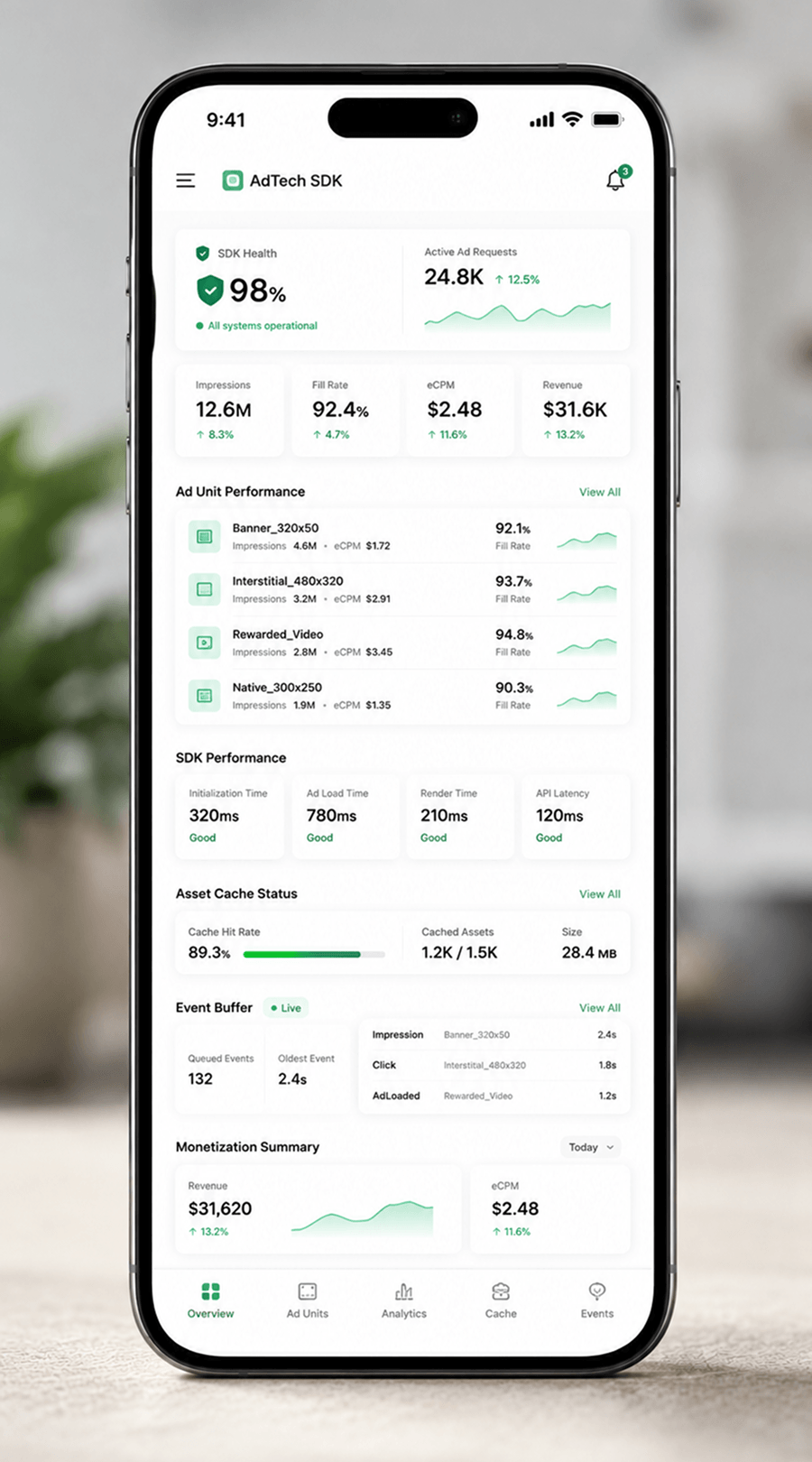

When a video unit stalls mid-load, banner auctions should keep running without interruption. Each ad format runs inside an independently threaded, timeout-controlled rendering pipeline so one format failure does not fail others. Fill rates across formats stay independent of each other under real traffic conditions.

First-party audience targeting only creates revenue impact when signals reach the auction before the bid request fires. Audience segments flow into floor price logic and demand partner selection at bid time, so high-value users generate higher floors rather than blending into a uniform pricing average.

Ad revenue analytics built at the SDK layer surfaces performance data as auction events fire, not when a batch report runs. Revenue anomalies become visible the same session they begin, giving teams time to act before a pricing issue compounds.

Mobile ad attribution requires clicks, completions, and conversions to be captured and assigned to the correct demand source at the SDK layer, not from post-bid logs. Session-persistent event tracking with demand-source assignment ensures budget allocation decisions reflect actual campaign performance, not approximations.

SDK consent management fails when consent validation sits outside the core data processing path as a wrapper rather than a gate. Every data operation in the SDK checks consent state before executing, so no bid request, audience signal, or analytics event moves without a valid consent record authorizing it.

Mobile SDK architecture stretched to serve living-room inventory produces predictable failures. A CTV ad SDK requires VAST 4.x compliance, server-side ad insertion logic, and connected TV identifier handling built natively into the auction layer, not adapted from mobile logic that was never designed for the format.

A floor price adjustment requiring an app store submission is not a decision at auction speed. Remote configuration pushes timeout values, partner enable states, and floor price logic to the SDK over the air so monetization decisions execute the same day they are made.

An ad fraud detection SDK filters bot traffic and invalid clicks at the request layer before they register as impressions. Performance metrics then reflect real users, and CPM integrity holds across the full partner roster rather than inflating reach with traffic that is never converted.

Auction behavior inherited from a third-party vendor reflects that vendor’s priorities, not yours. Custom auction logic makes floor price thresholds and partner priority weights configurable at the business level. Direct-sold campaigns compete in the programmatic auction on terms the business defines.
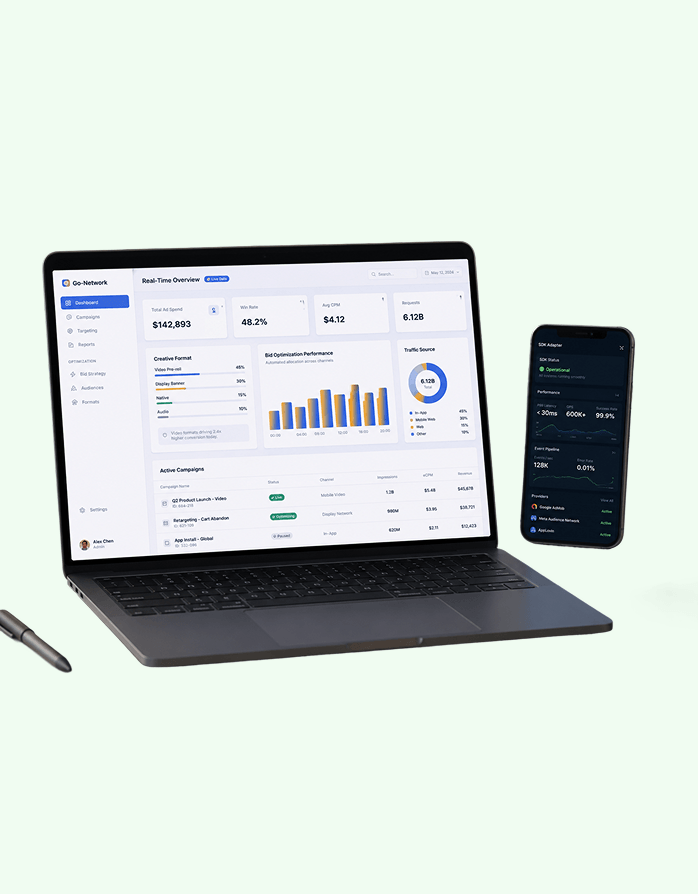
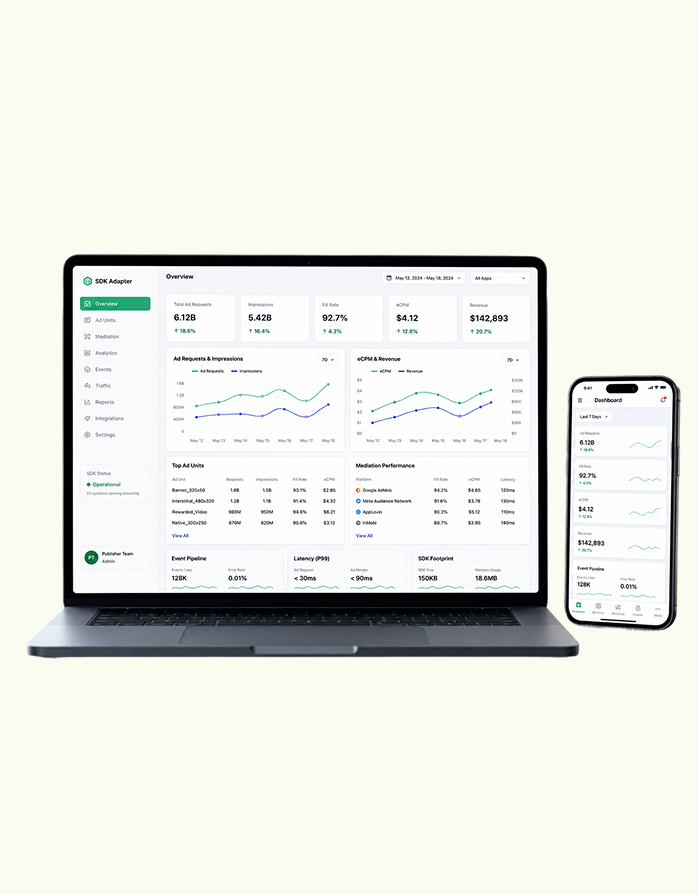
A high-performance mobile monetization company needed a custom SDK adapter and mediation platform capable of handling large-scale ad traffic with low-latency delivery, real-time event visibility, and flexible integration across multiple mobile advertising ecosystems.
Existing mediation platforms were expensive to customize and increasingly difficult to operate under high traffic conditions. The client needed infrastructure capable of processing billions of daily ad requests while maintaining low-latency delivery, stable event streaming, and consistent visibility into monetization performance.
Tuvoc engineered a custom mobile SDK adapter and mediation platform using GoLang, Kafka, Redis, Kubernetes, and distributed event pipelines. The system unified multiple mediation providers and SDK environments while supporting low-latency ad serving, real-time analytics processing, traffic orchestration, and centralized operational monitoring across large-scale mobile monetization workloads.
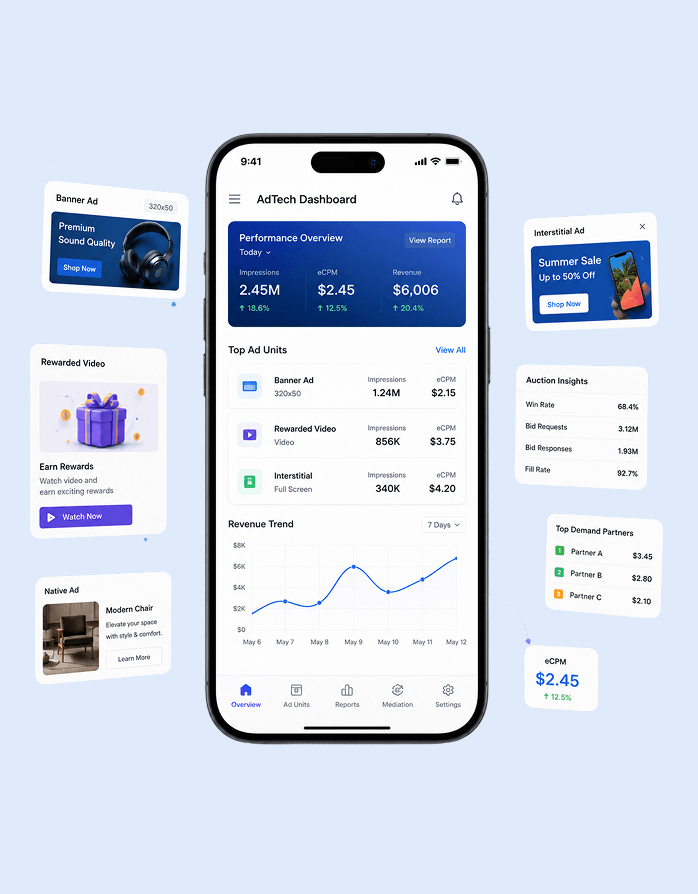
A fast-growing mobile publisher platform needed a custom Prebid Mobile environment capable of handling parallel auctions across multiple demand partners without the latency and fill-rate limitations created by sequential mediation waterfalls.
The existing monetization stack relied heavily on bundled mediation SDKs that introduced bidder timeout inconsistencies, fragmented analytics visibility, and unstable auction behavior during high traffic spikes. Revenue loss was becoming increasingly difficult to isolate because auction telemetry remained distributed across multiple vendor systems.
Tuvoc engineered a custom header bidding and Prebid Mobile integration layer with parallel auction execution, centralized bid telemetry, configurable timeout handling, and adapter-level mediation isolation. The platform unified demand orchestration while improving auction transparency across mobile inventory environments.
A connected TV advertising platform required a lightweight CTV SDK capable of supporting VAST delivery, quartile tracking, and cross-device monetization analytics across Roku, Android TV, and Fire TV environments.
The client was operating on repurposed mobile SDK infrastructure that struggled with pause-state rendering, playback synchronization, and large-screen ad measurement requirements. Event inconsistencies across device ecosystems were impacting reporting accuracy and advertiser confidence.
Tuvoc developed a custom CTV advertising SDK with native VAST and VMAP handling, server-side event synchronization, device-aware playback tracking, and centralized analytics processing for connected TV environments. The architecture supported platform-specific rendering behavior without fragmenting reporting pipelines.


Tuvoc Technologies delivered on time and was responsive. Their commitment to delivering high- quality solutions and forging long-term relationships with customers was amazing. After platform launch, a 40% increase in user engagement, and a 25% rise in customer satisfaction.


Tuvoc Technologies delivered a secure and highly efficient web platform for financial management, boosting user participation by 40% and reducing transaction times by 50%. The team used Agile methodologies, was highly responsive, and quickly adapted to changes. The team's expertise stood out.


Thank you, team, for your service. You did a fantastic job. I worked with many teams for software development, but you guys gave me a really overwhelming experience. You guys really gave us experience like family and friends more than any professional relationship. Thank you so much again. Keep it up.

We have worked with Tuvoc for several years, and they have consistently delivered high-quality work on time. Their diligence, attention to detail, and proactive communication have made them a reliable partner to develop and maintain the performance of our product.

Thanks to Tuvoc Technologies’ work, the client saw a 40% increase in online transactions, a 25% increase in customer retention, and a 30% reduction in transaction processing time. The team was responsive, attentive, and customer oriented. They maintained clear and consistent communication.
Partner with Tuvoc to build a custom AdTech SDK that gives you greater control over monetization, data, and growth.
Let's Build Your SDK
Programmatic monetization becomes a strategic asset when the infrastructure running it belongs to the business, not a vendor. Custom AdTech SDKs create measurable business value where advertising decisions impact the revenue bottom line, competitive position, and the ability to scale without hitting someone else’s architectural ceiling.
Beyond 500 million monthly impressions, third-party take rates become a calculable revenue loss. A publisher monetization platform built on proprietary SDK infrastructure eliminates that margin compression entirely, keeping yield rules and auction priorities inside the business.
Platforms sustaining hundreds of millions of daily requests need auction infrastructure that holds under sustained concurrency. Stateless auction processing with horizontal scaling architecture keeps demand win rates stable as traffic volume grows beyond projected peaks.
Licensing a proprietary ad server means paying for auction logic that cannot be modified or tuned. Building it removes that dependency, putting floor price logic and demand partner prioritization under direct business control.
Separate mobile, web, and CTV stacks mean the same advertiser gets measured differently across every surface. Cross-channel ad management produces consistent attribution and a single performance source of truth across all channels.
Retail media network solutions require first-party purchase data to reach external DSP demand without exposing raw transaction records. A retail media SDK translates shopping intent signals into bid-time audience parameters at the request level.
Advertisers buying across mobile, web, and CTV expect consistent measurement. Running those channels on separate stacks makes that impossible because each stack attributes differently. A unified SDK layer resolves this at the auction level, not the reporting level.
Most custom AdTech SDK development projects encounter problems that were designed in, not discovered late. At Tuvoc, architecture decisions get resolved before development begins because the planning stage is where performance, scaling behavior, and deployment stability are actually determined.
Existing SDK behavior is instrumented against live traffic before any architecture discussion begins. Design decisions come from real request patterns, not assumptions about what the current system does.
Auction logic is mapped as a state machine before coding begins. Every timeout path and fallback state gets a named resolution so production surprises are designed out.
Each module is tested against traffic patterns from the discovery phase. Actual demand partner responses from shadow mode are used so performance is validated against real conditions.
Traffic routes through the new SDK at 1%, 5%, 20%, then 100%. Each gate holds until CPM variance and error rates confirm stability before the next stage opens.
Behind every project is a business challenge solved and measurable results delivered. Explore how our custom software solutions have transformed operations and created competitive advantages for our clients.
Increase in productivity
Return on investment
Countries Served
5-star reviews

OpenRTB and Prebid integration requirements change. Platform policies update. Compliance standards expand into new jurisdictions. The engineering stack beneath a production AdTech SDK determines whether those changes get absorbed cleanly or trigger a reengineering cycle. At Tuvoc, stack selection is a long-term architectural decision, not a project preference.
Custom AdTech SDK performance is not a product of good development alone. The engineering decisions made before a single line of code is written determine whether the SDK holds under advertising traffic that doubles, spikes, or scales beyond original projections. Architecture is where performance is decided.
Programmatic revenue optimization becomes a business capability rather than a vendor negotiation when the SDK infrastructure belongs to you. Every product decision, pricing experiment, and monetization strategy moves at your business’s pace, creating a stronger foundation for revenue growth and long-term scalability.

Source code access means floor price thresholds, partner priority weights, and timeout values can be tested against live traffic without vendor approval or feature request queues.

A pricing floor adjustment requiring an app store submission loses its value before it deploys. Remote configuration pushes auction parameter changes so monetization decisions execute the same day they are made.

Audience-based price floors apply segment-level pricing in real time so high-value inventory reflects actual user signals rather than population averages that undervalue your best traffic.

The adapter layer built into the SDK makes each new SSP or DSP integration a self-contained module so demand partner expansion carries a predictable engineering cost every time.

First-party data ownership means every data operation, consent record, and retention period is logged inside your own infrastructure rather than requested from a vendor during a compliance review.

Shared infrastructure means competitors access the same demand signals and audience proxies. A proprietary SDK combines first-party data, custom fraud detection, and pricing logic into a signal set nobody else can replicate.

The future of custom AdTech SDK development is being shaped by post-IDFA programmatic yield optimization. Privacy-first identity and AI-driven decisioning are redefining how auctions run. Distributed architectures are redefining where they run. At Tuvoc, these shape how production SDKs get built today, not tomorrow.
Static floor rules reviewed quarterly cannot respond to live demand variation. Machine learning yield optimization updates floor prices within the auction session based on bid density and audience signal quality.
Privacy-first ad targeting built on on-device consent processing keeps monetization functional as device-level identifiers deprecate. Audience signals are inferred within the app data perimeter without cross-app identifier dependency.
AI audience targeting built on in-session behavioral prediction infers user intent before the bid request fires, shifting from historical segment classification to real-time signal evaluation.
Moving bid evaluation to edge nodes eliminates the central infrastructure round-trip so auction performance holds in high-latency markets where server distance has always been the binding constraint.
Unified ID 2.0 and Topics API cohort signals become the primary identity layer when cookieless identity resolution is built into the SDK. Audience addressability holds across iOS, Android, and CTV.
Policy-constrained autonomous agents monitor CPM, fill rate, and partner performance, reallocating budget and adjusting floor prices at signal speed without human approval on each adjustment cycle.
Federated learning advertising trains audience models on-device so only gradient updates aggregate centrally. Audience intelligence improves with scale without raw user data ever leaving its source environment.
Data clean room integration built into the SDK layer enables encrypted, non-joinable dataset analysis so publisher and advertiser first-party assets combine without raw records leaving either party’s infrastructure.
Fines, app store suspensions, and costly redevelopment almost always uncovers compliance issues that were patched in after deployment. At Tuvoc, mobile advertising privacy compliance sits inside the core data processing architecture from the first build so the exposure window never opens.
Jurisdiction-aware compliance logic inside a GDPR CCPA compliance SDK gates every data operation before it executes, not as a geographic filter applied after data has already moved across borders.
A user withdraws consent inside your app. Without IAB TCF compliance signal propagation, that withdrawal reaches the SDK but stops before it binds the SSPs, DSPs, and DMPs processing data downstream.
Compliant SKAdNetwork implementation requires postback validation that confirms conversion attribution without exposing device-level data, tested against pre-release iOS betas before each Apple policy update lands.
Privacy Sandbox API integration built before deprecation completes means Topics API targeting and Protected Audience remarketing are already operational when third-party cookies stop working.
Non-compliant bid requests fail silently. OpenRTB 2.6 compliance built into request construction surfaces specification errors at build time rather than unexplained demand partner timeouts in production.
Every data operation generates a structured log recording what was processed, which partner received it, and what consent authorized it. The audit trail exists before regulators ask.
Custom AdTech SDK development is measured by production performance, not presentation. At Tuvoc, engineering claims are not positions taken in a pitch. They are validated under real advertising traffic, real demand partner behavior, and real scaling pressure. That gap between knowing AdTech and having built it at scale is where Tuvoc’s work speaks.
One Tuvoc-built SDK scaled from 27,000 to 560,000 requests per second in production without architectural changes. Stateless auction processing and horizontal pod autoscaling across cloud regions absorbed the growth through additional instances, not redesign.
Full auction logic, mediation, and analytics delivered inside 150KB. Binary encoding over JSON, lazy-loaded modules, and a strict dependency audit at every release keep that constraint enforced per build, not just at launch.
No vendor kickbacks shaping our recommendations. No exceptions on confidentiality either. What you get is a technology stack matched to your business, and full protection over your data, source code, and IP for as long as we work together.
Compliance added after shipping creates an exposure window every time a regulation changes. SDK compliance architecture at Tuvoc places GDPR consent gates, ATT sequencing, and TCF v2.2 propagation inside the core before development begins.

SDK maintenance and updates at Tuvoc cover OS compatibility drift, demand partner API versioning, and IAB specification changes across every release cycle. The SDK stays current without pulling your engineering team off their core roadmap.
Every Tuvoc SDK deployment is preceded by load testing at five times projected peak, validating auction behavior under sustained concurrency and confirming graceful degradation before live traffic routes through.
White label SDK ownership means full source code transfer and no runtime licensing dependency. Everything built for a client belongs to that client from delivery. Tuvoc holds no ongoing leverage over the codebase.
Twelve to twenty weeks for most projects, depending on scope. The discovery and design work upfront adds a few weeks, but that is exactly what stops development from dragging on later.
Not messy at all. We build and test the new SDK while your existing one keeps serving traffic. By the time we cut over, the replacement has already been validated against real impressions.
The architecture is built with room to grow from day one, not sized tightly to launch numbers. If traffic outpaces projections, we scale with you rather than scrambling to catch up after the fact.
If a third-party SDK is already blocking a decision you want to make, that is usually the signal. We will go through your numbers before recommending anything.
Stay updated with articles that share practical tips, industry news, and thoughtful commentary on digital trends.
Most real estate businesses we talk to aren't short on leads or deals. Even your search for a white-label real…
Blog Summary Money still moves through infrastructure built for another era Consumer expectations are reshaping payment system priorities Real-time payments…
This Blog Explains: Cost Breakdown: Understand what actually increases Zillow-like app development expenses Infrastructure Reality: Learn why MLS systems change…

Thank you for getting in touch! Kindly fill the form, have a great day!