Step-by-Step Guide to Build Trending Software Development in 2026

Bhavin Umaraniya
Finance
Published : Dec 9, 2025

Key Takeaways:
AI-First Architecture:: Platforms without embedded AI will lose to autonomous, intelligent trading systems.
Resilience Over Speed:: Uptime and fault tolerance now matter more than raw execution latency.
Compliance Automation:: Manual processes fail; real-time RegTech handles MiFID II and DORA requirements.
Multi-Asset Integration:: One platform must seamlessly handle equities, crypto, RWAs, and DeFi liquidity.
Introduction: The Evolution of Trading Markets
In November 2025, macro and microgeoeconomic visuals shattered every algorithmic assumption. Suddenly, financial experts are asking, “How to build a trading platform in 2026?” Crypto plunged 35%, the Japanese bond yield crossed 2.5% after decades, and gold soared to $4100 while oil convulsed under geopolitical pressure.
As this environment of unpredictable volatility unfolds and generic trading interfaces fail, investors and portfolio managers seek a resilient, multi-asset architecture through robust and advanced trading software development.
Institutional and retail traders alike demand that custom trading software development must now transcend conventional design, integrating real-time geopolitical parsing, alternative data streams, multi-regime algorithms, and extreme-event architectures.
This trending software development guide 2026 explains how advanced trading software is capable of:
- Handling a 35% crypto drawdown without system-wide liquidation failures.
- Managing assets, ensuring profitability when bond yields spike unknowingly.
- Executing event-driven situations to capture AI-driven alpha in milliseconds.
The question is no longer optimization; it’s survival. Markets demand systems that adapt faster than volatility spreads, or risk becoming obsolete mid-execution.
From Mobile-First to AI-First
Legacy apps prioritized screen responsiveness, but modern interfaces must prioritize intent prediction. Custom trading platform development now centers on embedding inference models directly into the execution workflow to automate decision-making.
- Predictive execution models are replacing static inputs.
- Automated hedging logic within user workflows.
- Context-aware interfaces driving proactive decisions.
Market Outlook 2024–2026
To understand how to build a trading platform in 2026, it is necessary to analyze the transition from pure volume growth to intelligent, automated retail involvement and the institutional introduction of AI.
- Market Growth: The global online trading platform market is projected to reach $13.3 billion by 2026.
- Adoption: The AI-driven trading platform market is expanding at a ~22% CAGR, driven by growing demand for intelligence.
- Retail Uptake: Retail investors are projected to command 37.5% of the algorithmic trading market share by 2025.
- Asset Expansion: Mobile interfaces now account for over 54% of global internet traffic, mandating mobile-native architectures.
Why “Resilience” Replaced “Speed”
Latency remains critical, but system uptime during “Black Swan” events is the primary differentiator. Trading software development services focus on circuit breakers that prevent catastrophic cascading failures during 35% drawdowns.
- Fault tolerance prioritizes uptime over microseconds.
- Circuit breakers prevent systemic liquidation cascades.
- Graceful degradation during extreme volatility spikes.
What This Guide Covers: Architecture, AI, HFT, Compliance & Costs
We deconstruct the stack from kernel-bypass networking to DORA-compliant governance. Expect deep dives into Rust-based matching engines, event-driven Kafka pipelines, and the hidden costs of FinOps in this blueprint for trading platform development. We strip away marketing buzzwords to expose the raw engineering requirements.
- Kernel-bypass networking and low-latency architecture.
- DORA-compliant governance and regulatory frameworks.
- Rust-based matching engines for high throughput.
Types of Trading Software: Defining Your Niche

Diverse users have different needs that the trading platforms cater to. Some of them are simply aimed at new users, and others welcome sophisticated approaches to expert desks. Knowing these categories will help you in trading software development that suits your market and business, focusing on high performance and long-term growth.
Retail Trading Platforms: Gamification, Social Trading & UX Personalization
Trading is easy and involves regular users via retail platforms. Rewards, shared ideas, and guided actions enhance confidence. Such aspects are driving current stock trading software development, making it easier for new traders to learn without much friction.
Institutional & Prop Trading Systems: DMA, Dark Pools & Co-Location
The controls of trading in large volumes are based on institutional systems. They depend on access, private liquidity locations, and proximity hosting. These technologies define higher-level algorithmic trading software that aims for accuracy and speed.
Direct Market Access (DMA) Models
DMA enables the traders to trade on the exchanges without additional levels, enhancing visibility and control. All execution engines are built on active institutional workflows with robust routing logic.
- Faster order movement
- Lower routing costs
Dark Pool Integration & Routing
Dark pools enable large trades to take place in silence without affecting public prices. These venues are offered by routing systems when traders require privacy and reliable results.
- Lower market impact
- Hidden liquidity access
Latency-Sensitive Order Execution
Execution latency is minimized throughout the trading process. Low-latency systems help users respond quickly and accurately to new market conditions.
- Rapid order flow
- Local processing logic
Co-Location Policies by Exchanges
Co-location also places the trading servers close to the exchange systems, reducing travel time and enhancing stability. Firms involved in colocation enjoy greater performance predictability in fast markets.
- Shorter signal routes
- Better response times
DeFi 2.0 & RWA Trading Platforms (Tokenized Assets & On-Chain Liquidity)
DeFi is an RWA tokenization platform that allows users to trade digital and real-life assets via automated smart contracts. Such concepts direct the emergence of the RWA tokenization platform, providing markets with clear settlement, accessible liquidity, and programmability.
Tokenization of Real-World Assets (RWAs)
The idea of tokenization can convert real-life assets into digital assets that can be traded across different markets easily. This can be used to enhance access and allow flexible multi-asset trading across the globe.
- Simple asset transfer
- Global settlement access
Smart Contract Settlement Risks
Smart contracts remove third parties from transactions by using code. A plausible smart contract integration minimizes the risks of errors, bugs, and security vulnerabilities.
- Code-based rules
- Automated settlement
Liquidity Pool Mechanics & Price Feeds
Liquidity pools also allow users to trade using nontraditional order books. Additional reliable feeds help achieve equitable prices and balanced markets, which are necessary for safe crypto exchange development.
- Constant price updates
- Liquidity balancing
On-Chain Compliance & Identity Layers
On-chain compliance would be used to verify users’ identities and secure privacy. These layers help platforms meet regulatory requirements without slowing trading activity.
- Real-time checks
- Encrypted identity proofs
Algorithmic Trading & HFT Bots: Fully Autonomous Execution Pipelines
The algorithms are automated signals that operate with accurate logic. Model speeds are in the microsecond range. An aggressive strategy engine ensures that decisions are precise, dependable, and aligned with the dynamic market requirements.
Execution Logic Layers (Entry/Exit Rules)
Execution logic specifies trades based on definable rules for when to open and when to close them. Such a structure enhances uniformity and eliminates emotional trading.
- Simple trigger rules
- Automated exits
Signal-Generation Models (ML/Quant)
Signal-generation models perturb, quantize, and auxiliaryize signal engines that apply machine learning and patterns to data to identify trading opportunities.
- Pattern detection
- Trend scoring
Risk Filters & Position Sizing Engines
Risk filters safeguard the trades; exposure, leverage, and volatility are reviewed. These risk management tools in trading systems balance and manage portfolios.
- Position caps
- Exposure limits
Monitoring & Drift Detection
Drift detection occurs when the model becomes inconsistent with new market data. Early warning cushions performance and appropriates necessary strategy changes.
- Model shift alerts
- Live behavior checks
White-Label vs. Custom Platforms: Build, Buy, or Hybrid?
White-label systems can be launched quickly, whereas custom designs offer long-term flexibility. Many teams hire fintech developers to combine the two strategies and deliver a scalable, stable trading experience in their use cases.
Time-to-Market Considerations
Quick launch assistance in gaining initial momentum. White-label alternatives take less time to install, whereas a custom assembly requires more thorough planning before release.
- Faster deployment
- Lower early delays
Customization vs. Vendor Lock-In
The completely controlled designs and features are available in custom platforms. White-label tools are cheaper but less flexible and cannot be owned in the long term.
- Limited feature control
- Fixed system rules
Total Cost of Ownership (TCO)
TCO consists of building, hosting, maintenance, and upgrades. Knowledge of the cost to build a trading platform helps teams strategize more efficiently about resource allocation.
- Early setup cost
- Ongoing maintenance needs
Security & Compliance Limitations
White-label platforms may be unsuitable under stringent regulatory requirements. Tailor-made builds enable enhanced encryption and adaptable regulations on safer processes.
- Stronger data protection
- Adaptable compliance rules
Multi-Asset Support: Equities, Crypto, Forex, Derivatives & RWAs
Trading in many asset classes will need a dynamic program development environment. The assets are not all the same; thus, trading software development frameworks must provide liquidity, speed, rules, and pricing without disorienting the user base or impairing performance.
Asset-Specific Latency & Liquidity Behavior
Every asset is moved at its own pace. The sites should be able to handle both high-value markets, such as crypto, and low-value markets, such as bonds, without performance lapses.
- Volume spikes
- Spread widening
Different Order Types by Asset Class
Various assets dictate various order types, which correspond to the market behavior. The tips are helpful in supporting such decisions, allowing the user to buy and sell under varying circumstances.
- Multi-leg orders
- Conditional rules
Regulatory Variations (MiFID, SEC, Crypto-FATF)
There are various rules in various regions and assets. The platforms should respond quickly and address all needs to minimize the risks to reporting, transparency, and user protection.
- Region-based rules
- Reporting needs
Pricing Feed Variability Across Markets
Price feeds vary between exchanges and markets. Platforms need to standardize on these updates to provide users with clear insights during volatile periods.
- Feed refresh rates
- Vendor differences
Core Features: The Must-Have Functional Modules
Architectures of institutional-grade financial entities need to include modules capable of supporting high concurrent loads without latency impairment. Custom trading platform development prioritizes modularity, enabling basic building blocks such as the OMS and risk engine to be deployed independently while remaining synchronized to provide stability in a highly volatile environment.
Identity & Onboarding: Multi-Tiered KYC/AML & Fraud Prevention
The initial point of defense is called onboarding. A powerful stack combines KYC/AML compliance by leveraging multi-layer verification loops that balance a friction-free UX with strict regulatory compliance to prevent fraud.
Identity Verification (OCR, Biometrics, eKYC)
The automated pipes can be OCR and biometrically checked for liveness, verifying users within seconds. Advanced trading compliance software integrates these checks to minimize drop-offs.
- Biometric liveness detection
- Instant OCR parsing
AML Screening & Transaction Monitoring
Real-time screening cross-references global watchlists and PEP databases. Transaction monitoring engines flag suspicious velocity patterns or structuring attempts before funds settle in the wallet.
- Global sanctions matching
- Velocity pattern alerts
Risk Scoring Models & Tiering
Users are assigned dynamic risk scores based on geography, source of funds, and trading behavior. High-risk profiles trigger enhanced due diligence workflows automatically.
- Dynamic profile scoring
- Automated diligence triggers
Secure Document Storage/Encryption
When PII data is at rest, it can be encrypted using AES-256. Data encryption keys should be changed periodically. There must be stringent role-based access controls to ensure unauthorized internal visibility.
- AES-256 encryption
- Strict access controls
Order Management System (OMS): Core Execution Logic
The Order Management System (OMS) is the central nervous system, orchestrating order validation, routing, and lifecycle state management while maintaining state consistency across distributed database shards.
Market & Limit Orders
Market orders demand immediate liquidity interaction, while limit orders reside in the matching engine until price conditions are met, requiring persistent state tracking.
- Immediate liquidity fill
- Persistent state tracking
Conditional Orders (SL/TP/TSL)
Stop-loss and take-profit logic resides server-side, triggering only when the order book price feed hits specific thresholds to prevent premature execution during volatility.
- Server-side triggers
- Volatility threshold logic
Algorithmic Orders (TWAP, VWAP, Iceberg)
Execution algorithms slice large parent orders into child orders to minimize market impact. Real-time trading software features like TWAP and VWAP automate this fragmentation.
- Child order slicing
- Market impact reduction
Order Lifecycle States
Every order transitions through deterministic states – Pending, Open, Filled, Cancelled, or Rejected. The state machine ensures atomic updates to prevent race conditions during high throughput.
- Deterministic state machine
- Atomic status updates
Rejection Logic & Error Flags
Pre-trade validation layers reject orders violating margin requirements or risk limits immediately. Error flags provide precise feedback codes to the API for debugging.
- Pre-trade validation
- Precise error codes
Internal Crossing Systems
Before routing to external exchanges, the engine checks for internal matches. This reduces exchange fees and improves fill times for offsetting client orders.
- Fee reduction logic
- Internal match checks
Market Data & Charting: L1/L2 Feeds, Indicators & Analytics
Pinpointed market data systems receive, normalize, and distribute tick-level data. The design should also separate ingestion and distribution lest slow consumers block such important pricing streams.
L1 vs L2/L3 Market DataL1 provides the best bid/ask, while L2/L3 feeds expose full market depth. Architects must handle the exponentially higher bandwidth requirements of depth feeds.
- Full-depth visibility
- High bandwidth handling
Candlestick & OHLC Rendering
Raw tick data is aggregated into OHLC bars via time-windowed buckets. Efficient rendering pipelines prioritize recent data points to maintain UI responsiveness during high volatility.
- Time-windowed buckets
- Responsive UI rendering
Real-Time Indicators & Overlays
Client-side libraries calculate SMAs, EMAs, and RSIs on the fly using streaming data points. This offloads computation from the backend, reducing server latency.
- Client-side calculation
- Reduced server load
Depth Chart & Order Book Visuals
Visualizing the market depth requires rendering the L2 order book structure dynamically. It highlights buy/sell walls and liquidity gaps for traders analyzing immediate support/resistance.
- Liquidity wall visualization
- Dynamic book structure
Data Throttling / Rate Limit Handling
Conflation algorithms merge rapid price updates to match the UI refresh rate. High-throughput systems cap downstream messages to prevent client-side browser crashes.
- Update conflation logic
- Client crash prevention
Watchlists & Screeners: Real-Time Filtering & AI Recommendations
Screeners act as the discovery engine for traders. Key features of a trading software MVP include real-time filtering capabilities that query normalized market data without latency penalties.
Basic Filters (Price, Volume, Change%)
Users filter assets by standard metrics like percent change, volume, and market cap. Indexing these fields in memory ensures sub-millisecond query responses.
- In-memory indexing
- Sub-millisecond queries
Advanced Filters (Volatility, Correlation, Beta)
Volatility and beta calculations require historical data correlation. These distinct queries run on read replicas to avoid impacting the performance of the core transactional database.
- Read-replica execution
- Historical correlation logic
AI-Based Screening (Sentiment, Patterns)
AI-powered trading strategies leverage NLP models to score sentiment from news feeds. The screener highlights assets showing unusual positive or negative sentiment velocity.
- NLP sentiment scoring
- Velocity trend highlighting
Multi-Asset Heatmaps
Heatmaps visualize market performance across sectors using color-coded grids. Efficient tiling algorithms render thousands of tickers simultaneously without significant GPU overhead on the client.
- Color-coded visualization
- Efficient tiling algorithms
Cross-Device Syncing
Watchlist states are synced via WebSockets to a central user database. Changes made on mobile reflect instantly on desktop, ensuring a unified session experience.
- WebSocket state sync
- Unified session state
Portfolio Management: P&L, Risk Metrics, Tax Lots & Reports
Accurate accounting distinguishes professional platforms. Understanding the OMS vs. EMS differences is crucial; the portfolio module relies on the OMS to calculate realized and unrealized P&L.
Real-Time P&L Calculation
Calculations update with every tick. Anomaly detection algorithms monitor for calculation errors caused by nasty data ticks, preventing false profit displays during flash crashes.
- Tick-by-tick updates
- Bad data filtering
Exposure, VaR & Risk Buckets
Risk buckets merge the asset part or division. Value-at-Risk (VaR) models estimate potential losses and trigger margin calls when the threshold is breached.
- Sector-level aggregation
- Margin warning triggers
Tax Lot Tracking
FIFO, LIFO, and HIFO logic tracks the cost basis for every trade execution. This granular tracking is essential for accurate capital gains reporting.
- Granular cost basis
- Capital gains accuracy
Trade Ledger & Audit History
An unchangeable ledger documents all fills and fees, as well as funding adjustments. This establishes an audit trail that can be verified during the reconciliation process and in regulatory investigations.
- Verifiable audit trail
- Fee tracking logic
Performance Attribution
Attribution analysis breaks down returns by strategy or asset class. Time-weighted return calculations allow traders to assess skill relative to market beta.
- Strategy return breakdown
- Time-weighted calculations
Funds, Deposits & Withdrawals: Fiat Ramps & Crypto Wallet Integration
Integrating APIs in trading software to accept payments must include robust error handling to account for any latencies in the trading system and the confirmation time for a block in the cryptocurrency.
Banking Integrations (ACH, SEPA, UPI, SWIFT)
Payment gateway integrations as well as ACH, SEPA, and wire transfers are supported. Webhooks listen for deposit success events to credit user balances asynchronously.
- Asynchronous balance credit
- Webhook event listeners
Crypto Wallets (Hot/Cold Storage)
Hotels manage operating liquidity through hot wallets, with most funds secured in cold storage. Multi-signature schemes require multiple approvals for any outbound cold wallet transaction.
- Multi-sig approval
- Cold storage security
Reconciliation Processes
Automated jobs compare internal database balances against external bank and blockchain ledgers daily. Discrepancies trigger immediate alerts for finance teams to investigate.
- Daily ledger comparison
- Discrepancy alert triggers
Fraud Checks & Velocity Limits
Velocity limits restrict the frequency and volume of withdrawals within a set window. IP geolocation checks flag withdrawal requests originating from suspicious or new locations.
- Withdrawal velocity caps
- Geo-location flagging
Withdrawal Queue Management
Manual review queues hold large withdrawals for admin approval. Batch processing aggregates smaller requests to save on blockchain gas fees or banking transaction costs.
- Admin approval queue
- Batch fee optimization
Trade History & Compliance Logs
Compliance with the regulations is absolute. Using trading API integration feeds, all data modifications to orders and trade execution are logged in the archival systems to maintain the required retention period.
Activity Logs & Audit Trails
Logs capture every user action, including login attempts and changes to settings. These trails are critical for forensic analysis during security incidents or account disputes.
- Forensic analysis trails
- User action logging
Regulation-Ready Reports (MiFID/SEC)
Reporting engines generate standardized reports for MiFID II or SEC requirements. Automated generation schedules ensure the timely submission of transaction data to regulatory bodies.
- Standardized report formats
- Automated submission schedules
Data Export Formats
Users require CSV or PDF exports for external tax software. The system generates these asynchronously to prevent database locks during heavy reporting periods.
- Asynchronous generation
- External tax compatibility
Immutable Storage Requirements
WORM (Write Once, Read Many) storage compliance ensures logs cannot be altered. This guarantees data integrity for auditors validating historical trade data.
- WORM storage compliance
- Data integrity guarantee
Passive Tools (Core Features) vs. Active Partners (Next-gen Features)
| Feature Category | Core Features (Passive Tools) |
Emerging Features (Active Partners) |
|---|---|---|
| Execution Logic | Order Management System (OMS): Executes static rules (Limit, Market, Stop-Loss) initiated by the user. | Agentic AI: Autonomous agents that proactively hedge, rebalance, or snipe liquidity without manual input based on intent. |
| User Interface | Static Dashboards: Fixed grids of charts and buttons that look the same for every user. | Hyper-Personalization: Adaptive layouts that morph based on volatility (e.g., simplifying the UI during a crash) and behavioral risk scores. |
| Market Analysis | Technical Indicators: RSI, MACD, and Moving Averages based on historical price data. | Sentiment & GenAI: NLP models parsing Twitter/News for FUD and Generative AI simulating “Black Swan” crash scenarios. |
| Interaction | Point & Click: Manual data entry and button presses to place trades. | Conversational Finance: Voice-activated execution (NLP) and intent-based commands (e.g., “Close my exposure to Tech”). |
| Risk Management | Pre-Trade Checks: Validating margin and position limits before a trade is sent. | Predictive Risk Engines: AI models forecasting liquidity drying up before it happens and preventing entry. |
| Compute Location | Cloud-Based: Calculations happen on a central server, introducing network latency. | On-Device Inference: Edge AI running risk scoring and signal generation directly on the user’s phone for zero-latency feedback. |
| Testing | Backtesting: Replaying historical data to see how a strategy would have performed. | Synthetic Simulation: Using GenAI to create fake “perfect storms” (e.g., -50% flash crash) to stress-test systems against events that haven’t happened yet. |
Next-Gen Features: The 2026 Differentiators
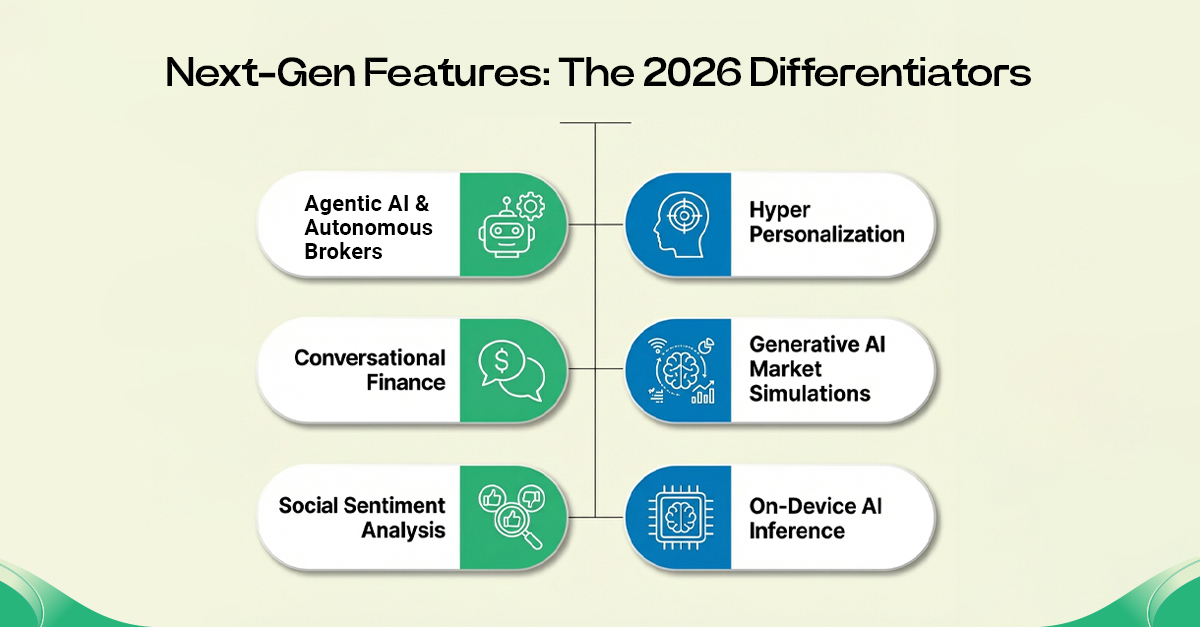
Passive tools will be extinct by the year 2026. The next major trend in fintech software development services is the rise of agentic AI and hyper-personalization, where platforms evolve from static execution interfaces into proactive wealth partners that navigate volatility, anticipate user behavior, and take action autonomously.
Agentic AI & Autonomous Brokers
Moving beyond simple alerts, Agentic AI executes complex strategies autonomously. Modern stock trading software development embeds these intelligent agents to manage liquidity, hedge risks, and rebalance portfolios without manual intervention.
Reactive Agents (Event–Response Rules)
Scenario: An inflation report triggers a 50-bps spike in bond yields. The reactive agent immediately shorts tech equities and buys gold futures to hedge the portfolio delta, executing within milliseconds of the data release using algorithmic trading software.
- Instant news-based hedging
- Delta-neutral execution speed
Proactive Agents (Predictive Rebalancing)
Scenario: To anticipate a liquidity crunch towards the end of the day, the agent splits a large block order into smaller child orders earlier in the day. By doing this earlier in the session, they minimize slippage costs and eliminate the volatility that would otherwise accompany a large block order.
- Liquidity crunch avoidance
- Slippage minimization logic
Multi-Agent Coordination
Scenario: A “Sniper Agent” identifies an arbitrage opportunity while a “Risk Agent” simultaneously validates capital limits. They negotiate instantly: the Risk Agent authorizes a temporary leverage boost to capture the alpha safely.
- Inter-agent logic negotiation
- Dynamic leverage authorization
Risk-Constrained Autonomy
Scenario: An autonomous bot attempts to double down on a losing crypto position. The hard-coded risk constraint overrides the AI’s decision, forcing a stop-loss execution to preserve capital and adhere to the maximum drawdown mandate.
- Hard-coded safety overrides
- Maximum drawdown enforcement
Human Oversight Models
Scenario: The AI proposes a high-risk portfolio rotation into emerging markets. It pauses execution, pushing a “human-in-the-loop” notification to the trader’s mobile app that details the thesis and awaits biometric authorization to proceed.
- Push notification approval
- Biometric execution clearance
Hyper-Personalization via Behavioral Analytics
Static dashboards are dead. Enhanced UI/UX for trading platforms is based on behavioral analytics that dynamically adjust the layout based on metrics specific to the strategy, the trader’s risk-taking preferences, and historical trading interaction patterns.
Behavioral Scoring Models
Algorithms analyze hold times and panic-selling tendencies to assign a “trader psychology” score, customizing the platform’s risk warnings accordingly to prevent emotional decision-making.
- Panic-sell detection
- Psychology-based warnings
Adaptive UI Layouts
The interface automatically simplifies during high volatility to focus on execution buttons while expanding analytical tools during low-volume accumulation phases to encourage research.
- Volatility-based simplification
- Context-aware tools
Personalized Trading Alerts
Instead of generic price pings, users receive alerts tailored to their specific portfolio beta, highlighting only events that materially impact their holdings.
- Portfolio-impact filtering
- Beta-weighted notifications
Personalized Market Recommendations
ML models suggest assets that statistically correlate with the user’s successful past trades, effectively creating a bespoke discovery feed for new investment opportunities.
- Success-correlation suggestions
- Bespoke asset discovery
Conversational Finance (Voice/NLP Trading Interfaces)
Natural Language Processing (NLP) enables “Voice-to-Action” workflows. Specialized trading software development services implement these interfaces, allowing traders to execute complex multi-leg options strategies or query portfolio risk using conversational spoken commands.
Voice Command Parsing
The engine converts spoken phonemes into structured JSON trade orders. It distinguishes between similar tickers and financial jargon with high accuracy to prevent execution errors.
- Phoneme-to-JSON conversion
- Financial jargon recognition
Natural Language Intent Detection
Intent models understand context, discerning that “Get me out” means “Liquidate all open positions immediately” rather than just closing the app interface.
- Contextual panic recognition
- Immediate liquidation intent
Secure Voice Authentication
Voice authentication is performed by examining special cadence and pitch (charges) to enable high-value transactions, providing a frictionless security layer on top of passwords.
- Vocal print analysis
- Frictionless transaction approval
Multilingual Support
Real-time translation layers allow global user bases to trade in native dialects, ensuring complex financial terms are localized accurately to prevent costly misunderstandings.
- Real-time dialect translation
- Localized terminology accuracy
Generative AI Market Simulations (Stress, Liquidity & Crash Scenarios)
GANs (Generative Adversarial Networks) form natural market conditions. The algorithms can be trained using synthetic market crash testing, which makes them robust to events that have never occurred before, including Black Swans.
Stress-Testing Generators
The system generates hypothetical “perfect storms,” combining interest rate hikes with geopolitical shocks to test portfolio resilience under maximum theoretical pressure.
- Hypothetical storm generation
- Maximum pressure validation
Volatility Regime Simulation
Models simulate transitions between low-volatility and high-volatility regimes, ensuring execution logic adapts correctly when market texture changes abruptly.
- Regime transition training
- Adaptation logic verification
Synthetic Liquidity Modeling
AI generates fake order book depth to test how considerable orders impact slippage in thin markets, optimizing execution algorithms before live deployment.
- Fake order book depth
- Slippage impact testing
Crisis Replay Engines
Engineers recreate past crashes (e.g., 2008, 2020) using modified variables to understand how current strategies respond to past disasters.
- Historical crash re-simulation
- Strategy performance auditing
Social & Sentiment Analysis (Twitter/X, Reddit, News & On-Chain Data)
An informational advantage is offered by incorporating non-structured data feeds. Trend/FUD detection engines process millions of social signals to quantify market psychology, identifying pump-and-dump schemes or institutional accumulation in advance of price action.
NLP Sentiment Models
Transformer models analyze news headlines and social posts, assigning real-time polarity scores (bullish/bearish) to tickers to filter signal from noise.
- Real-time polarity scoring
- Signal-to-noise filtering
Event Impact Prediction
Historical data trains models to predict the magnitude of price movement following specific event types, such as earnings misses or regulatory bans.
- Magnitude prediction logic
- Event-type correlation
Crowd Behavior Signals
Algorithms detect coordinated retail buying patterns (e.g., Reddit swarms) to distinguish organic growth from viral manipulation or short squeeze mechanics.
- Retail swarm detection
- Short squeeze identification
Trend/FUD Detection Engines
Specialized engines identify Fear, Uncertainty, and Doubt campaigns by analyzing keyword velocity and bot-network activity, alerting users to manipulation attempts.
- Bot-network activity analysis
- Manipulation attempt alerts
On-Device AI Inference for Ultra-Low Latency
Cloud round-trip adds unacceptable delay. Low-latency financial trading systems now deploy quantized AI models directly to the user’s device (Edge AI), enabling millisecond inference for signal generation without network dependency.
Local Model Storage
Optimized model binaries are stored within the app package, ensuring the trading engine remains functional even during intermittent network connectivity.
- Offline functionality assurance
- Network-independent execution
Device-Level Feature Extraction
The smartphone’s NPU/GPU processes raw market data locally to generate technical indicators, thereby significantly reducing bandwidth load on the central server.
- Local NPU processing
- Bandwidth load reduction
Offline Scoring Models
Risk scoring logic runs on the client device, preventing the submission of erroneous orders before they ever leave the user’s terminal.
- Client-side risk validation
- Erroneous order prevention
Privacy-Preserving Computation
Federated Learning methods are used to process sensitive behavioral data locally, enhancing model accuracy without sending personal trading habits to the cloud.
- Federated Learning application
- Data transmission avoidance
System Architecture: Designing for Speed & Scale
Solvency is determined by architecture. A sound trading software development plan has to strike a balance between raw throughput and horizontal scalability, ensuring the system remains stable when receiving thousands of simultaneous tick updates without overloading the matching engine at market open.
Monolithic vs Microservices Architecture
Monoliths are fragile; microservices are robust and highly complex. The current trading system architecture has moved towards adopting event-driven microservices to isolate failures so that the failure of the reporting module will not bring down the main execution engine.
Scalability Characteristics
Monoliths are built upwards (larger hardware) with a brick ceiling. Microservices can scale horizontally (by adding additional instances) to support unlimited growth of non-latency-sensitive components such as logging and user dashboards.
- Vertical vs Horizontal scaling limits
- Component-level resource allocation
Deployment Complexity
Microservices need advanced orchestration (i.e., Kubernetes) and service-mesh services. It adds overhead to the simple copy-and-execute deployment of a compiled monolithic binary.
- Orchestration overhead requirements
- Service mesh dependency
Failure Isolation Models
In a monolith, a memory leak in the chat service can crash the entire platform. Microservices contain these failures, ensuring the OMS remains operational even if peripheral features degrade.
- Blast radius containment]\Service decoupling benefits
Performance Impacts
Microservices introduce network hop latency (serialization/deserialization) between components. For HFT, critical paths (Market Data → Algo → OMS) often remain monolithic to avoid this specific penalty.
- Network hop latency
- Critical path optimization
Maintainability & Team Structure
Microservices enable teams with separate domains of ownership (e.g., the Risk Team owns the Risk Service). This is similar to Conway’s Law, which speeds up development in large engineering companies.
- Domain-driven ownership
- Independent release cycles
Event-Driven Architecture (EDA) for Tick-Driven Processing
Markets are streams of events, not static database records. Kafka event streams form the backbone of modern platforms, enabling asynchronous processing where multiple consumers (Risk, UI, and Archival) can react to a single price tick simultaneously.
Tick Event Pipelines
Ingestion services push normalized market data onto “hot” topics. This decouples the exchange feed from internal consumers, preventing slow subscribers from blocking the critical tick data ingestion loop.
- Decoupled ingestion/consumption
- Topic-based distribution
Message Brokers & Streams
Kafka, or Redpanda, serves as the immutable log of truth. They ensure that even if a service crashes, the message stream is preserved, allowing the service to “replay” events and recover state upon restart.
- Immutable log persistence
- Replay-based recovery
Stateless vs Stateful Event Handlers
Stateless processors (e.g., FIX protocol parsers) scale trivially. Stateful processors (e.g., Rolling VWAP calculators) require local state stores, such as RocksDB, to maintain context across event windows without external database lookups.
- Trivial stateless scaling
- Local state management
Event Sourcing Patterns
Instead of storing just the “current balance,” the system stores every “deposit” and “trade” event. The current state is derived by replaying these events, providing a mathematically provable audit trail.
- Derived state calculation
- Provable audit trails
Handling Backpressure
When market volatility spikes, consumers may fall behind producers. Reactive streams protocols implement backpressure, signaling producers to slow down (or drop non-critical messages) to prevent system-wide memory exhaustion.
- Consumer overflow prevention
- Reactive streams signaling
Serverless Workloads for Alerts & Non-Critical Tasks
AWS Lambda (serverless functions) is best used when there is a burst of activities in the work, which does not require latency. They are a key component of cloud infrastructure for trading, handling sporadic jobs like “End of Day” reporting without incurring idle server costs.
Cold Start Optimization
Serverless functions experience “cold starts” (initialization delays). Provisioned concurrency maintains a baseline of warm instances, ensuring immediate execution for time-sensitive alerts such as margin calls.
- Warm instance provisioning
- Initialization latency mitigation
Event Triggers & Scheduling
A function can react to cloud events (e.g., whenever a file is uploaded to S3, it triggers a reconciliation script). This automates glue logic without requiring a dedicated server fleet.
- Infrastructure-event triggers
- Automated glue logic
Serverless Cost Models
You pay only for the compute time used. For periodic tasks like generating monthly PDF statements, this is orders of magnitude cheaper than maintaining 24/7 EC2 instances.
- Pay-per-execution billing
- Idle cost elimination
Limitations of Serverless for Trading Systems
The unpredictable latency tail makes serverless unsuitable for core order routing. The “stateless” nature also makes it difficult and expensive to manage persistent connections (such as WebSocket feeds).
- Unpredictable latency tails
- Connection persistence issues
Hybrid Architectures
The best design is hybrid: bare-metal or containerized microservices should be used on the hot path (execution) and on the cold path (reporting, alerts, KYC); serverless functions are based on the instance model of serverless computing.
- Hot-path bare metal
- Cold-path serverless
Database Strategy: Choosing the Right Storage Engine
No single database can handle all trading workloads. A Redis caching layer handles ephemeral speed, while specialized engines handle history.
| Data Type | Recommended Tech | Latency Req | Persistence Policy | Best For.. |
|---|---|---|---|---|
| Tick Data | KDB+/InfluxDB | Low (Write) | Permanent/ Compressed |
Storing billions of price updates for backtesting. |
| User Profiles | PostgreSQL | Medium | ACID Compliant | Balances, KYC data, and deposit ledgers. |
| Order Book | Redis | Ultra-Low | Ephemeral/Snapshot | maintaining the live L2/L3 book state in memory. |
| Analytics | ClickHouse | Medium (Read) | Columnar/Aggregated | Aggregating trade volumes for reporting dashboards |
Time-Series Databases (KDB+, InfluxDB)
Specialized for write-heavy workloads. Market data systems require engines that can ingest millions of points per second and perform efficient windowed aggregations (e.g., “Give me the 5-minute VWAP”).
- High-velocity ingestion
- Windowed query optimization
Relational Databases (PostgreSQL, MySQL)
Used for transactional integrity. User balances and trade ledgers require ACID properties to ensure that a debit in one column is perfectly matched by a credit in another, preventing money from vanishing.
- ACID transactional integrity
- Financial ledger consistency
In-Memory Stores (Redis, Memcached)
The live order book and active session tokens live here. Redis caching provides sub-millisecond read/write access, essential for matching engines that need to update state instantly.
- Sub-millisecond state access
- Live book maintenance
Columnar Stores for Analytics
Row-oriented databases are slow for aggregation. Columnar stores (such as ClickHouse) enable analysts to query terabytes of trade history to find “Average Trade Size by Region” in seconds.
- Aggregation query speed
- Terabyte-scale analytics
Hot vs Warm vs Cold Storage
Recent data (Hot) lives in memory/NVMe for instant access. Older data (Warm) moves to SSDs. Ancient regulatory logs (Cold) move to S3 Glacier to minimize storage costs.
- NVMe instant access
- Cost-tier data lifecycle
Edge Computing: Bringing Logic Close to Exchanges
Light speed is finite. Low-latency financial trading systems deploy execution logic to the “Edge”—servers physically located near the exchange’s data center—to shave milliseconds off network latency.
Geo-Proximity for Low Latency
Hosting a server in New Jersey (near the NYSE) vs. Virginia (standard AWS) saves ~8 ms in round-trip time. In HFT, this difference is the entire profit margin.
- Physical distance reduction
- Round-trip time optimization
CDN-Based Compute Layers
Cloudflare Workers or AWS Lambda Subnets are hosted to run code at the closest PoP. This enables API requests to be pre-validated (e.g., validating API keys) before the central server even receives them.
- Request pre-validation
- Distributed logic execution
Edge Containers & Functions
Deploying lightweight Docker containers to edge nodes allows for distributed risk checks. A user in Tokyo validates their order against a local risk node before it routes to New York.
- Distributed risk checking
- Localized container deployment
Security Concerns at the Edge
Edge nodes are physically dispersed and harder to secure than a central fortress. Zero Trust principles must apply to inter-node communication to prevent a compromised edge node from poisoning the network.
- Distributed surface hardening
- Zero Trust node communication
Failover Between Edge Regions
If the Tokyo edge node fails, DNS-based routing redirects traffic to the Singapore node immediately. This ensures global availability even during regional ISP outages.
- DNS traffic redirection
- Regional outage resilience
Streaming Infrastructure: Kafka, Redpanda, NATS
These roads are the information highways. Messaging buses have high throughput, ensuring producers and consumers (exchange gateways and algo engines) can operate at different speeds without losing data.
Low-Latency Stream Processing
Standard Kafka is throughput-oriented rather than latency-oriented. Tuning specific parameters (e.g., linger.ms and batch.size) or switching to the C++-based Redpanda can reduce message delivery latency to single-digit milliseconds.
- Parameter tuning optimization
- C++ alternative implementation
Consumer Group Management
Consumer groups allow parallel processing. If the “Trade Archiver” service is slow, you can spin up 10 instances in the same group to consume the backlog 10x faster.
- Parallel backlog processing]
- Dynamic instance scaling
Replication & Durability Settings
Trading data cannot be lost. acks=all ensures that a message is written to multiple disk replicas before it is confirmed. This trades a small amount of latency for absolute data durability.
- Multi-replica write confirmation
- Latency-durability trade-off
Partitioning & Throughput Scaling
The topics are divided into partitions (e.g., Partition 1 = Symbols A-M, Partition 2 = N-Z). This enables more than two consumers to read the same topic simultaneously without contention.
- Symbol-based data sharding
- Lock-free parallel consumption
Monitoring & Lag Tracking
Consumer lag is a significant measure. When the lag increases, it indicates that the system is processing less data than it is receiving, a sign of an imminent system collapse.
- Ingestion rate monitoring
- Failure warning signals
Fault Tolerance: Failover, Replication & HA Zones
Downtime kills reputation. Trading software development frameworks must include automated failover protocols that assume hardware will fail and plan for immediate recovery.
Multi-Zone Deployments
Infrastructure is multi-Availability Zone (AZ). If one information center is destroyed by fire, the load balancer will automatically redirect traffic to the standby zone with minimal disruption.
- Cross-datacenter redundancy
- Automatic traffic shifting
Active/Active vs Active/Passive
Active/Active runs two identical live systems, splitting the load; if one fails, the other takes 100%. Active/Passive keeps a backup “cold” standby that only boots up during a failure (slower recovery, lower cost).
- Load-splitting redundancy
- Cold-standby cost efficiency
Heartbeat & Health Checks
Services broadcast a “pulse” every second. If the Orchestrator misses three consecutive pulses, it assumes the service is dead and immediately spins up a replacement.
- Service pulse monitoring
- Automated replacement triggers
Automated Failover Logic
Database failover (electing a new Primary node) must happen automatically. Scripts detect the primary’s failure, promote a replica, and update connection strings without human intervention.
- Primary node election
- Connection string updates
Disaster Recovery Plans
DR is not only server-based. Consistent verification of database backup and restore processes ensures that, in the event of disastrous data corruption, the system can be restored to a familiar, usable state.
- Backup restoration testing
- Corruption recovery protocols
The High-Frequency Trading (HFT) Engine

This is the Formula 1 of fintech. Custom trading platform development for HFT requires abandoning standard OS kernels and networking stacks in favor of direct hardware manipulation to save nanoseconds.
Understanding Micro-Latency: Milliseconds → Microseconds → Nanoseconds
Standard web apps measure in milliseconds (ms). High-frequency trading (HFT) systems operate at frequencies of microseconds (µs) or nanoseconds (ns). This shift requires an entirely different engineering mindset in which the speed of light through a fiber-optic cable is a tangible constraint.
Latency Contributors (Network, CPU, Kernel)
Every layer adds drag. The network switch, the NIC, the OS kernel context switch, and the CPU cache miss all add latency penalties. HFT engineering is the process of systematically eliminating these layers.
- Low latency minimization
- Hardware-layer optimization
Threading & CPU Affinity
The OS scheduler relocates processes across the CPU cores, leading to cache thrashing. CPU Affinity This ensures that the trading thread is bound to a given physical core and that the critical data stays in the high-speed L1/L2 cache.
- Core-locking optimization
- Cache thrashing prevention
Spinlocks vs Mutexes
Standard locks (Mutexes) put a thread to sleep if a resource is busy (slow). Spinlocks keep a thread active in a tight loop, continuously checking the resource. It burns CPU cycles but reacts instantly when the resource frees up.
- Busy-wait loop logic
- Instant resource reaction
Latency Monitoring Techniques
What you cannot measure you can never maximize. Network packets include hardware timestamps, enabling the engineer to estimate the exact time the packet reached the NIC relative to when the application was run.
- Hardware packet timestamping
- NIC-to-App delta measurement
Clock Drift Analysis
Servers drift apart in time. Resolution timing equipment can hold the timestamps of “Server A” and “Server B” to the nanosecond, which are essential to the logic of correlating the logs within a distributed system.
- Nanosecond server synchronization
- Distributed log correlation
FPGA & Hardware Acceleration
General-purpose CPUs are jacks-of-all-trades. FPGA acceleration enables engineers to implement the trading algorithm directly on a silicon chip, bypassing the CPU entirely for tasks such as market data filtering.
FPGA vs GPU Workloads
GPUs are great for parallel processing (like backtesting massive datasets). FPGAs are superior for pipelined, low-latency execution where data flows through the chip in a straight line without buffering.
- Parallel vs Pipelined processing
- Buffer elimination
SmartNIC Packet Offloading
The Network Interface Card (NIC) runs logic. It can filter out irrelevant tick data (e.g., symbols you don’t trade) before it ever reaches the CPU, saving processing power for the strategy logic.
- Pre-CPU data filtering
- Irrelevant symbol dropping
ASICs & Custom Silicon
ASICs are chips baked for one specific purpose. They offer the ultimate performance but cannot be reprogrammed. They are used only for extremely stable, high-volume strategies that rarely change.
- Ultimate performance rigidity
- Stable strategy deployment
PCIe Throughput Optimization
Information goes between the FPGA and the CPU via the PCIe bus. Utilizing this bus bandwidth is essential to ensure the FPGA does not saturate the CPU with more data than it can absorb.
- Bus bandwidth management
- Data flood prevention
Hardware Debugging & Profiling
Debugging hardware requires logic analyzers, not print statements. Engineers inspect the electrical signals on the chip to find bottlenecks that don’t exist in software code.
- Signal-level inspection
- Silicon bottleneck detection
Kernel Bypass & NIC-Level Optimization
The Linux kernel is slow. Kernel bypass techniques allow the trading application to communicate directly with the network card, bypassing the OS entirely.
DPDK (User-Space Packet Processing)
Technical Deep Dive: The Data Plane Development Kit is a set of libraries that takes packet processing out of the OS kernel and into user space. It scales against the NIC drivers, too, removing the overhead of interrupt handling and context switching to leverage the throughput to push 100GbE interfaces.
RDMA (Remote Direct Memory Access)
Technical Deep Dive: RDMA enables a network driver to transfer data to the memory of another computer without requiring the CPU of either machine. Zero-copy networking avoids accessing the kernel stack, reducing latency and CPU usage by a significant margin in high-frequency server-to-server communication.
XDP/eBPF (In-Kernel Acceleration)
Technical Deep Dive: eXpress Data Path (XDP) is a programmable, sandboxed eBPF program that executes the OS network driver hook. This allows for extremely early packet filtering or redirection at the lowest software layer possible, dropping malicious traffic or routing orders before the whole network stack engages.
Zero-Copy Networking
Technical Deep Dive: Traditional networking copies data from the NIC to Kernel Space, then from Kernel Space to User Space. Zero-copy maps the NIC’s hardware buffer directly into the application’s memory space. The application reads the data right where the hardware wrote it, eliminating redundant CPU copy operations.
NIC Interrupt Moderation Tuning
Technical Deep Dive: Standard NICs group incoming packets to reduce CPU interrupts (Interrupt Coalescing), which saves CPU but adds latency. In HFT, this moderation is disabled. The system is tuned to handle an interrupt for every single packet immediately, prioritizing reaction speed over CPU efficiency.
Co-Location Infrastructure: Proximity to Exchange Matching Engines
The speed of light is the limit. Co-location is the real estate game of placing your server racks within the same physical building as the exchange’s matching engine.
Exchange Colocation Tiers
Exchanges sell proximity. Tier 1 racks are meters away from the matching engine; Tier 2 racks are in the next room. The price difference is massive, but so is the latency advantage.
- Physical proximity pricing
- Latency advantage tiering
Distance & Fiber Latency Math
Light travels ~200km per millisecond in fiber. Every meter of cable adds ~3.3 nanoseconds of delay. Engineers measure cable lengths to the centimeter to ensure fairness and calculate theoretical minimum latencies.
- Nanosecond cable delay
- Market microstructure physics
Hardware Placement Strategies
You don’t just place a server; you place the specific card in the server. The FPGA card should be in the PCIe slot physically closest to the CPU to minimize travel time across the motherboard.
- PCIe slot optimization
- Motherboard travel reduction
Rack Power & Cooling Needs
HFT servers run overclocked CPUs that generate immense heat. High-density racks require liquid cooling or specialized airflow containment to prevent thermal throttling during trading hours.
- Overclocked thermal management
- Liquid cooling requirements
SLAs & Exchange Policies
Exchanges enforce strict rules on hardware. You must adhere to power limits and “fair access” policies. Violating a Service Level Agreement (SLA) can result in your rack being deprioritized or disconnected.
- Power limit adherence
- Fair access compliance
Atomic Settlement Readiness (T+0 Clearing)
The industry is moving to T+1 and eventually T+0. Atomic settlement requires instant back-office processing that matches the speed of the front-office execution.
Clearing House Integrations
APIs must connect directly to the DTCC or CCPs. The system needs to push trade confirmations instantly to the clearing house to meet compressed settlement windows.
- Direct CCP connectivity
- Instant confirmation push
RTGS & Instant Settlement Systems
Real-Time Gross Settlement (RTGS) systems allow for the immediate transfer of funds. Integrating these ensures that capital is released and reusable for new trades within seconds, not days.
- Immediate fund transfer
- Blockchain-based settlements speed
Custodian API Limitations
Many custodians still run on batch processes. The trading platform must implement middleware that polls legacy custodian APIs or utilizes webhooks to bridge the gap between real-time trading and slow settlement.
- Legacy middleware bridging
- Webhook gap closing
Regulatory Readiness (SEC/MiFID)
Regulators are mandating shorter cycles. The software must be configurable to switch settlement rules (e.g., T+2 to T+1) via a config change rather than a code rewrite to stay compliant.
- Configurable cycle switching
- Regulatory rule adaptation
Risk Implications of T+0
Instant settlement means instant liquidity requirements. The risk engine must pre-validate that cash is actually available in the settlement account before the trade is executed to avoid failed deliveries.
- Instant liquidity validation
- Delivery failure prevention
Clock Synchronization (PTP, NTP) & Latency Drift Monitoring
If you don’t know when something happened, you don’t know why. Drift detection relies on precise timekeeping to correlate order submission with market response.
Precision Time Protocol (PTP) Setup
NTP (Network Time Protocol) is precise to the millisecond; PTP (Precision Time Protocol) is precise to the microsecond. HFT shops require hardware-supported PTP to synchronize all servers in the rack to a master clock.
- Microsecond hardware sync
- Master clock alignment
Grandmaster Clock Configuration
A GPS antenna on the roof feeds a “Grandmaster” clock. This device distributes the atomic time signal to the internal network, ensuring the trading system is synced with Universal Coordinated Time (UTC).
- GPS atomic signal
- UTC network alignment
Drift Threshold Alerts
The discrepancy between the master and the local clock is tracked by software. When the drift exceeds a predetermined threshold (e.g., 50 microseconds), the system notifies admins or stops trading to avoid clock corruption.
- Offset monitoring logic
- Corruption prevention halt
Time Failover Systems
If the Grandmaster fails, the system must instantly failover to a secondary clock source without jumping time (which would scramble log sequencing).
- Seamless source switching
- Log sequence preservation
Exchange Time Requirements
Exchanges such as Eurex or NASDAQ will only allow participants to synchronize their time within tolerances for trading. Failure to comply may result in the levying of fines or the loss of connection.
- Exchange tolerance compliance
- Disconnection risk mitigation
Trading Infrastructure: OMS, EMS, Market Data & Execution Layer
Infrastructure defines execution quality. A resilient trading system architecture segregates state management from execution velocity, ensuring that heavy compliance logic in the OMS never bottlenecks the microsecond-sensitive routing logic within the EMS or Matching Engine.
OMS: Order Validation & Routing Logic
The Order Management System (OMS) serves as the central state machine, managing the lifecycle of client orders from receipt and validation through confirmation and settlement, ensuring regulatory compliance before routing.
Pre-Trade Compliance Checks
Logic gates validate orders against restricted lists, asset class permissions, and regional regulations (MiFID/SEC) before they ever reach the risk layer or execution venues.
- Restricted list filtering
- Regional regulation enforcement
Margin & Buying Power Validation
The engine calculates the required initial margin against the user’s available free equity in real time and rejects orders immediately if the account lacks sufficient purchasing power.
- Real-time equity calculation
- Instant rejection logic
Routing Rule Hierarchies
Configurable rules determine destination logic based on asset type or client tier. VIP orders may route to premium low-latency gateways, while retail orders aggregate via standard pipes.
- Client-tier routing logic
- Asset-based destination selection
Error Handling & Reject Codes
When orders fail, the OMS translates raw exchange error strings into standardized internal codes, ensuring the API returns actionable feedback to the client application.
- Standardized error mapping
- Actionable API feedback
Internal Crossing Engines
Before hitting the open market, the OMS checks the internal liquidity pool for offsetting orders and executes matches locally to save on exchange fees and spread costs.
- Internal liquidity matching
- Fee avoidance logic
EMS: Execution Interfaces & Algo Engines
While the OMS manages the state, the Execution Management System (EMS) manages speed. It provides the connectivity and algorithmic intelligence required to fragment orders and navigate fragmented liquidity venues efficiently.
DMA Connectivity Modes
Direct Market Access passes orders directly to the exchange’s matching engine via high-speed pipes, bypassing broker intervention for clients who require maximum control and minimum latency.
- High-speed direct pipes
- Broker intervention bypass
Algo Execution Templates
Standardized logic templates (TWAP, VWAP, Sniper) allow traders to deploy complex strategies instantly. These algorithms automatically slice parent orders to minimize market impact and disguise intent.
- Instant strategy deployment
- Intent disguise logic
Smart Route Scoring
The execution engine dynamically scores venues based on historical fill rates and current latency. It routes child orders to the exchange with the highest execution probability.
- Probability-based routing
- Historical fill analysis
Slippage Optimization
Execution algorithms monitor the spread and depth. If slippage exceeds a defined tolerance, the system pauses execution or switches limit prices to protect the trader’s alpha.
- Spread monitoring logic
- Alpha protection pauses
Execution Venue Failover
If a primary exchange connection drops, the EMS instantly reroutes active orders to secondary venues or backup gateways to prevent “stuck” orders during market volatility.
- Instant order rerouting
- Stuck order prevention
Matching Engine: Order Book Processing
The matching engine is the core of any exchange. It maintains the Limit Order Book, determines priority, and executes trades deterministically based on price and arrival time.
Price-Time Priority Matching
Orders are ranked first by price, then by timestamp. This standard model encourages traders to place aggressive limit orders early to gain priority in the queue at a specific price level.
- Price-first ranking
- Early queue priority
FIFO vs Pro-Rata Matching
FIFO gives priority to the earliest order. Pro rata allocation fills are proportional to order size, encouraging market makers to post larger liquidity sizes at the best bid/offer.
- Time-based allocation
- Size-based proportional fills
L2/L3 Order Book Maintenance
The engine updates the order book state with every new message. L2 creates price-aggregated levels, while L3 maintains visibility of every individual order ID for granular depth analysis.
- Aggregated price levels
- Granular order visibility
Auction Mechanisms (Open/Close)
During market open/close, the engine switches to auction mode, aggregating orders to calculate a single equilibrium price that maximizes executable volume before continuous trading begins.
- Equilibrium price calculation
- Maximized volume aggregation
Priority Queue Optimization
To handle burst traffic, the matching engine utilizes lock-free priority queues. This ensures incoming orders are processed strictly in sequence without CPU thread contention slowing down the loop.
- Lock-free sequence processing
- Thread contention elimination
Market Data Engine
Data fuels execution. The engine consumes raw tick data, transforms it into a single format, and disseminates it to downstream consumers, including the OMS and Risk Engine, without being bound by latency.
Tick Capture Pipeline
FPGA or kernel-bypass NICs capture multicast packets directly from the wire. The pipeline timestamps every packet at the hardware level to ensure precise latency measurement.
- Wire-speed packet capture
- Hardware-level timestamping
Event Normalization
Feeds from NYSE (binary) and Binance (JSON) are converted into a standardized internal binary format. This decoupling allows internal systems to be agnostic to the source exchange.
- Standardized binary format
- Exchange source agnosticism
Throttle & Rate Limit Enforcement
Downstream systems cannot handle raw HFT throughput. The engine throttles updates (conflation) for UI consumers while passing full-resolution data to the algo trading engines.
- Update conflation logic
- Full-resolution algo feeds
Aggregation Windows (1 ms, 5 ms, 100 ms)
The system builds time-based candles (OHLC) in memory. Sliding windows aggregate ticks into bars instantly, ensuring charting applications receive pre-calculated structures rather than raw streams.
- In-memory candle building
- Pre-calculated chart structures
Feed Failover & Recovery
Redundant data lines prevent blindness. If the primary feed detects a gap in sequence numbers, the system seamlessly switches to the backup line to maintain accurate market depth.
- Sequence gap detection
- Seamless backup switching
Execution Gateway (FIX/FAST/ITCH/OUCH)
Gateways translate internal instructions into exchange-specific protocols. They handle the complex session layers required to maintain connectivity with global liquidity venues.
FIX Session Management
The Financial Information eXchange (FIX) protocol requires heartbeats and sequence number tracking. The gateway automatically handles logons, resend requests, and session resets during connection interruptions.
- Heartbeat sequence tracking
- Automated session recovery
FAST Protocol Compression
Streaming market data consumes massive bandwidth. FAST compression reduces message size by encoding only the field differences (deltas) between sequential updates, lowering bandwidth costs.
- Delta-based field encoding
- Bandwidth cost reduction
OUCH/ITCH Direct Feeds
For low-latency execution, gateways use native binary protocols such as OUCH (Order entry) and ITCH (Data). These offer lower overhead than FIX but are exchange-specific.
- Low-overhead binary protocols
- Exchange-specific optimization
Retry & Ack Logic
Networking is unreliable. The gateway implements aggressive retry logic for unacknowledged orders, ensuring that a lost packet doesn’t result in a missed trade opportunity.
- Aggressive retry implementation
- Packet loss protection
Multicast vs Unicast Considerations
Market data uses UDP Multicast for efficiency (one sender, many receivers). Order entry uses TCP Unicast for reliability (guaranteed delivery). The gateway architecture must support both stacks.
- Efficient UDP Multicast
- Reliable TCP Unicast
Smart Order Router (SOR): Venue Selection Models
In fragmented markets, liquidity is everywhere. High-frequency trading (HFT) systems utilize SORs to scan all available venues and split orders to achieve the best aggregate price.
Venue Latency Scoring
The router pings venues continuously to update a dynamic latency map. It avoids routing time-sensitive orders to exchanges currently experiencing network lag or performance degradation.
- Dynamic latency mapping
- Lag avoidance logic
Liquidity Detection Algorithms
The SOR probes dark pools and lit venues to estimate hidden liquidity. It uses “Ping” orders to detect icebergs without revealing the full size of the parent order.
- Hidden liquidity probing
- Iceberg detection pings
Dark Pool Routing Logic
To minimize market impact, the SOR prioritizes dark pools. It routes aggressive limit orders to these venues first, only failing over to lit exchanges if liquidity is absent.
- Market impact minimization
- Lit exchange failover
Execution Quality Monitoring
Post-trade analysis compares the execution price against the NBBO (National Best Bid and Offer) at arrival time. This feedback loop auto-tunes routing parameters to improve future performance.
- NBBO benchmark comparison
- Auto-tuning routing parameters
Cost-Based Routing
Exchanges charge different “Make” and “Take” fees. The SOR optimization logic considers net price (Price + Fee) to maximize total profitability, not just execution price.
- Make/Take fee analysis.
- Net profitability optimization
Risk Engine (Pre-Trade & In-Trade Checks)
The risk engine is the kill switch. Risk management tools in trading systems must validate every instruction within microseconds to prevent catastrophic losses from algorithm bugs or fat-finger errors.
Fat Finger Checks
Hard limits prevent orders from deviating significantly from the last traded price or exceeding a maximum notional size. This stops “fat finger” typos from causing flash crashes.
- Price deviation limits
- Notional size caps
Exposure Limits & Position Caps
The engine tracks net exposure per asset and sector. It rejects orders that would breach defined concentration limits, ensuring the portfolio remains diversified and solvent.
- Net exposure tracking
- Concentration limit enforcement
Real-Time Margin Evaluations
Margin is recalculated on every tick. If equity drops below the maintenance requirement, the system rejects new opening orders and prepares for potential auto-liquidation.
- Tick-based recalculation
- Auto-liquidation preparation
Kill Switch Triggers
A global panic button lets admins cancel all open orders and instantly turn off new entries. This is critical during software malfunctions or extreme market anomalies.
- Global panic button
- Instant entry disablement
Real-Time Alerts & Freeze Events
Real-time trading software features include automated alerts for unusual activity. If a strategy loses 5% in 1 minute, the account is frozen automatically pending manual review.
- Unusual activity monitoring
- Automated account freezing
Observability: Latency, Throughput & Telemetry Dashboards
You cannot optimize what you cannot see. Comprehensive observability stacks provide engineering teams with X-ray vision into the performance and health of the distributed system.
Metrics Collection (Prometheus/Grafana)
Time-series measures are shown alongside the throughput (orders/sec), error, and latency histograms. Grafana dashboards visualize these vital signs, highlighting outliers and real-time trends in performance degradation.
- Throughput rate tracking
- Outlier visualization
Distributed Tracing (Jaeger/OpenTelemetry)
Tracing follows a single order across microservices. It reveals exactly where latency occurred—whether in the Risk check, the SOR logic, or the database write operation.
- Microservice path visualization
- Latency bottleneck identification
Log Normalization (ELK/Graylog)
Logs from all services are aggregated into a central search index. Structured JSON logging enables engineers to query for “Order ID 123” and see every related event across the stack.
- Centralized search index
- Structured JSON logging
Alerting Rules & Incident Pipelines
Alerts are expressed as code (Prometheus rules). Critical severity alerts (e.g., Exchange Disconnect) cause PagerDuty to wake on-call engineers right now.
- Code-defined alert rules
- PagerDuty incident triggers
SLA/SLO Monitoring
Service Level Objectives (SLOs) monitor the achievement of success rates (e.g., 99.9% of orders will be answered within 10 ms). Breaching the error budget triggers freeze periods to prioritize stability over features.
- Error budget tracking
- Stability prioritization triggers
API Ecosystem & Integrations
Modern trading software development is an exercise in integration. The platform is rarely a silo; it is a hub connecting liquidity providers, data vendors, and payment rails through a complex mesh of protocols, each optimized for specific latency profiles and payload structures.
FIX, WebSocket & REST APIs: When to Use Each
Choosing the proper protocol dictates system responsiveness. FIX protocol integration remains the gold standard for institutional order routing, while WebSockets dominate frontend streaming and REST handles non-critical administrative tasks.
| Protocol | Latency Profile | Best Use Case | Complexity |
|---|---|---|---|
| FIX 5.0 | Low | Institutional Order Routing | High |
| WebSocket | Low-Medium | Streaming Prices to UI | Medium |
| REST API | Medium-High | Account History/Deposits | Low |
| Binary (ITCH/OUCH) | Ultra-Low | HFT Direct Feeds | Very High |
FIX 4.4 vs FIX 5.0 Differences
FIX 4.4 remains the industry-wide standard for order-routing stability. FIX 5.0 introduces transport independence and granular data extensions, offering higher throughput for complex derivatives trading.
- Widely supported stability
- High-throughput extensions
WebSocket Streaming Models
WebSockets maintain persistent, full-duplex connections for pushing real-time price updates to the UI. Effective trading API integration uses binary frames rather than text frames to minimize payload size.
- Persistent full-duplex connection
- Binary frame optimization
REST Snapshot/CRUD Endpoints
RESTful endpoints support stateless operations, such as retrieving historical trade lists or updating user profile settings. These request-response cycles are simple to implement but unsuitable for live execution.
- Stateless operation handling
- Simple implementation logic
Idle/Heartbeat Management
Persistent connections require heartbeat messages to prevent load balancers from severing the link. The client must send periodic “pings” to verify the session remains active and healthy.
- Connection vitality verification
- Load balancer keep-alive
API Authentication & OAuth2
OAuth2 provides secure, non-credential-based, token-based delegated access. Granular scopes (e.g., Read-Only) for API keys ensure that API functions cannot be used without authorization if one of them is compromised.
- Token-based delegated access
- Granular scope restriction
Broker APIs (Alpaca, IBKR, Zerodha, Binance)
Integrating APIs in trading software ties your architectural logic to the broader market. These integrations require robust error parsers to translate broker-specific idiosyncrasies into a unified internal object model.
Trading Endpoints
These endpoints accept order instructions and return immediate acknowledgment IDs. The architecture must handle asynchronous state updates via webhooks, as the final fill confirmation often arrives later.
- Immediate acknowledgment IDs
- Asynchronous fill updates
Portfolio/Positions Endpoints
Endpoints return the current holdings and margin utilization. Innovative caching strategies are required here to avoid hitting rate limits while keeping the user’s view reasonably fresh.
- Margin utilization tracking
- Smart caching strategies
Market Data Endpoints
Brokers provide consolidated top-of-book data. While convenient, these feeds often carry higher latency than direct exchange feeds, making them suitable for retail displays but not HFT.
- Top-of-book consolidation
- Retail display suitability
Rate Limits & Throttling
There are brokers with a substantial request load (e.g., 200 requests per minute). The gateway should use token bucket algorithms, which will push the outgoing requests into a queue, avoiding the 429 ‘Too Many Requests’ errors.
- Request quota enforcement
- Token bucket queuing
Back-Office/Compliance APIs
These APIs retrieve monthly statements and tax documents. Automated jobs schedule these fetches during off-peak hours to generate regulatory reports without impacting trading performance.
- Monthly statement retrieval
- Off-peak scheduling
Payment & KYC Integrations
Frictionless money movement converts users. Integrations with banking rails and identity providers must balance seamless UX with the strict risk checks required by financial regulators.
Plaid ACH/Banking Flows
Plaid tokenizes bank credentials to facilitate ACH transfers. The integration utilizes webhooks to track the multi-day settlement lifecycle of an ACH deposit from “Pending” to “Available.”
- Credential tokenization logic
- Settlement lifecycle tracking
Stripe Identity & Payments
Stripe handles credit card on-ramps and identity verification. Its SDKs offload PCI-DSS compliance requirements by tokenizing card data directly on the client side before transmission.
- PCI-DSS compliance offloading
- Client-side data tokenization
Trulioo/Onfido KYC
Global identity APIs verify documents against government databases in real time. The workflow uses cascading logic, trying primary databases first before falling back to manual review.
- Real-time database verification
- Cascading verification logic
Risk Policy Enforcement
Before a withdrawal API call is authorized, the risk engine checks for recent password changes or suspicious login IP addresses, blocking the transaction if heuristics fail.
- Suspicious activity blocking
- Withdrawal heuristic validation
Settlement & Reconciliation APIs
Automated jobs query banking APIs to confirm wire receipt. This creates a closed-loop reconciliation process that ensures the internal database ledger matches the actual bank account balance.
- Closed-loop ledger matching
- Wire receipt confirmation
Market Data Integrations: Bloomberg, Reuters, Polygon.io
Data quality dictates algorithm performance. Integrations must normalize disparate vendor schemas into a single internal standard to ensure the strategy engine remains vendor-agnostic.
Vendor API Differences
Bloomberg uses a request-response model; Polygon uses WebSocket streams. The ingestion layer must abstract these transport differences so downstream services perceive a uniform data stream.
- Transport layer abstraction
- Uniform stream delivery
Feed Latency Variability
Feed latency varies by vendor infrastructure. Systems must measure timestamp deltas between providers, automatically preferring the faster source for execution signals while logging the slower one.
- Timestamp delta measurement
- Faster source preference
Normalization & Unified API Layers
Vendors use different symbology (e.g., “AAPL.O” vs. “AAPL”). A symbology master service maps these external tickers to a permanent internal ID (SecurityID) for consistent routing.
- Symbology mapping service
- Permanent internal IDs
Licensing & Entitlements
Data vendors audit usage strictly. The entitlement system must track which users access real-time data versus delayed data to automate monthly reporting and royalty payments.
- Usage audit tracking
- Royalty payment automation
Failover Between Vendors
If the primary feed halts, the system switches to a secondary vendor. This logic detects stale ticks (no updates for X seconds) and seamlessly reroutes subscription channels.
- Stale tick detection
- Seamless channel re-routing
Crypto Exchange APIs (CEX + DEX)
Crypto infrastructure operates 24/7 with fragmented liquidity. Crypto exchange development requires adapters that can handle both standardized CEX REST APIs and raw blockchain RPC nodes simultaneously.
REST vs WebSocket Feeds
EST polls for account snapshots, while WebSockets provide live order book updates. Hybrid architectures use WebSockets for speed and periodic REST polling to verify state consistency.
- Live book updates
- State consistency verification
Order Signing & Nonce Handling
Transactions require local cryptographic signing before broadcast. Proper nonce management is critical to ensure blockchain-based settlements are processed in the correct order without “nonce too low” errors.
- Local cryptographic signing
- Sequential nonce management
Liquidity Pool Depth Variations
DEX APIs expose liquidity across multiple pools (Uniswap V2/V3). The router queries multiple pool depths to calculate the optimal split for minimizing price impact.
- Optimal split calculation
- Price impact minimization
Smart Contract Interactions
Interacting with on-chain protocols requires encoding function calls into ABI bytecode. Smart contract integration allows the platform to execute complex DeFi swaps directly via node RPCs.
- ABI bytecode encoding
- Direct node RPCs
Slippage & MEV Protection
Transactions made on public chains can be front-run. Connection to private RPC endpoints (e.g., Flashbots) will avoid using the public mempool and guard against MEV bots.
- Front-running protection
- Private mempool routing
Webhooks & Callback Systems
Polling is inefficient; events are superior. Fintech software development relies on webhooks to receive instant asynchronous notifications for deposits, trade fills, and KYC status changes.
Subscription Models
The system registers callback URLs with external providers. Secure implementations generate unique secrets for each subscription to validate the authenticity of incoming payloads.
- Callback URL registration
- Payload authenticity validation
Retry Policies
If the server on which the server-grouper is hosted returns a 500 error, the provider rereads the server-grouper. Idempotent processing requires logic to prevent two “Deposit Confirmed” webhooks from resulting in a double deposit.
- Idempotent processing logic
- Double-credit prevention
Delivery Guarantees
Webhooks typically offer “at least once” delivery. The system must tolerate out-of-order delivery by checking event timestamps against the current database state before applying updates.
- Out-of-order tolerance
- Timestamp state verification
Signature Verification
Every webhook includes an HMAC signature header. The gateway calculates the payload’s hash using the stored secret key to verify the sender’s legitimacy.
- HMAC signature calculation
- Sender legitimacy verification
Consumer Scaling
Queues are rapidly filled with a high volume of webhooks (e.g., market fills). Decoupling ingestion (receiving the hook) from processing (updating the DB) is necessary so the API returns 200 OK immediately.
- Ingestion/Processing decoupling
- Instant API response
Vendor SLAs, Rate Limits & Data Licensing
Dependencies create liability. Managing third-party SLAs requires defensive coding to protect the core platform from external outages and aggressive rate limiting.
Rate Limit Enforcement
Outgoing gateways use distributed counters (Redis) to track API usage. If the limit is near, the system preemptively delays low-priority requests to save capacity for critical orders.
- Distributed usage counters
- Priority-based request delaying
Burst Protection
Vendors often allow short bursts above the limit. The rate limiter configures “leaky bucket” algorithms to smooth out outgoing traffic spikes, maximizing throughput without triggering bans.
- Leaky bucket smoothing
- Throughput maximization logic
SLA Violations & Penalties
Monitoring tools track vendor uptime and latency against the terms of the contract. Automated logs generate evidence of SLA breaches to support credit claims during contract renewals.
- Uptime/Latency tracking
- Breach evidence generation
Data Retention Policies
Contracts dictate how long data can be stored. Automated purge jobs delete historical tick data after the licensed period (e.g., 24 hours) to maintain compliance.
- Automated purge jobs
- License compliance maintenance
Compliance With Licensing Terms
Some licenses restrict display to “Non-Professional” users. The entitlement system enforces these display rules, requiring users to self-certify their status during onboarding.
- User status enforcement
- Display rule restrictions
The Tech Stack: Choosing Your Tools
Selecting the best tech stack for trading platforms is a strategic wager on latency versus maintainability. The stack defines your throughput ceiling, developer velocity, and long-term technical debt profile, requiring distinct choices for execution cores versus user interfaces.
Backend Options: C++, Rust, Golang, Python
You must hire fintech developers proficient in systems programming. The backend requires a tiered approach, utilizing specific languages for specific latency profiles within the execution pipeline.
| Language | Memory Safety | Execution Speed | Ecosystem Maturity | Best For |
|---|---|---|---|---|
| C++ | Low (Manual) | Fastest | Very High | HFT & Matching Engines |
| Rust | Very High | Very Fast | Medium | Crypto & DeFi Systems |
| Golang | High (GC) | Fast | High | Order Routing & Gateways |
| Order Routing & Gateway | High | Slow | Very High | Quant Research & AI |
C++: Ultra-Low Latency Execution
The industry-standard universal matching engine. C++ provides direct memory control and zero-overhead abstractions that are necessary to reduce tick-to-trade latency in HFT systems.
- Manual memory management
- Zero-overhead hardware abstraction
Rust: Memory Safety for Trading & DeFi
Rust guarantees memory safety without garbage collection, making it ideal for the RWA tokenization platform layer, where smart contract security and high throughput must coexist.
- Null-pointer exception prevention
- Concurrency without data races
Golang: High Concurrency Order Routing
Go excels at high-concurrency network routing. Its lightweight goroutines efficiently handle thousands of active WebSocket connections for gateways and market data distribution.
- Built-in concurrency primitives
- Fast compilation and deployment
Python: AI, ML & Quant Research
Too slow for execution, Python is the lingua franca of quantitative analysis. It powers offline research, backtesting pipelines, and machine learning model training.
- Extensive data science libraries
- Rapid prototyping capabilities
Polyglot Architectures (When to Mix Languages)
The best tech stack for trading platforms is a mix of tools: the hot path (execution) is in C++/Rust, networking in Go, and data science in Python.
- Optimized tool-for-task alignment
- Decoupled service boundaries
Frontend Frameworks: React, Flutter, WebAssembly (Wasm)
While developing a web-based trading platform, the frontend should be able to display high-frequency updates at 60 fps. Frameworks are chosen for rendering performance and state synchronization speed.
React for Enterprise Web Trading Platforms
React’s virtual DOM handles complex state changes efficiently. It is the default choice for dashboards that require modular components and extensive ecosystem support.
- Component-based architecture
- Huge third-party library ecosystem
Flutter for Unified Mobile and Desktop Apps
Flutter is compiled to a native ARM binary, and with this tool, the same code can run on mobile and desktop environments with identical rendering and high performance.
- Single codebase deployment
- Native ARM code compilation
Wasm for Ultra-Low-Latency Browser Execution
WebAssembly is a binary code interpreter that runs in a browser and thus does not require Python to execute JavaScript. This provides near-native performance on the web, simulating at the speed of FPGA acceleration in intricate charting.
- Near-native browser performance
- Complex calculation offloading
Real-Time Charting & Canvas Rendering
Canvas-based rendering (WebGL) creates fluid charts. Unlike SVG, Canvas draws pixels directly, allowing thousands of data points to update without DOM thrashing.
- WebGL pixel-based rendering
- High-frequency data visualization
WebSocket State Management
Managing connection state is critical. The frontend must handle reconnection logic, message queueing, and binary frame decoding to keep the UI in sync.
- Automatic reconnection logic
- Binary frame decoding
Cloud vs Bare Metal: AWS, GCP, On-Prem, Hybrid
Infrastructure choices dictate latency. Cloud infrastructure for trading offers elasticity, while bare metal offers raw speed. The optimal strategy often involves a hybrid deployment model.
Bare-Metal for HFT & Ultra-Low Latency
Essential for the matching engine. Direct hardware access disables noisy neighbors and OS jitter, ensuring the deterministic latency required for HFT execution.
- Noisy neighbor elimination
- Deterministic latency guarantees
Cloud Scalability for Retail Platforms
Retail platforms leverage cloud elasticity to handle user spikes during market openings. Auto-scaling groups expand web servers dynamically to absorb login traffic surges.
- Dynamic resource elasticity
- Traffic surge absorption
Hybrid Models (Edge + Cloud + Colocation)
Keep the execution core in a collocated data center while offloading historical data, analytics, and web hosting to the public cloud.
Collocated execution core
- Cloud-based analytics offload
- Cost vs Performance Trade-Offs
Bare metal requires high C
APEX and maintenance. Cloud shifts to OPEX but can become expensive at scale due to egress fees and premium compute.
CAPEX vs OPEX trade-offsHigh data egress fees
Vendor Lock-In Considerations
Migration is challenging because it involves heavyweight, proprietary cloud services (AWS Lambda/DynamoDB). Containerization helps eliminate this risk by standardizing the deployment artifact across providers.
- Proprietary service dependency
- Container-based portability
Mid-Funnel CTA
Note: Stuck on the Architecture?
Don’t build technical debt. Get your Trading Engine architecture validated by our HFT experts before you write a single line of code.
DevOps & Infra Tools: Docker, Kubernetes, Terraform, Helm
The existing speed depends on Kubernetes scaling. By ensuring that trading environments are version-controlled, reproducible, and immutable, Infrastructure as Code (IaC) prevents configuration drift.
Containerization for Microservices
Dockers are packages that include applications with their dependencies. This makes development laptops and production servers consistent, removing “it works on my machine” defects
- Consistent runtime environments
- Dependency conflict elimination
Kubernetes Autoscaling Strategies
Horizontal Pod Autoscalers (HPA) monitor CPU metric spikes. As the load increases, Kubernetes automatically spins up new pods to maintain throughput, rather than requiring manual intervention.
- CPU metric monitoring
- Automated pod replication
IaC with Terraform (Immutable Infrastructure)
Terraform provides infrastructure configuration in Terraform files. This enables teams to code across the entire environment (VPCs, Load Balancers, Databases) so it can quickly recover after a disaster.
- Infrastructure as Code
- Rapid disaster recovery
Helm for Environment Configuration
Helm acts as the package manager for Kubernetes. It templates complex application manifests, allowing simple versioning and rollback of multi-service deployments.
- Complex manifest templating
- Simplified release versioning
Observability & Tracing Integrations
Integrating Prometheus and Jaeger provides visibility. Tracing requests across microservices highlights latency bottlenecks, while metrics trigger alerts for system health anomalies.
- Latency bottleneck tracing
- System health alerting
CI/CD Ecosystems: Jenkins, GitHub Actions, GitLab CI
Code is also shipped safely using automated pipelines. Continuous Integration verifies logic, whereas Continuous Deployment deploys changes to production, minimizing the lead time between commits and releases.
Multi-Stage Deployment Pipelines
The pipeline coordinates the construction stage. It bundles code, runs unit tests, and automatically builds and pushes artifacts to the registry using Docker images.
- Automated build orchestration
- Docker image generation
Automated Testing & QA Gates
Quality gates block destructive code. The pipeline halts deployment if unit tests fail or code coverage drops below a defined percentage threshold.
- Mandatory quality thresholds
- Automated deployment blocking
Secrets Management in CI/CD
Plaintext keys should never actually be stored in a CI/CD tool. Vault integration, or AWS Secrets Manager, is dynamically integrated with Vault and ensures the codebase remains non-vulnerable.
- Dynamic credential injection
- Plaintext key elimination
Canary vs Blue-Green Deployments
Deploy updates to a small subset of users first. This validates stability in production before routing full traffic, minimizing impact if bugs exist.
- Risk-mitigated rollout
- Production stability validation
Rollback & Recovery Pipelines
If alerts trigger post-deployment, the pipeline initiates an automatic rollback. This reverts the environment to the previous stable version instantly.
- Instant version reversion
- Automated failure response
Third-Party SDKs: TradingView, Plaid, Market Data Vendors
Don’t reinvent the wheel. Three-party SDKs speed up development by enabling secure integration with complex external services such as charting, bank connectivity, and data feeds.
Charting Libraries (TV/ChartIQ) Setup
TradingView or ChartIQ libraries provide professional-grade technical analysis tools out of the box, saving months of frontend engineering time on canvas rendering.
- Professional technical analysis
- Frontend engineering savings
Banking/KYC SDK Integration
The SDKs are Plaid or Stripe, which offer tokenization of banking credentials. This is an easy way to establish the flow of connections and to adhere to security standards such as PCI-DSS and SOC2.
- Credential tokenization
- PCI-DSS compliance
Market Data SDK Throttling Controls
Market data SDKs handle rate limits internally. They implement queueing logic to respect vendor quotas, preventing the application from being banned for spamming.
- Vendor quota respect
- Internal queuing logic
Error Handling & Retries
Robust SDKs implement exponential backoff. When APIs fail, the SDK retries requests with increasing delays, preventing network congestion and server overload.
- Exponential backoff logic
- Network congestion prevention
SDK Versioning & Backward Compatibility
SDKs abstract API changes. Using a maintained library buffers the platform from breaking changes in the vendor’s API, ensuring long-term stability.
- API change abstraction
- Long-term platform stability
Security Architecture: The Zero Trust Standard

In 2026, the perimeter is dead. Zero trust security assumes the presence of both internal and external threats to the network. All such requests, irrespective of their source, should be authenticated, authorized, and encrypted, and security will no longer be a dead wall but a living fabric, with identity as the identity.
Zero Trust Architecture (Identity-First Security)
Nothing to trust, everything to prove. Zero Trust Architecture requires that a system not trust any user or service. It grants the user access based on the identity they have verified and the device’s security posture at the time of the request.
Network Micro-Segmentation
The network is partitioned into independent zones. Micro-segmentation will ensure that an attacker cannot move laterally before accessing the database or the matching engine, even if the web server is breached.
- Lateral movement prevention
- Isolated network zones
Continuous Verification Layers
Authentication does not occur once. The system re-authenticates identity and permissions with each API request, ensuring that hijacked session tokens are revoked as soon as possible.
- Per-request verification
- Immediate token revocation
Role-Based Access Controls
Permissions are granular. A “Junior Trader” role can view the order book but cannot execute trades above $10k, strictly limiting the blast radius of a compromised account.
- Granular permission scoping
- Blast radius limitation
Device Trust & Posture Checks
Access is denied if the device is risky. The system checks if the user’s laptop has disk encryption enabled and the latest OS patch before allowing login.
- Device health validation
- Risky endpoint blocking
Secrets & Token Rotation Policies
Static credentials are a liability. The automated policies rotate API keys and database passwords every hour, so they become useless before an attacker can use them.
- Automated key rotation
- Stolen credential uselessness
Quantum-Resistant Cryptography (Post-Quantum Security)
Quantum computing will crack RSA encryption. Currently, platforms capable of supporting Post-Quantum Cryptography (PQC) algorithms are being integrated to prevent the attack on long-term data protection commonly referred to as ‘Harvest Now, Decrypt Later.’
PQC Algorithms (CRYSTALS-Kyber, Dilithium)
NIST-standardized algorithms are used instead of the old ECC/RSA. CRYSTALS-Kyber handles secure key encapsulation, and Dilithium provides authenticity for trade using quantum-resistant digital signatures.
- NIST-standardized protection
- Secure key encapsulation
Hybrid Classical + PQ Encryption
Safe passage through hybrid schemes. The information is encrypted using not only a classical algorithm (ECC) but also a post-quantum algorithm, ensuring it remains safe even if one layer is compromised.
- Dual-layer encryption
- Safe transition strategy
Key Management & Rotation
Crypto-agility is essential. The architecture allows administrators to globally swap out underlying encryption algorithms via configuration, enabling rapid updates as cryptographic standards evolve.
- Algorithm agility configuration
- Rapid standard evolution
Migration Strategies
Audit all cryptographic dependencies. The roadmap prioritizes upgrading high-value targets—like root CA keys and long-term storage—before migrating ephemeral session keys.
- High-value target prioritization
- Cryptographic dependency auditing
Compliance Requirements for PQC
Regulators are drafting PQC mandates. Early adoption ensures the platform remains compliant with upcoming SEC and GDPR amendments regarding long-term data protection standards.
- Regulatory mandate preparation
- Long-term data compliance
Behavioral Biometrics (Continuous Authentication)
Passwords are insufficient. Anomaly detection engines examine user behavior within the system and report any patterns of physical behavior that are out of the norm as anomalies, suggesting that a bot or an imposter is controlling the account.
Keystroke Dynamics
Users have a unique typing rhythm. The system measures flight time between key presses to distinguish between the legitimate account owner and a remote attacker.
- Unique typing rhythm
- Remote attacker distinction
Mouse/Tap Movement Patterns
Humans move cursors in arcs; bots move in straight lines. Analyzing the micro-movements of the mouse or touchscreen interactions instantly identifies non-human scripts.
- Human arc analysis
- Bot script identification
Behavioral Anomaly Scoring
Every session generates a risk score. If a user who typically trades large caps suddenly executes high-risk micro-cap trades at 3 AM, the score spikes.
Session risk scoringDeviation pattern flagging
Risk-Based Authentication Flows
Low-risk actions proceed silently. High-risk anomalies trigger “Step-Up” authentication, requiring the user to re-verify via Face ID or OTP before the transaction clears.
- Step-up challenge triggers
- Friction-right security
Device/Browser Fingerprinting
dvanced fingerprinting collects hundreds of data points (screen resolution, installed fonts) to create a unique device ID and detect whether a new machine hijacked a session.
- Unique device identification
- Session hijack detection
Network-Level Security (DDoS, WAF, Rate Limiting)
One of the security requirements is Availability. Well-built network defenses will absorb volumetric attacks and block malicious traffic at the edge, so the trading engine itself is not overwhelmed by a cyber siege.
Distributed Denial of Service Mitigation
Junk traffic eats through scrubbing centers. Anycast routing distributes the attack traffic across a global network, preventing any data center from becoming overloaded.
- Global traffic scrubbing
- Anycast load spreading
Web Application Firewalls
The WAF blocks application-layer attacks. They scan incoming HIV requests for SQL Injection or Cross-site Scripting (XSS) payloads and immediately reject malicious packets.
- SQL Injection blocking
- Malicious payload inspection
API Rate Limit Enforcement
Defensive rate limiting prevents abuse. Granular rules limit requests by IP, User ID, or Endpoint, stopping brute-force attacks and resource exhaustion attempts.
- Granular request limiting
- Resource exhaustion prevention
Bot Detection Systems
Heuristics identify automated scrapers. Challenges (CAPTCHA or JS puzzles) verify humanity without blocking legitimate API traffic from high-frequency market makers.
- Automated scraper identification
- Human verification challenges
TLS & Encryption Best Practices
TLS 1.3 is mandatory. Forward secrecy is guaranteed because, even if the server’s private key is compromised in the future, it will not be possible to decrypt past session traffic.
- TLS 1.3 enforcement
- Forward Secrecy assurance
Secure Enclaves & HSMs
Data in use must be protected. Data in use must be protected. Hardware Security Modules (HSMs) and Trusted Execution Environments (TEEs) are used to perform sensitive operations in isolated, hardware-protected memory that the main OS cannot access. Data encryption extends to computation itself.
Secure Multi-Party Computation
Parties jointly compute data without revealing their inputs. This allows executing trade matches on encrypted order data, proving fairness without exposing trade secrets.
- Joint private computation
- Trade secret protection
Isolation of Private Keys
Private keys never leave the HSM. All cryptographic signing operations happen inside the physical hardware boundary, making key extraction impossible even with root access.
- Hardware boundary isolation
- Key extraction prevention
Encrypted Memory Processing
RAM is encrypted by TEEs (such as Intel SGX). An attacker can even physically dump the server’s memory, but the data remains encrypted and cannot be processed.
- RAM encryption
- Physical dump protection
HSM-as-a-Service Providers
Cloud HSMs (AWS CloudHSM) offer FIPS 140-2 compliance without hardware maintenance. They provide dedicated hardware appliances accessible via standard cloud APIs.
- FIPS 140-2 compliance
- Cloud API accessibility
Side-Channel Attack Prevention
Hardware isolation mitigates timing attacks. By normalizing execution time for crypto operations, the system prevents attackers from inferring key bits by measuring processing delay.
- Timing attack mitigation
- Execution time normalization
Secrets Management (Vault, KMS)
Hardcoded credentials are a critical vulnerability. Centralized secrets management systems dynamically inject credentials, ensuring that source code repositories remain free of sensitive keys.
Secret Rotation Policies
Automate the lifecycle of secrets. Database credentials are rotated daily, and the application automatically retrieves the new valid credentials without downtime.
- Automated lifecycle management
- Zero-downtime credential updates
Encryption Key Hierarchies
Use a master key to encrypt data keys. This “envelope encryption” allows you to re-encrypt massive datasets simply by rotating the master key, not the data itself.
- Envelope encryption logic
- Master key rotation
App-Level Encryption Controls
Fields that are sensitive to the industry (SSN, DoB) are encrypted and then written to the database. Data is not revealed to the database admin, as the ciphertext prevents insider threats.
- Field-level encryption
- Insider threat protection
Audit Logs for Secret Access
Every access to a secret is logged. Immutable logs record exactly which service or user requested the “Production Database Password” and when.
- Immutable access recording
- Access request tracking
Multi-Cloud Secret Handling
Abstract provider differences are represented in unified vaults. One instance of HashiCorp Vault is used to store secrets in AWS, GCP, and On-Prem, and apply policy uniformly.
- Unified vault abstraction
- Consistent policy enforcement
Regulatory Compliance: Navigating the Global Maze
Compliance is no longer a back-office function; it is code. Custom trading platform development requires embedding regulatory logic directly into the execution path to navigate the fragmented global maze of MiFID II, SEC, and DORA mandates without sacrificing speed.
MiFID II: Transparency, Reporting & Best Execution
The EU framework demands absolute transparency. Specialized trading compliance software must automate the complex reporting of trade data and execution quality to prove “Best Execution” to regulators.
Best Execution Monitoring
Algorithms compare fill prices against the market consensus at arrival time. The system flags outliers where execution quality drifted beyond acceptable tolerance levels.
- Real-time benchmark comparison
- Outlier drift flagging
RTS 27/28 Reporting Obligations
Venues must publish quarterly reports on execution quality. Automated jobs aggregate millions of data points to generate these granular public disclosures on time.
- Automated quarterly aggregation
- Granular public disclosure
Transaction Reporting Requirements
Firms must report transactions to Approved Reporting Mechanisms (ARMs) by T+1. The engine automatically formats trade data into ISO 20022 messages.
- T+1 reporting automation
- ISO 20022 formatting
Pre-Trade Controls for EU Markets
European regulators mandate specific price collars. The OMS validates that limit orders do not deviate excessively from the last traded price before routing.
- Price collar validation
- Pre-routing deviation checks
Record-Keeping Standards
All communications and trade data must be retained for five to seven years. WORM storage ensures that these historical records remain immutable and retrievable.
- Seven-year immutable retention
- WORM storage enforcement
SEC Rule 15c3-5: Market Access & Risk Controls
Market access rules impose liability on brokers. Effective risk management in trading mandates direct control over pre-trade risk checks to prevent erroneous orders from ever reaching the exchange.
Pre-trade Risk Checks
The “Naked Access” ban requires broker-controlled risk layers. Checks must validate credit limits and order accuracy before the trade hits the market center.
- Credit limit validation
- Naked access prevention
Unauthorized Access Prevention
Strict verification procedures prevent unauthorized individuals from entering the market. The system records each login attempt; it blocks the IPs of external geolocations not allowed.
- Strict geo-fenced logging
- Unauthorized IP blocking
Capital Threshold Requirements
Firms must set hard capital ceilings. If a trading desk’s aggregate exposure nears the firm’s net capital limit, the system halts buying power.
- Hard capital ceilings
- Aggregate exposure halts
Kill Switch Policies
A mandatory “Red Button” functionality. Compliance officers must be able to immediately cancel all open orders and turn off connectivity during system malfunctions.
- Immediate order cancellation
- System-wide connectivity disablement
SEC Audit Readiness
The CEO must certify controls annually. The platform generates comprehensive evidence logs that prove risk checks were active and functional for every trade.
- Annual control certification
- Comprehensive evidence logging
GDPR/CCPA: Data Privacy Obligations
Data sovereignty laws impose strict penalties. Architects must separate Personally Identifiable Information (PII) from trading data to ensure privacy without breaking trade reconstruction capabilities.
Consent Management Systems
Users must explicitly opt in to data tracking. The system manages granular consent flags, disabling analytics or marketing cookies for users who decline.
- Granular opt-in management
- Analytics cookie disabling
Data Minimization Practices
Collect only what is strictly necessary. The architecture ensures that non-essential PII is never stored, thereby reducing the potential liability footprint in the event of a breach.
- Strict collection limits
- Liability footprint reduction
Right-to-be-Forgotten Workflows
Users can request data deletion. Automated workflows purge PII from active databases and backups while retaining legally required financial transaction records.
- Automated PII purging
- Legal record retention
Data Residency & Localization
German user data stays in Germany. Database sharding strategies ensure that PII is physically stored within the user’s legal jurisdiction to comply with sovereignty laws.
- Jurisdiction-based sharding
- Physical storage compliance
Pseudonymization/Anonymization Techniques
PII is replaced with artificial identifiers. Analysts can study user behavior trends on a pseudonymized dataset without ever seeing a user’s real name.
- Artificial identifier replacement
- Private behavior analysis
DORA (Operational Resilience for EU Markets)
DORA requires financial entities to be operationally resilient. DORA compliance will demonstrate that your ICT can respond to, withstand, and recover from major cyber incidents and disruptions.
Incident Reporting Timelines
Significant ICT incidents have to be reported within tight deadlines (e.g., 4 hours).
Automated monitoring tools trigger regulatory alerts immediately upon confirming a critical breach.
- Strict reporting windows
- Automated breach alerts
ICT Risk Assessments
Regular scans identify vulnerabilities in the tech stack. The system maintains a live inventory of all software assets and their current patch status.
- Live asset inventory
- Vulnerability scan automation
Dependency Mapping for Third-Party Providers
You are responsible for your vendors. The architecture maps all critical dependencies (e.g., Cloud AWS, Data Feeds) to visualize concentration risk and failure points.
- Critical dependency visualization
- Concentration risk mapping
Business Continuity Requirements
Systems must recover quickly. Testing proves that the backup data center can take over the full load within the Recovery Time Objective (RTO) mandates.
- RTO mandate verification
- Backup load takeover
Operational Stress Testing
Routine penetration testing is compulsory. The platform is subjected to a simulated, sophisticated cyberattack to test defenses against the threat through exercises known as Red Teaming.
- Penetration testing exercises
- Defense validation simulations
Automated RegTech: Surveillance, Alerts & Reporting
Manual compliance is impossible at HFT speeds. Integrated KYC/AML compliance engines utilize real-time surveillance to detect market abuse and automate the submission of suspicious activity reports.
Real-Time Market Surveillance
Pattern recognition engines detect abuse like “Spoofing” or “Layering.” The system flags orders that are placed and cancelled rapidly to manipulate prices.
- Spoofing pattern detection
- Price manipulation flagging
Trade Reconstruction Tools
Regulators demand full context. The system links email communications, chat logs, and order data to reconstruct the exact timeline of a specific trade event.
- Full context linking
- Timeline reconstruction logic
Algorithmic Trading Oversight
Algorithms must be monitored. The system tracks the “Algo ID” for every order, enabling compliance to identify and pause a specific malfunctioning algorithm instantly.
- Algo ID tracking
- Malfunction pause logic
ML-Based Fraud Detection
Machine learning models analyze deposit patterns. They identify complex money laundering schemes, such as “smurfing,” where large amounts are broken into small, undetectable transactions.
- Laundering scheme identification
- Smurfing pattern detection
Compliance Report Automation
Suspicious Activity Reports (SAR) are auto-filled. The system completes the regulatory forms with the pertinent trade information and obtains the final human signature.
- SAR auto-population
- Streamlined human sign-off
ESG Reporting: Sustainability Metrics
Investors demand sustainability transparency. ESG compliance tools aggregate non-financial data, allowing platforms to score assets based on environmental impact and governance standards alongside traditional financial metrics.
Carbon Footprint Tracking
Calulators estimate the emissions of crypto assets. The system displays the carbon intensity of a Bitcoin trade versus a Proof-of-Stake asset trade.
Emission intensity displayCrypto asset estimation
Governance Scoring
The data feeds monitor corporate board diversity. The stocks are also filtered by governance metrics, allowing users to create portfolios that reflect their individual ethical practices.
- Board diversity tracking
- Ethical portfolio filtering
Social Impact Metrics
Metrics quantify a company’s community impact. The platform aggregates labor practice scores and human rights data to provide a holistic “Social” rating.
- Labor practice aggregation
- Holistic social rating
Portfolio-Level ESG Screening
The engine scans the entire portfolio. It alerts users if their holdings drift below a target ESG score or include excluded industries, such as tobacco.
- Drift alert triggers
- Industry exclusion logic
Regulatory Reporting Alignment
Europe’s SFDR requires specific disclosures. The reporting module automatically formats portfolio ESG data to comply with the Sustainable Finance Disclosure Regulation.
- SFDR disclosure formatting
- Automated standard alignment
Development Lifecycle: From Concept to Launch

The steps to develop trading software require a rigorous SDLC that treats system availability as a solvency metric. From initial requirements gathering to production release, the lifecycle must balance rapid feature iteration with the zero-error tolerance required by financial regulators.
Discovery & Requirements: Defining MVP Scope
Scoping prevents feature creep. Defining the key features of a trading software MVP ensures the engineering team builds a lean, functional core that solves immediate liquidity needs before adding unnecessary complexity, something best achieved through custom software development services that follow a disciplined, outcome-focused approach.
Feature Prioritization Frameworks
The significance lies in leveraging RICE (Reach, Impact, Confidence, Effort) to rank incomplete tasks. It is to make high-impact compliance and implementation functionality a high priority among cosmetic UI enhancements.
- RICE scoring application
- High-impact feature ranking
Stakeholder Interviews
Engineers interview traders and compliance officers directly. Capturing the nuance of “one-click hedging” versus “two-click confirmation” reduces the risk of building unusable interfaces.
- Direct trader feedback
- Usability risk reduction
Documentation Requirements
Functional specs must be granular. Every API endpoint and state transition is documented before coding begins, forming the foundation for effective web application development services.
- Granular functional specs
- QA source of truth
Technical Feasibility Assessments
Architects assess whether the stack can handle projected throughput. When developing a web-based trading platform, the team validates WebSocket concurrency limits and browser rendering bottlenecks before implementation.
- Concurrency limit validation
- Browser bottleneck testing
Asset Class & Market Selection
Launch scope is defined by asset complexity. Starting with spot crypto (simple) before moving to options (complex) reduces the initial modeling burden on the risk engine.
- Scope reduction strategy
- Complex asset deferral
UX/UI Design: Accessibility, Dark Mode & Behavioral UX
Traders demand speed. Effective UI/UX for trading platforms minimizes cognitive load by using high-contrast data visualization to ensure decision-making remains accurate and reaction times remain fast during high-stress volatility events.
Accessibility Standards & WCAG
Compliance goes up to usability. The interface must meet WCAG 2.1 Level AA standards, including a color contrast ratio that maintains data density while accommodating traders with visual impairments.
- WCAG 2.1 compliance
- High-contrast data density
Dark Mode & Contrast Guidelines
Traders stare at screens for hours. Dark mode is not an aesthetic choice but an ergonomic requirement to reduce eye strain and improve chart legibility in low-light environments.
- Ergonomic strain reduction
- Low-light legibility improvement
Behavioral UX Patterns (Heatmaps, Flows)
Heatmaps track cursor movement. Optimizing navigation flows for multi-asset trading ensures users switch from crypto spot dashboards to equity futures views without losing context or focus.
- Context switching optimization
- Click heatmap analysis
Real-Time Data Visualization
Charts must render smoothly at 60 fps. Engineers prioritize Canvas or WebGL rendering over DOM manipulation to prevent browser lag during high-frequency market updates.
- WebGL rendering prioritization
- Lag prevention logic
User Journey Mapping
Map the “First Trade” journey. Removing friction points in the deposit-to-trade workflow increases conversion rates while ensuring all regulatory risk disclosures are displayed clearly.
- Friction point removal
- Clear disclosure display
Legacy Modernization: Updating Old Trading Cores
Modernization is surgery, not demolition. Trading platform development for legacy systems involves the “Strangler Fig” pattern: gradually replacing monolithic functions with microservices without downtime.
Codebase Refactoring Strategies
Refactor incrementally. Identify “hot spots” in the legacy code—modules with high churn or bug rates—and rewrite those into isolated microservices first.
- Incremental module rewriting
- Hot spot isolation
API Layer Extraction
Wrap the legacy core in an API Gateway. This allows the frontend to consume modern REST/GraphQL endpoints while the backend team slowly migrates the underlying logic.
- API Gateway wrapping
- Frontend logic decoupling
Containerization of Legacy Services
Cargo Rocketetic lifts and shifts monolithic binaries into Docker containers. This is standardized in a deployment pipeline, where legacy applications can coexist with modern microservices on the same user base using a Kubernetes cluster.
- Deployment pipeline standardization
- Kubernetes coexistence strategy
Migration from On-Prem to Cloud
Move non-latency-sensitive workloads first, using trusted cloud migration services to guarantee system reliability, streamline modernization, and support full compliance.
- Latency-sensitive hybrid split
- Reporting workload migration
De-risking the Rewrite Process
Avoid the “Big Bang” rewrite. Run the new system in parallel with the old (Shadow Mode), comparing outputs to ensure parity before switching live traffic.
- Shadow mode validation
- Output parity checks
Agile Delivery: Sprints, Feature Flags & Rapid Iterations
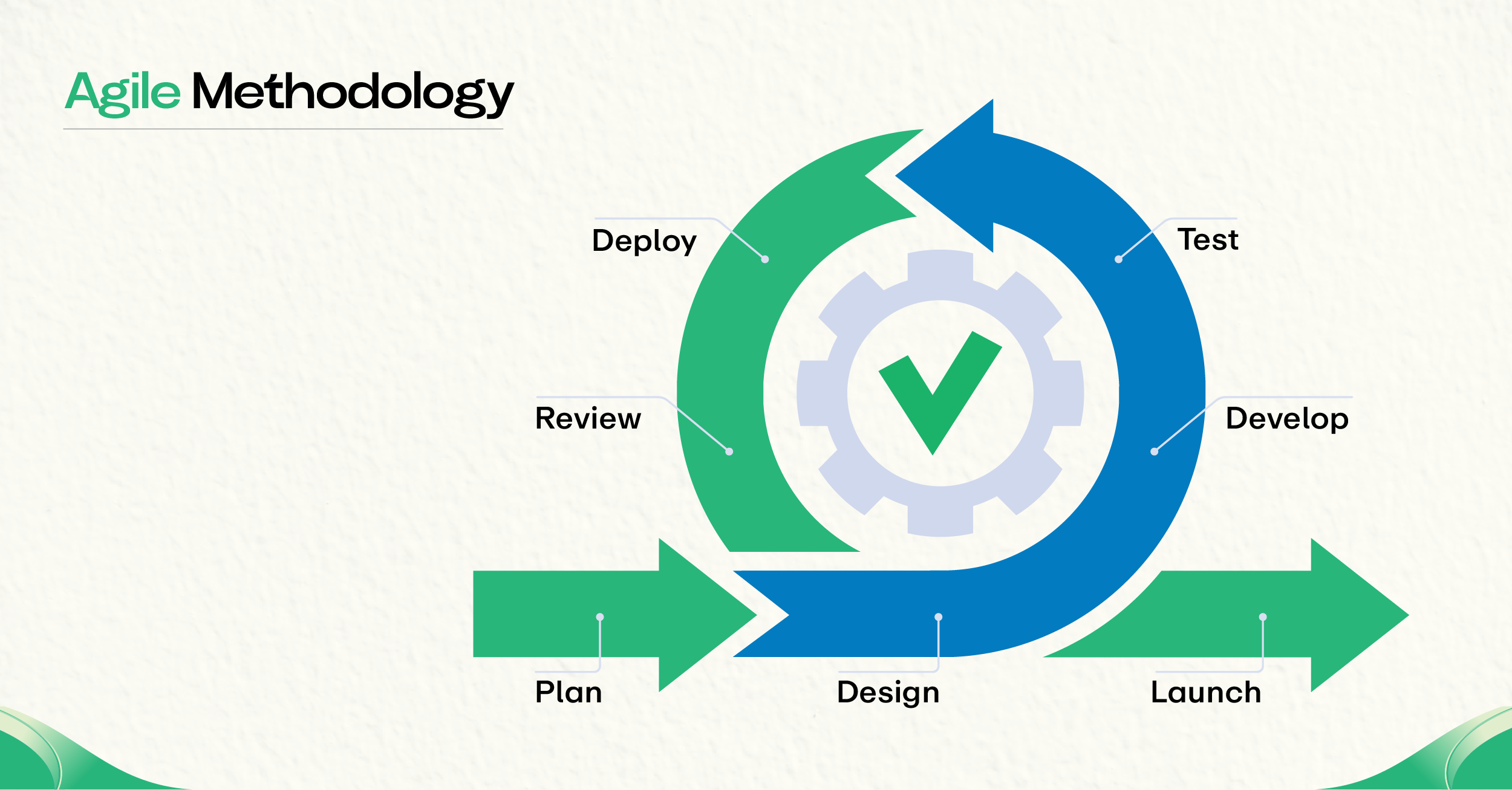
Waterfalls fail in fast markets. A modern trading software development company utilizes Agile methodologies, deploying code daily via automated pipelines to adapt instantly to regulatory changes.
Sprint Planning & Backlogs
Sprints are short (1-2 weeks). The backlog will always be scrubbed to ensure that any regulatory deadlines (such as T+1 settlement) take precedence over non-critical feature requests.
- Regulatory deadline prioritization
- Short iteration cycles
Feature Flag Rollouts
Decouple deployment from release. Code is deployed behind feature flags, allowing product managers to toggle new features on for internal testers without redeploying the app.
- Deployment/Release decoupling
- Internal testing toggles
Cross-Functional Collaboration
Developers, QAs, and Compliance officers sit together. This ensures that a new trade type is built, tested, and legally approved within the same sprint cycle.
- Unified sprint approval
- Cross-domain alignment
Iterative Testing Cycles
Testing runs continuously. Test packs based on automated regression suites are executed after every commit to ensure that new code does not break the existing order-routing code.
- Continuous regression testing
- Logic breakage prevention
Velocity Metrics
Measure throughput, not just hours. Tracking the number of story points completed rather than the number of bugs found helps the team balance its velocity without sacrificing code quality.
- Throughput quality tracking
- Optimization without sacrifice
MVP vs Full Scale: What to Build First
Priorities determine the timeline. The OMS vs. EMS differences hinge on whether to build an adequate state machine (OMS) initially to achieve reliability or a fast router (EMS) to achieve speed.
Core vs Nice-to-Have Features
The MVP must trade. Order entry, risk checks, and market data are mandatory; social chat, complex options strategies, and dark mode are deferred to Phase 2.
- Mandatory execution features
- Phase 2 deferrals
Scalability Constraints
Don’t over-engineer early. MVP architecture operates at 100 TPS (Transactions Per Second); the Full Scale architecture is refined subsequently to support 10,000 TPS as the number of users increases.
- TPS-based architectural evolution
- Over-engineering avoidance
Infrastructure Prioritization
Invest in security first. An unsafe yet safe MVP is good; unsafe yet fast is a liability. Firewalls and encryption before auto-scaling are among the areas of infrastructure spending targets.
- Security-first investment
- Firewall over auto-scaling
User Validation Stages
Release to “Friends and Family” first. Small, trusted user groups validate the trading loop mechanics and UI flows before the platform opens to the general public.
- Trusted group testing
- UI flow validation
Budget vs Timeline Trade-Offs
Speed costs money. Accelerating the timeline requires hiring more senior engineers or buying white-label components, increasing the budget to buy speed.
- Senior talent hiring
- Buying speed trade-off
Testing & Quality Assurance: Breaking to Build
In high-frequency environments, software bugs equal instant financial loss. Robust QA uses synthetic market crash testing to verify that the platform remains solvent and responsive even when market data becomes chaotic and internal components fail under load.
The Testing Pyramid (Unit, Integration, E2E)
A balanced testing strategy builds confidence from the bottom up. Engineers write thousands of fast unit tests to validate math, while heavier E2E tests certify critical user journeys.
Unit Test Coverage & Mutation Testing
Unit tests authenticate the functions individually. To test real logic failures, mutation testing intentionally injects bugs into a piece of code.
- Function-level logic validation
- Deliberate bug insertion
Integration Tests for APIs & Flows
Integration tests verify communication between services. They validate that the Order Service creates the correct message payload when sending instructions to the Risk Engine via Kafka.
- Cross-service message validation
- Payload structure verification
End-to-End (E2E) Testing Scenarios
E2E tests simulate a real user trade. Automation bots log in, place an order, wait for execution, and verify the updated portfolio balance matches the fill.
- Full user journey simulation
- Portfolio balance verification
Test Data Management
Tests require predictable data. Teams maintain isolated databases populated with seeded datasets (e.g., specific user profiles) to ensure test runs are deterministic and repeatable.
- Deterministic dataset seeding
- Repeatable test environments
Parallel & Distributed Test Execution
Running thousands of tests sequentially is too slow. Distributed runners split the suite across hundreds of cloud nodes to provide feedback on pull requests within minutes.
- Cloud-based node splitting
- Rapid feedback loops
Chaos Engineering: Failure Injection & Reliability Testing
Hope is not a strategy. Chaos engineering stresses the system in a production-like environment to demonstrate its resilience, enabling it to survive network partitions, latency spikes, and random server failures.
Latency Chaos (Delay Injection)
Injects artificial network lag between microservices. This verifies that the OMS handles timeouts gracefully and doesn’t lock up waiting for a slow response from the Risk Engine.
- Artificial leg injection
- Timeout handling verification
Network Chaos (Packet Drops/Throttling)
Simulates a flaky network connection by dropping packets. The system must retry failed requests via exponential backoff without overwhelming the downstream service with retry storms.
- Flaky connection simulation
- Retry storm prevention
Resource Chaos (CPU, Memory, Disk Pressure)
Eats 100 percent of a disk of CPU or RAM. It demonstrates that the Kubernetes autoscalers identify the stress, and new pods are deployed before the service crashes.
- Resource exhaustion simulation
- Autoscaler trigger validation
Dependency Chaos (Killing Services)
Randomly terminates critical dependencies, such as the database or cache. The application must fail over to replicas instantly or degrade functionality without compromising data integrity.
- Dependency termination tests
- Instant failover validation
Fault Injection in Production-Like Environments
Chaos runs in staging environments that mirror production. This ensures that failure recovery protocols work on the actual infrastructure configuration, not just on developer laptops.
- Staging environment validation
- Infrastructure config testing
Synthetic Data Generation
Real data is often too “normal.” Synthetic data creates edge cases—like negative oil prices or flash crashes—to stress-test algorithms against mathematically possible but historically rare events.
Crash & Circuit-Breaker Scenarios
Generators simulate a 50% market drop in seconds. This validates that internal circuit breakers trigger correctly to halt trading and protect user capital from liquidation cascades.
- 50% drop simulation
- Circuit breaker validation
Liquidity Shock Modeling
Models remove 90% of order book depth instantly. This tests how execution algorithms perform when spreads widen massively, ensuring they don’t fill orders at predatory prices.
- Order book evacuation
- Spread widening tests
High-Volatility Synthetic Bars
Creates artificial OHLC bars with extreme ranges. This ensures charting engines and indicator calculations don’t crash when processing values that exceed standard integer limits.
- Extreme range creation
- Calculation limit testing
News/Event-Driven Market Simulation
Simulates high-velocity news flow. The system ingests thousands of “breaking news” signals per second to verify that the sentiment analysis engine scales without lagging the trade loop.
- High-velocity news ingestion
- Sentiment engine scaling
Order Book Replay & Manipulation Simulation
Replays historical L3 data with injected manipulation patterns. This validates that surveillance tools can detect “spoofing” or “layering” attempts buried within legitimate market noise.
- Historical L3 replay
- Manipulation detection validation
Backtesting Engines
A strategy is only as good as its test. A robust backtesting engine replays historical market data to validate algorithmic performance, profitability, and risk profile before live deployment.
Historical Data Replay Systems
The engine streams terabytes of tick data in real time. Strategies subscribe to this stream and receive events sequentially to simulate realistic market conditions.
- Terabyte-scale streaming
- Realistic condition simulation
Forward Testing & Walk-Forward Analysis
Test the robustness of the test strategy on “unseen” data. The engine optimizes parameters using past data, then validates performance on a subsequent time window to detect overfitting.
- Out-of-sample validation
- Overfitting check logic
Paper Trading Simulations
Strategies run in a live environment with fake money. This tests the full execution stack—including API latency and connectivity—without risking actual capital during validation.
- Live environment simulation
- Capital-free stack testing
Tick-by-Tick Backtesting
Standard OHLC backtests miss intraday volatility. A precise backtesting engine simulates every single trade and quote update to capture realistic slippage and spread costs.
- Intraday volatility capture
- Realistic cost simulation
Slippage & Spread Modeling
Simulates execution friction. The engine applies variable spreads and slippage penalties based on historical liquidity, ensuring net profit calculations reflect real-world trading costs.
- Execution friction simulation
- Real-world cost reflection
Security Audits & Penetration Testing
A state of security needs an adversarial attitude. Urgent audits and offensive security exercises help detect vulnerabilities in code and infrastructure before malicious actors can exploit them.
Static Application Security Testing (SAST)
Scans source code for vulnerabilities. Tools analyze the codebase during the build process to find SQL injection flaws or hardcoded secrets before compilation.
- Source code scanning
- Vulnerability detection build
Dynamic Application Security Testing (DAST)
Attacks the running application. The scanner sends malicious payloads to API endpoints to identify runtime vulnerabilities, such as cross-site scripting or broken authentication logic.
- Runtime endpoint attacks
- Broken auth identification
Penetration Testing Methodologies
Ethical hackers seek to break into systems. Manual testers probe creative attack vectors that automated tools cannot identify, exploiting the logic weaknesses in complex business rules.
- Ethical hacker simulation
- Business logic probing
Vulnerability Scanning Pipelines
Scanners are automated and part of the test infrastructure. They discover unpatched operating systems, improperly configured firewalls, or open ports that put the platform at risk by exposing it to honeypots known as CVE exploits.
- Infrastructure patch checks
- Misconfiguration identification
Red Team vs Blue Team Exercises
A full-scale war game. The Red Team attacks efficiently using any means necessary, while the Blue Team defends, testing their ability to detect and contain active breaches.
- Full-scale war game
- Defense response testing
Deployment & Maintenance: The “Day 2” Operations
Launch is just the start. The day 2 operations guarantee a long-term solvency. Canary deployments reduce upgrade risk, and automated pipelines handle the complexity of maintaining institutional-grade uptime.
CI/CD Pipelines: Automated Build → Test → Deploy
Automation builds confidence. Pipelines transform raw code into deployable artifacts, handling complex Kubernetes scaling configurations automatically to ensure consistent deployments across all environments.
Staging → Pre-Prod → Prod Workflows
Code promotes linearity through gated environments. It passes strict validation gates in Staging and Pre-Prod, ensuring only certified artifacts reach Production.
- Linear environment promotion
- Strict validation gates
Automated Rollbacks & Fail-Safe Triggers
If health checks fail post-deploy, the system reverts immediately. Triggers monitor error rates and automatically roll back to the last stable version.
- Instant stability reversion
- Error rate monitoring
Dependency Vulnerability Checks
Scanners analyze libraries during the build process. The pipeline blocks deployment if critical CVEs are detected, forcing developers to patch vulnerabilities first.
- Build-time vulnerability blocking
- Mandatory patch enforcement
Deployment Orchestration (K8s + GitOps)
GitOps synchronizes cluster state with the repository. Kubernetes operators apply the desired configuration, ensuring the running environment matches the code definition.
- Repo-to-cluster sync
- Configuration drift prevention
Secrets & Environment Handling
Secrets are injected securely at runtime. The pipeline never exposes credentials; it uses vault integrations to populate environment variables only when needed.
- Runtime credential injection
- Secure vault integration
Canary Releases: Gradual, Safe Production Rollouts
Updates shouldn’t be binary. Rolling out changes to a small subset reduces the blast radius. Integrating Chaos engineering principles helps validate resilience during these partial rollouts.
1% → 5% → 50% Release Stages
Traffic changes at a slow pace. The load balancer sends a small percentage of users to the new version, gradually increasing exposure as confidence grows.
- Incremental traffic shifting
- Controlled blast radius
Real-Time Error/Crash Monitoring
Observability tools watch the canary closely. Spikes in HTTP 500 errors or application crashes trigger alerts that pause the rollout immediately.
- Immediate crash detection
- Rollout pause triggers
Performance Threshold Alerts
Latency is a pass/fail metric. If the new version is slower than the baseline, the system halts promotion to protect user experience.
- Latency baseline comparison
- UX protection halts
Automatic Promotion Policies
Success triggers expansion. If the canary survives the soak time without errors, the orchestrator automatically promotes the version to the wider fleet.
- Error-free promotion logic
- Automated fleet expansion
Rollback Decision Frameworks
Decision logic dictates reversion. Canary deployments rely on predefined frameworks to determine when to kill a bad release rather than attempt a hotfix.
- Predefined kill criteria
- Hotfix vs rollback logic
FinOps: Cloud Cost Governance & Optimization
Cloud bills bleed margins. Governance aligns engineering spend with revenue. Monitoring Kafka event stream costs helps optimize high-volume data ingestion and retention policies.
Budgeting & Cost Forecasting
Forecasts predict spending based on usage trends. Teams set hard limits and receive alerts when projected costs exceed the monthly budget.
- Usage trend prediction
- Hard limit alerts
Reserved vs On-Demand Instances
Commitment saves money. Analyzing baseline compute needs enables purchasing Reserved Instances for steady workloads and using On-Demand only for unpredictable traffic spikes.
- Baseline compute commitment
- Spike-only on-demand usage
Idle Resource Cleanup
Unused resources are a waste. Scripts identify and terminate orphaned volumes or stopped instances that are no longer serving active traffic.
- Orphaned volume termination
- Active traffic verification
Network Egress Cost Reduction
Data transfer costs add up. Optimizing zone placement and using internal endpoints reduces the costs associated with cross-region traffic.
- Zone placement optimization
- Intelligent zone-routing logic
Team-Level Cost Accountability
Tagging tracks ownership. Every resource is tagged with a cost center, making individual engineering teams responsible for the efficiency of their services.
- Resource cost tagging
- Team efficiency responsibility
Incident Response & SRE Playbooks
It needs discipline in the work during downtime. SRE playbooks precisely define the steps for triaging, mitigating, and resolving outages, ensuring a methodical response under high pressure.
Detection (Metrics, Logs, Alerts)
The first defense is that of monitoring. PagerDuty alerts on aggregated metrics and log anomalies have helped ensure engineers are notified whenever thresholds are exceeded.
- Anomaly alert triggers
- Immediate engineer notification
Triage (Severity Classification)
Severity dictates response speed. Incidents are classified by impact level, determining whether to wake the VP or just log a ticket.
- Impact level classification
- Response speed determination
Mitigation (Temporary & Long-Term Fixes)
Stop the bleeding first. The priority speed is restoring service availability through rollbacks or circuit breakers, rather than pursuing the root cause immediately.
- Availability restoration priority
- Root cause deferral
Communication Protocols (Internal & External)
Updates maintain trust. Status pages and internal channels are updated regularly to keep stakeholders informed without distracting the resolution team.
- Regular stakeholder updates
- Resolution team isolation
Postmortems & Blameless Culture
Failure is learning. Blameless reviews analyze the process gaps that allowed the incident, focusing on systemic improvements rather than human error.
- Systemic gap analysis
- Learning over blaming
Patch Management: Dependency Audits & Version Control
Security is a moving target. Regular audits ensure that dependencies remain secure and version control tracks every change to the environment.
CVE Monitoring & Patch Schedules
Automation watches for exploits. Scanners check the software bill of materials against national vulnerability databases to flag risky components immediately.
- Exploit database cross-referencing
- Risky component flagging
Dependency & Library Upgrades
Libraries age poorly. Scheduled maintenance sprints upgrade third-party packages to their latest stable versions to inherit security patches and performance fixes.
- Scheduled maintenance sprints
- Security patch inheritance
Runtime vs Build-Time Security Fixes
Fixes happen at different stages. Build-time updates libraries, while runtime tools like RASPs protect against exploits targeting unpatched vulnerabilities.
- Library update timing
- Exploit protection tools
Regression Testing After Patches
Patches break things. Automated suites run complete regression tests after every upgrade to ensure security fixes didn’t introduce functional bugs.
- Full suite execution
- Functional bug prevention
Documentation & Governance Requirements
Compliance needs proof. Logs document precisely when patches were applied and approved, providing necessary evidence for regulatory audits.
- Patch application logging
- Audit evidence provision
Risks & Challenges: What Can Go Wrong?
Silence is dangerous in risk management in trading. Life systems never tend to crash because there are code errors that are easy to spot; they crash as a result of entropy and physics. The only way to incorporate survivability engineering into the architecture is to identify the failure points, which in this case are silicon degradation and liquidity evaporation.
Latency Drift (Performance Degradation Over Time)
A strategy engine optimized for nanoseconds eventually degrades. Entropy, cache pollution, and network congestion slowly erode the speed advantage, turning profitable arbitrage strategies into losing trades if left unmanaged.
CPU/JIT Behavior Changes
The Threat: JIT compilers may unexpectedly re-optimize code paths during trading, causing execution pauses.
The Mitigation: Pin critical threads to isolated cores and turn off C-states to enforce deterministic performance.
Network Congestion Patterns
The Threat: Microbursts of market data inundate switch buffers, causing packet loss and retransmissions.
The Mitigation: Adjust TCP window sizes and use kernel-bypass networking to absorb incoming spikes of high-velocity ingress traffic.
Memory Fragmentation Issues
The Threat: Long-running processes fragment RAM, increasing allocation times and triggering garbage collection pauses.
The Mitigation: Pre-allocate all memory pools at startup and use custom arenas to avoid runtime allocation.
Kernel/OS Updates Impact
The Threat: Newly added system-call overhead, decreased execution speed, and security patches (such as Spectre/Meltdown).
The Mitigation: Lock OS versions. Each version of Lock OS is in production and benchmarks every patch against any kernel before rolling.
Monitoring & Drift Correction
The Threat: Slow degradation goes unnoticed until the P&L curve inverts due to slippage accumulation.
The Mitigation: Track wire-to-wire latency histograms continuously and auto-disable strategies if 99th percentile latency spikes.
Strategy Decay (When Algorithms Lose Predictive Power)
AI-powered trading strategies are perishable goods. Market regimes shift, rendering trained models obsolete. Continuous validation is required to distinguish between simple bad luck and a fundamental breakdown of the predictive model.
Overfitting & Curve Fitting Risks
Models memorize noise instead of the signal. An overfitted algorithm performs perfectly in backtests but fails disastrously when exposed to live, chaotic market data.
- Noise memorization danger
- Live performance failure
Regime Changes in Markets
Mean-reversion strategy. The low-volatility strategy of non-reversion to trend cannot work in a high-volatility crash.
- Volatility state detection
- Automated strategy hibernation
Data Distribution Shifts
Input data characteristics change over time. If the statistical properties of the live feed differ from those of the training set, model inference becomes unreliable.
- Statistical property deviation
- Inference reliability loss
Reinforcement Learning Adaptation
RL agents learn the wrong lessons from feedback loops. Without constraints, an agent might learn that “not trading” minimizes loss, causing it to freeze.
- Incorrect feedback loops
- Agent freezing behavior
Human Oversight & Model Governance
Black-box AI needs a kill switch. Governance frameworks ensure a human trader validates the logic and retains the authority to override autonomous decisions.
- Black-box kill switch
- Human override authority
Strategy Decay (When Algorithms Lose Predictive Power)
AI-powered trading strategies are perishable goods. Market regimes shift, rendering trained models obsolete. Continuous validation is required to distinguish between simple bad luck and a fundamental breakdown of the predictive model.
Overfitting & Curve Fitting Risks
Models memorize noise instead of the signal. An overfitted algorithm performs perfectly in backtests but fails disastrously when exposed to live, chaotic market data.
- Noise memorization danger
- Live performance failure
Regime Changes in Markets
Mean-reversion strategy. The low-volatility strategy of non-reversion to trend cannot work in a high-volatility crash.
- Volatility state detection
- Automated strategy hibernation
Data Distribution Shifts
Input data characteristics change over time. If the statistical properties of the live feed differ from those of the training set, model inference becomes unreliable.
- Statistical property deviation
- Inference reliability loss
Reinforcement Learning Adaptation
RL agents learn the wrong lessons from feedback loops. Without constraints, an agent might learn that “not trading” minimizes loss, causing it to freeze.
- Incorrect feedback loops
- Agent freezing behavior
Human Oversight & Model Governance
Black-box AI needs a kill switch. Governance frameworks ensure a human trader validates the logic and retains the authority to override autonomous decisions.
- Black-box kill switch
- Human override authority
Operational Risk (Downtime, Failures & Errors)
The single point of failure is the Execution Management System (EMS). Operational risk includes hardware rot and software bugs, as well as fat fingers, which are physical factors that can make a company bankrupt within seconds.
Hardware (Disk, NIC, RAM) Failures.
Hardware Failures (Disk, NIC, RAM)
Physical components degrade. A single flipped bit in RAM or a failed network card can corrupt trade data or sever exchange connectivity instantly.
- Component degradation risk
- Connectivity severance danger
Software Bugs & Regressions
New code introduces new errors. A logic bug in the routing engine can result in unintended double-fills or inverted buy/sell orders during production.
- Logic bug introduction
- Unintended double-fills
Infrastructure Misconfigurations
Human error in config files is deadly. A misconfigured firewall rule or load balancer setting can blacklist the exchange’s IP address, halting all trading activity.
- Config file errors
- Exchange IP blacklisting
Human Error Prevention Systems
Fat fingers cost millions. The UI must implement “sanity checks,” such as confirmation modals for large notional values, to prevent accidental large orders.
- Sanity check implementation
- Accidental order prevention
Business Continuity Strategies
Disaster strikes unexpectedly. The firm needs a geographically distant backup site capable of assuming full trading load within the defined RTO window.
- Geographic backup sites
- RTO window compliance
Talent Shortage (C++/Rust/HFT Specialists)
Implementing Kernel bypass requires niche expertise. The intersection of finance, low-level systems programming, and FPGA engineering is a talent pool so shallow it threatens project viability.
Hiring Challenges for HFT Skills
True low-latency experts are rare. Firms compete globally for a handful of engineers who understand both market microstructure and C++ memory models.
- Global expert scarcity
- Niche skill competition
Skill Gaps in Real-Time Systems
Web developers cannot build HFT. The gap between standard backend engineering and lock-free concurrency is massive, requiring extensive retraining for existing staff.
- Backend vs HFT gap
- Extensive staff retraining
Multi-Disciplinary Expertise Requirements
Engineers must understand finance. A coder who doesn’t understand “slippage” or “delta” cannot effectively optimize the execution logic for profitability.
- Financial domain knowledge
- Execution logic optimization
Upskilling Internal Teams
Training is less expensive than recruitment. To build loyalty and fill the domain-specific knowledge gap, investing in internal workshops on Rust, FPGAs, and system architecture is feasible.
- Internal workshop investment
- Domain gap bridging
Outsourcing Considerations
Buying talent accelerates delivery. Partnering with specialized dev shops provides immediate access to senior architects without the long lead time of recruitment.
- Immediate expert access
- Recruitment delay avoidance
Business Strategy: Monetization & Costs
Calculating the cost to build a trading platform requires balancing upfront engineering CAPEX against long-term monetization strategies. Whether through spreads, subscriptions, or APIs, the architecture must support the revenue model while minimizing operational overhead to ensure positive ROI.
Revenue Models (Commission, Spread, Subscription, APIs)
Understanding the full trading software development cost breakdown is essential when defining pricing. Platforms offset development expenses by layering transaction fees, subscription tiers, and data monetization strategies to create diverse revenue streams.
Commission-Based Pricing
Traditional fees are charged per trade execution. This model aligns platform revenue directly with user activity but faces pressure from zero-commission competitors.
- Volume-based revenue alignment
- Zero-commission competitive pressure
Spread Markups & Routing Fees
Platforms capture the difference between the buy and sell price. Routing logic directs orders to venues offering rebates, creating a hidden profit margin on every transaction.
- Bid-ask spread capture
- Liquidity rebate generation
Subscription Tiers (Basic → Pro → AI)
SaaS models are recurring revenues. The simplest levels are execution and Pro levels, which are centered on higher analytics, AI insights, and Level 2 market data.
- Recurring SaaS revenue
- Premium feature gating
API Monetization Models
Charging third-party developers for access. Firms monetize their infrastructure by selling API calls for market data, execution, or historical backtesting access.
- Metered API access
- Infrastructure-as-a-service revenue
Premium Data & Research Upsells
Exclusive content drives value. Platforms partner with research firms to sell institutional-grade sentiment analysis or alternative data feeds to retail users.
- Exclusive content partnerships
- Alternative data monetization
PFOF Alternatives (Staking, Lending, Rebates)
With Payment for Order Flow facing scrutiny, platforms leverage atomic settlement capabilities to offer instant yield products. Lending assets and staking rewards replace lost routing revenue with a transparent financial platform.
Payment for Order Flow Constraints
Regulatory pressure threatens PFOF. Systems must be architected to switch revenue streams instantly if regulators in the EU or the US ban order-flow payments.
- Regulatory ban risk
- Revenue dependency switching
Crypto Lending & Yield Strategies
Idle assets generate interest. Integrated lending pools allow users to earn yield on held crypto or cash, with the platform taking a management fee.
- Idle asset monetization
- Management fee capture
Liquidity Rebates
Exchanges pay for liquidity. Market-making strategies capture rebates by posting limit orders, turning execution costs into a net source of revenue.
- Exchange rebate capture
- Market-making revenue
Maker-Taker Fee Models
Differentiate aggression. Takers (market orders) pay a fee, while Makers (limit orders) receive a rebate, incentivizing liquidity provision on the platform.
- Liquidity provision incentive
- Aggressive order taxation
Non-Trading Revenue Streams
Diversification stabilizes cash flow. Debit card interchange fees, currency conversion FX spreads, and educational course sales generate income that is unrelated to market volatility.
- Interchange fee generation
- FX spread capture
Cost Analysis (MVP, Retail, Institutional)
Costs vary by complexity. While a basic app is cheaper, integrating sophisticated Trend/FUD detection engines drastically increases initial development spending due to the need for NLP pipelines and massive data ingestion.
MVP Cost Breakdown
A detailed trading software development cost breakdown for an MVP focuses on essential execution, risk, and KYC, typically ranging from $50k to $150k, depending on the region.
- Essential execution focus
- Regional cost variance
Retail Trading App Cost Factors
UX drives retail costs. Heavy investment in mobile responsiveness, gamification features, and real-time frontend state management consumes the majority of the budget.
- Mobile UX investment
- Gamification feature costs
Institutional/HFT Cost Requirements
Speed drives institutional costs. The budget shifts to FPGA hardware, colocation leases, and kernel-bypass networking expertise, often exceeding $500k for the core engine.
- FPGA hardware investment
- Colocation lease expenses
Ongoing OPEX & Maintenance Costs
Software is never finished. Monthly cloud bills, data feed licensing, and 24/7 SRE support teams constitute permanent operational expenses that grow with scale.
- Cloud and feed bills
- 24/7 support staffing
Compliance/Regulatory Budget Allocation
Compliance is expensive. Budgeting for legal retainers, annual audits, and automated surveillance software licenses is mandatory to avoid massive regulatory fines.
- Legal retainer budgeting
- Surveillance software licenses
Build vs Buy (White-Label vs Custom)
Custom builds allow deep FIX protocol integration and proprietary logic. White-labeling saves time but limits differentiation. The decision hinges on whether technology is your product or just a utility.
| Feature | White-Label Solution | Custom Build |
|---|---|---|
| Time to Market | 2–4 Weeks | 6–12 Months |
| Upfront Cost | Low ($5k–$20k) | High ($100k+) |
| IP Ownership | Vendor Owned | 100% You |
| Customization | Limited (UI colors only) | Unlimited |
| Valuation Multiplier | Low | High (Asset) |
Vendor Lock-In Concerns
SaaS platforms own your infrastructure. Migrating away from a white-label provider involves rebuilding the entire backend and migrating sensitive user data, creating high friction.
- Infrastructure ownership risk
- High migration friction
Feature Limitations in White-Label Solutions
Roadmaps are shared. You cannot build a unique “AI-Agent” feature if the white-label provider doesn’t support the necessary APIs or data access.
- Shared roadmap dependency
- Innovation cap restrictions
Ownership of IP & Source Code
Investors value IP. Owning the source code increases the company’s valuation and enables licensing the technology to other firms as a B2B product.
- Valuation increase factor
- B2B licensing potential
Custom Scalability Advantages
Control your bottlenecks. Custom architecture enables optimizing specific hot paths (such as the matching engine) without being constrained by vendor-shared resource limits.
- Bottleneck optimization control
- Resource limit avoidance
Long-Term Cost Efficiency
Rent vs. Own. While white-label solutions are cheap initially, revenue-share models and per-user fees can be significantly more expensive than owning infrastructure at scale.
- Revenue-share accumulation
- Scale-based cost savings
OPEX & CAPEX Planning
Financial planning should take regulatory requirements into consideration. Allocating the budget for DORA compliance tools ensures the platform meets operational resilience standards without cannibalizing feature development funds.
Infra & Hosting Costs
Cloud bills scale with usage. Using reserved instances and tiering storage (Hot/Cold) moves predictable costs from variable OPEX to fixed, lower rates.
- Storage tiering efficiency
- Variable to fixed conversion
Team Salaries & Engineering Resources
Talent is the most oversized line item. High salaries for Rust/C++ engineers and SREs are a necessary CAPEX investment to build a stable, performant asset.
- Specialist talent investment
- Stability CAPEX requirements
Licensing & Market Data Fees
Data is rented, not owned. Exchange fees and redistribution licenses are recurring monthly costs that increase linearly with the number of active users.
- Recurring redistribution costs
- User-based cost scaling
Backup/BCP Costs
Resilience costs money. Maintaining a redundant “hot standby” data center doubles infrastructure spending but is required for business continuity compliance.
- Redundant infrastructure spend
- Business continuity requirement
Scaling & Growth Investments
Growth requires capital. Budgeting for marketing, user acquisition, and regional expansion ensures the platform captures market share to cover its high fixed costs.
- User acquisition budgeting
- Market share capture
Future Outlook: The 2027+ Horizon
The trading landscape of 2027 will bear little resemblance to today’s screens. We are moving beyond latency wars into a computational arms race where quantum mechanics and sentient AI interfaces redefine the very nature of alpha generation and user interaction.
Quantum Computing & The Next Frontier
Quantum superiority is imminent. Integrating a zero trust architecture now prepares platforms for a future in which quantum processors crack standard encryption and solve complex risk models in milliseconds, rendering classical security obsolete.
Quantum Monte Carlo Simulations
Quantum algorithms execute risk simulations exponentially faster than classical CPUs. This allows real-time pricing of complex exotic derivatives that previously required overnight batch processing.
- Exponentially faster risk modeling
- Real-time exotic pricing
Quantum-Accelerated Pricing Models
Pricing engines use quantum superposition to calculate millions of market probability paths simultaneously. This creates a “perfect” pricing curve that eliminates arbitrage inefficiencies instantly.
- Simultaneous probability path calculation
- Arbitrage inefficiency elimination
Quantum-Resistant Architectures
Standard encryption is vulnerable. Implementing zero trust security with lattice-based cryptography ensures that today’s trade secrets remain secure against tomorrow’s quantum decryption capabilities (Harvest Now, Decrypt Later).
- Lattice-based cryptography implementation
- Future-proof data protection
Hardware/Cloud Requirements
In particular, large-scale quantum processing units (QPUs) must be cooled using specialized cryogenics. QPUs will be available for Hybrid cloud Handling: Hybrid cloud QPUs will be accessed via an API, pushing individual math functions off-hand while maintaining the logic on classical silicon.
- API-based QPU access
- Hybrid silicon architecture
Adoption Challenges
The talent gap is massive. Finding engineers who understand both quantum physics and financial market microstructure is the primary bottleneck preventing immediate widespread adoption.
- Niche talent scarcity
- Physics-finance knowledge gap
AI-First Interfaces (End of Traditional Dashboards)
Static grids are obsolete. Future interfaces align with ESG compliance by optimizing efficiency and using predictive AI to present only relevant decision data, rather than overwhelming users with energy-intensive raw noise.
Intent-Based Trading Navigation
The interface predicts user goals. If a trader opens a chart, the system automatically populates the order entry ticket with their standard position size and risk parameters.
- Predictive goal anticipation
- Automated order population
Adaptive Workflows
The UI morphs based on context. During high volatility, it strips away analytics to focus purely on execution buttons; during calm, it expands research tools.
- Context-aware UI morphing
- Volatility-based tool expansion
Voice & Gesture Interfaces
Keyboards are too slow. Traders execute complex multi-leg strategies using natural voice commands or simple hand gestures, reducing the “click-friction” between thought and action.
- Natural language execution
- Frictionless gesture control
Agent-Led Decision Support
AI agents act as co-pilots. They constantly analyze the portfolio, proactively suggesting hedges or rebalancing moves that the human trader accepts with a single click.
- Proactive hedging suggestions
- One-click rebalancing
Fully Autonomous Portfolio Assistants
The platform becomes the manager. Users set high-level goals (e.g., “Preserve capital”), and the autonomous assistant executes all underlying trades, custody, and reporting without manual input.
- Goal-based autonomous execution
- Zero-touch portfolio management
Next Steps: Choosing the Right Development Partner
Navigating the steps to develop trading software requires a partner who understands that code is liability and architecture is solvency. You need engineers, not just coders.
Select a development partner that builds for the “Day 2” reality of compliance and volatility. Your partner must demonstrate profound expertise in kernel-bypass networking, Rust, and DORA governance.
Conclusion & Key Takeaways
Excelling at trading software development in 2026 requires shifting the emphasis to systemic robustness to meet the requirements of event-driven architectures and survive the age of divergent volatility.
The Strategic custom trading platform development will enable companies to retain control over their intellectual property rights, allowing proprietary execution logic and AI agents to evolve faster than the market.
Key Takeaways
- Tech: Low-latency standards can easily be redefined by the Rust language, combined with event-driven architectures
- Risk: DORA compliance and pre-trade checks are essential to operational survival.
- AI: Agentic AI shifts platforms from passive communication tools to active partners.
- Value: Custom source code ownership maximizes long-term business valuation.
FAQs
Base retail MVPs begin at $40K; however, HFT engines with FPGA software, colocation, and DORA-regulated infrastructure require a capital investment of $500K or more.
A basic trading MVP typically takes 3-4 months. Complex institutional platforms with multi-asset routing and custom matching engines usually require 12-18 months of engineering.
For high latency, developers prefer Rust or C++. Go, React, or Flutter is ideal for creating high-concurrency, responsive user interfaces across many cross-platform devices.
Select white-label to enter the market within a short time (2-4 weeks) with low cost. Have the software customized to address proprietary IP, specialized algorithms, or long-term valuation growth.
To ensure the company remains solvent, ensure the onboarding process follows the books to the letter, that market data ingestion is performed in real time, that the Order Management System (OMS) is stable, and that the pre-trade risk engine runs smoothly.

Bhavin Umaraniya
Bhavin Umaraniya is the CTO at Tuvoc Technologies, with 18+ years of experience in frontend and web software development. He leads tech strategy and engineering teams to build scalable and optimized solutions for start-ups and enterprises.

Have an Idea? Let’s Shape It!
Kickstart your tech journey with a personalized development guide tailored to your goals.
Discover Your Tech Path →Share with your community!
Latest Articles

When to Choose a White Label Real Estate App Development Company and Why?
Most real estate businesses we talk to aren't short on leads or deals. Even your search for a white-label real…

Real-Time Payment Infrastructure Architecture: Why Money Can No Longer Move at Yesterday’s Speed
Blog Summary Money still moves through infrastructure built for another era Consumer expectations are reshaping payment system priorities Real-time payments…
Cost to Develop a Real Estate App Like Zillow or Trulia
This Blog Explains: Cost Breakdown: Understand what actually increases Zillow-like app development expenses Infrastructure Reality: Learn why MLS systems change…